The Power of Early Second Opinions
A second opinion is an independent review of a patient’s diagnosis and treatment plan by another qualified specialist, typically after the initial recommendation has been made. By re‑examining imaging, history and and clinical findings, a second opinion can catch misdiagnoses, refine uncertain diagnoses, and reveal alternative, less invasive therapies. Studies in orthopaedic and spinal care show that up to 88 % of patients receive a different or more precise diagnosis after a second review, and that 30 % avoid unnecessary surgery. This additional validation boosts patient confidence, reduces anxiety, and increases overall satisfaction with care decisions, empowering individuals to choose the most appropriate, evidence‑based pathway for their spine health.
Why Seek a Second Opinion Before Spine Surgery?
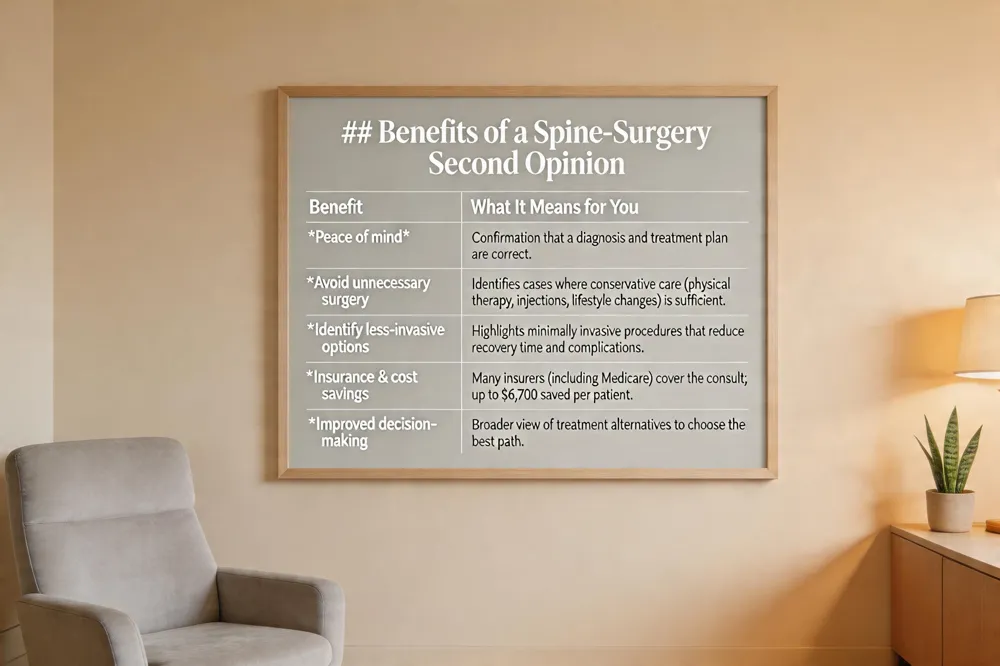
Benefits of a Spine‑Surgery Second Opinion
| Benefit | What It Means for You |
|---|---|
| Peace of mind | Confirmation that a diagnosis and treatment plan are correct. |
| Avoid unnecessary surgery | Identifies cases where conservative care (physical therapy, injections, lifestyle changes) is sufficient. |
| Identify less‑invasive options | Highlights minimally invasive procedures that reduce recovery time and complications. |
| Insurance & cost savings | Many insurers (including Medicare) cover the consult; studies show up to $6,700 saved per patient by avoiding unnecessary surgery. |
| Improved decision‑making | Provides a broader view of treatment alternatives, empowering you to choose the best path. |
 A spine‑surgery second opinion gives you peace of mind and guarantees that the care you receive is truly needed and evidence‑based. At the Orthopedic Spine Institute of St. Louis, Dr. David S. Raskas reviews your imaging, history, and goals to confirm whether surgery is essential, suggest conservative alternatives such as physical therapy, injections, or lifestyle changes, and identify minimally invasive options that can shorten recovery.
Spine surgery second opinion – By comparing the original recommendation with Dr. Raskas’s expert assessment, you avoid unnecessary risks, uncover less‑invasive treatments, and make an informed decision about back, neck, or sciatica care.
Should you always get a second opinion before surgery? – In non‑urgent cases, a second opinion is a wise safeguard: it confirms diagnosis, reveals cheaper, safer options, and builds confidence. Only life‑threatening emergencies may bypass this step.
When to seek a second opinion – Request one if the diagnosis feels unclear, the proposed plan is aggressive, you have a complex or rare condition, or your current therapy isn’t helping. Many insurers, including Medicare, cover these consultations when surgery is suggested, turning a short‑term expense into long‑term savings and reduced medical errors.
Finding the Right Surgeon: Regional Guides
Phoenix & Arizona Spine Surgeons – Quick Reference
| Surgeon / Provider | Location | Specialty / Notable Technique |
|---|---|---|
| Dr. Young | Phoenix | Ultra‑mini‑invasive endoscopic procedures for herniated discs & sciatica |
| Dr. Anthony Yeung – Desert Institute for Spine Care (DISC) | Phoenix | Multidisciplinary spine care, advanced imaging (EOSedge) |
| Barrow Neurological Institute | Phoenix | Board‑certified neurosurgery & orthopedic spine, minimally invasive surgery |
| OrthoArizona | Multiple AZ locations | Orthopedic spine, minimally invasive techniques |
| Dr. Nima Salari | Phoenix | Minimally invasive orthopedic spine, 4.9 Healthgrades rating |
| Dr. Mark J. Wang | Phoenix | Endoscopic spine surgery |
| Dr. Joshua Abrams, DO | Phoenix | Endoscopic spine surgery, high patient satisfaction |
| Dr. Edward J. Dohring – Spine Institute of Arizona | Scottsdale | Multidisciplinary care, physical therapy & injections before surgery |
| Dr. Sanjay Jatana | Scottsdale | Artificial‑disc replacement, robotic‑assisted procedures |
| Dr. Chris Johnson | Scottsdale | Spinal fusion, deformity correction |
 Back surgeons Phoenix – The Phoenix area offers a robust network of spine specialists who prioritize non‑surgical options before recommending an operation. Notable providers include Dr. Young, who performs ultra‑mini‑invasive endoscopic procedures for herniated discs and sciatica, and the Desert Institute for Spine Care (DISC) led by Dr. Anthony Yeung. The Barrow Neurological Institute’s spine program and OrthoArizona’s multiple locations feature board‑certified neurosurgeons and orthopedic surgeons renowned for minimally invasive techniques and advanced imaging such as EOSedge.
Best spine surgeon in Arizona – Patients frequently cite Dr. Nima Salari, MD, a minimally invasive orthopedic spine surgeon with a 4.9 Healthgrades rating, as a top choice. Dr. Mark J. Wang and Dr. Joshua Abrams, DO, also earn high satisfaction scores and specialize in cutting‑edge endoscopic surgery, mirroring the patient‑first ethos of the St. Louis Institute.
Spine surgeons in Arizona – Beyond Phoenix, Scottsdale’s Spine Institute of Arizona, led by Dr. Edward J. Dohring, offers multidisciplinary care that integrates physical therapy, injections, and minimally invasive surgery. These centers routinely provide second‑opinion consultations, helping patients avoid unnecessary procedures, reduce costs (studies show up to $6,700 saved per patient), and improve confidence in their treatment plan.
Colorado Spine Specialists and Programs
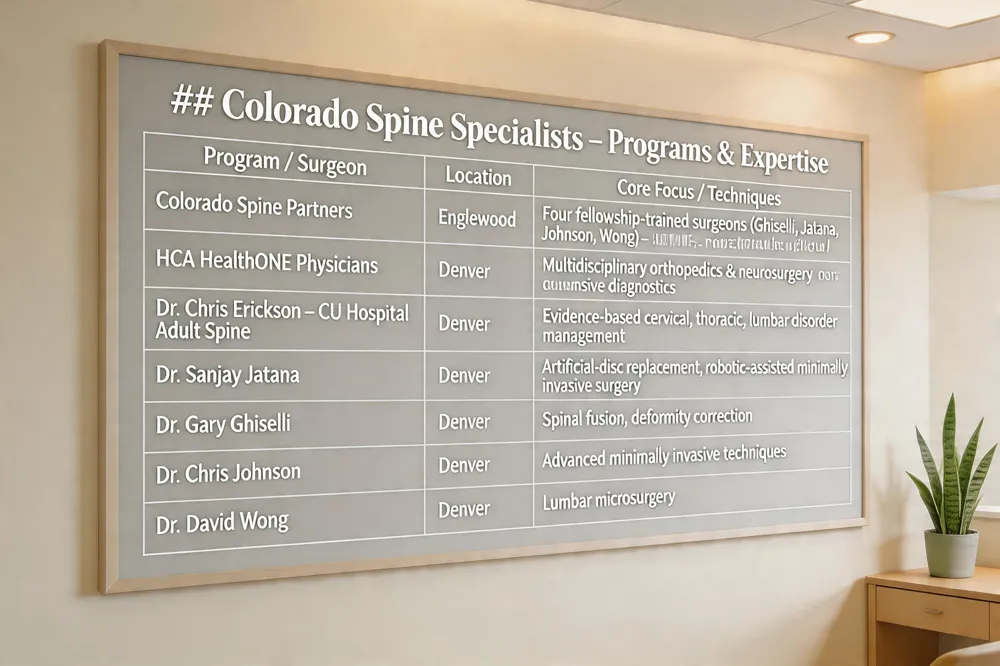
Colorado Spine Specialists – Programs & Expertise
| Program / Surgeon | Location | Core Focus / Techniques |
|---|---|---|
| Colorado Spine Partners | Englewood | Four fellowship‑trained orthopedic surgeons (Ghiselli, Jatana, Johnson, Wong) – non‑surgical first, ALIF, TLIF, artificial disc replacement |
| HCA HealthONE Physicians | Denver | Multidisciplinary orthopedics & neurosurgery, comprehensive diagnostics |
| Dr. Chris Erickson – Adult Spine Division, University of Colorado Hospital | Denver | Evidence‑based management of cervical, thoracic, lumbar disorders |
| Dr. Sanjay Jatana | Denver | Artificial‑disc replacement, robotic‑assisted minimally invasive surgery |
| Dr. Gary Ghiselli | Denver | Spinal fusion, deformity correction |
| Dr. Chris Johnson | Denver | Advanced minimally invasive techniques |
| Dr. David Wong | Denver | Lumbar microsurgery |
 Colorado spine specialists
Colorado offers a robust network of spine experts, highlighted by Colorado Spine Partners in Englewood. Their four fellowship‑trained orthopedic surgeons—Dr. Gary Ghiselli, Dr. Sanjay Jatana, Dr. Chris Johnson, and Dr. David Wong—focus on non‑surgical care first and provide minimally invasive options such as ALIF, TLIF, and artificial disc replacement. In Denver, HCA HealthONE Physicians delivers a multidisciplinary program that blends orthopedics, neurosurgery, and therapy, ensuring comprehensive diagnostics and tailored treatment plans for sciatica, herniated discs, and spinal stenosis.
Colorado spine specialists
Colorado offers a robust network of spine experts, highlighted by Colorado Spine Partners in Englewood. Their four fellowship‑trained orthopedic surgeons—Dr. Gary Ghiselli, Dr. Sanjay Jatana, Dr. Chris Johnson, and Dr. David Wong—focus on non‑surgical care first and provide minimally invasive options such as ALIF, TLIF, and artificial disc replacement. In Denver, HCA HealthONE Physicians delivers a multidisciplinary program that blends orthopedics, neurosurgery, and therapy, ensuring comprehensive diagnostics and tailored treatment plans for sciatica, herniated discs, and spinal stenosis.
Top spine surgeons in Colorado Leading surgeons combine academic rigor with private‑practice excellence. Dr. Chris Erickson heads the Adult Spine Division at the University of Colorado Hospital, known for evidence‑based management of complex cervical, thoracic, and lumbar disorders. Colorado Spine Partners’s team includes Dr. David Wong (lumbar microsurgery) and Dr. Sanjay Jatana (artificial‑disc replacement), alongside Dr. Gary Ghiselli and Dr. Chris Johnson, who excel in spinal fusion, deformity correction, and advanced minimally invasive techniques.
Best spine surgeon Denver Patients often cite Dr. Sanjay Jatana as Denver’s premier spine surgeon, praised for his board‑certified, fellowship‑trained expertise in artificial‑disc and robotic‑assisted procedures. The University of Colorado Hospital’s Adult Spine Division and Neurosurgery One also provide top‑tier, minimally invasive spine care, offering a full spectrum from conservative therapy to cutting‑edge surgery. Choosing a surgeon with specific expertise, board certification, and experience with your condition ensures the best personalized outcome.
Virtual and Remote Options for Second Opinions
Virtual Second‑Opinion Platforms – How They Work
| Platform | Process | Typical Cost (USD) | Insurance Coverage |
|---|---|---|---|
| Telehealth portals (generic) | Upload imaging & records → board‑certified surgeon reviews → written report & optional video call | $150‑$300 (self‑pay) | Often not covered, but cheaper than in‑person visit |
| Orthopedic Spine Institute of St. Louis (Dr. Raskas) | Online intake → nurse coordinator matches specialist → detailed report + video consult | $199‑$250 (often covered by standard benefits) | Covered by most private plans & Medicare Part B |
| DISC – Scottsdale location | Online or phone scheduling → upload records → specialist review → report & tele‑visit | $200‑$350 (self‑pay) | Accepted by major insurers; some plans cover second‑opinion consults |
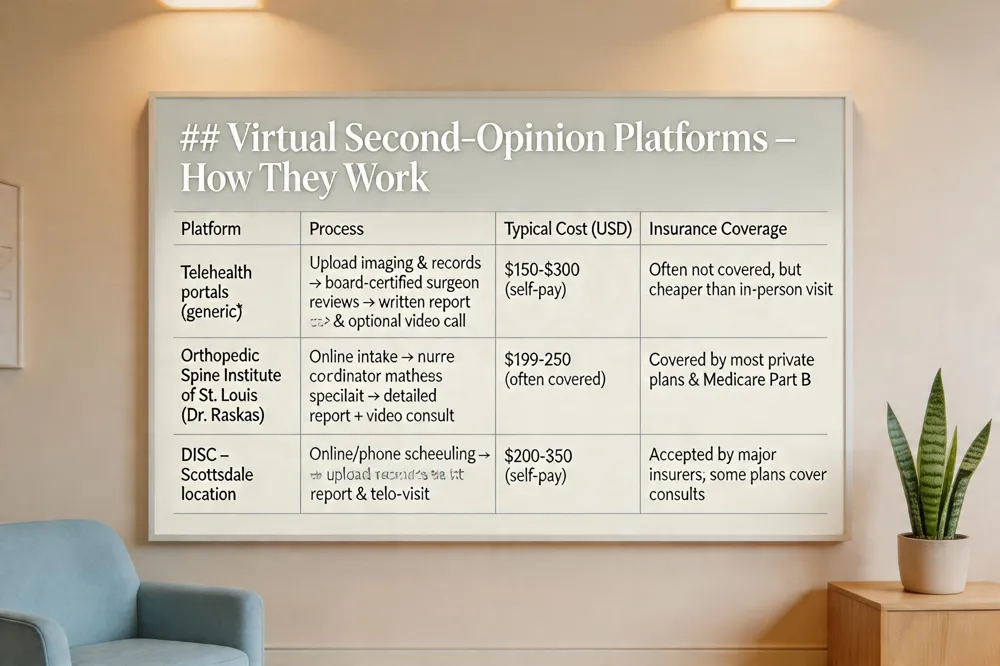 Telehealth platforms – Modern telemedicine lets you obtain a spine specialist’s review without leaving home. Upload imaging, records and a brief history to a secure portal; a board‑certified orthopedic surgeon evaluates the case and delivers a written report with diagnosis confirmation, treatment options and minimally invasive recommendations. This approach saves travel time, reduces expenses and provides peace of mind, though most services are self‑pay and often cheaper than an in‑person visit.
Virtual second opinion at the Orthopedic Spine Institute of St. Louis – After completing an online intake form, a nurse coordinator gathers your records and matches you with Dr. David S. Raskas or another specialist. The physician reviews all data, prepares a detailed written report, and you can schedule a brief video call to discuss findings, treatment options, risks and next steps. This patient‑first service helps you decide between conservative care and minimally invasive surgery.
DISC Scottsdale location – The Desert Institute for Spine Care (DISC) in Scottsdale is located at 8630 East Vía de Ventura, Suite 210, Scottsdale, AZ 85258 (phone (602) 944‑2900). DISC offers minimally invasive spine surgery, endoscopic discectomy, artificial disc replacement and advanced pain‑mapping diagnostics, plus non‑surgical options such as epidural steroid injections. Board‑certified, fellowship‑trained surgeons focus on rapid recovery and reduced postoperative pain, and appointments can be scheduled online or by phone with most major insurance accepted.
Navigating the Process: Questions, Insurance, and Patient Experience
Key Questions & Insurance Tips for a Spine‑Surgery Second Opinion
| Question | Guidance |
|---|---|
| Do I need a referral? | Most insurers allow direct access to a spine specialist for a second opinion; check plan details. |
| Will my insurance cover it? | Private plans, Medicare Part B, and programs like Included Health usually cover a board‑certified spine specialist’s assessment when surgery is recommended. |
| What records should I provide? | Full imaging (MRI, CT, X‑ray), prior notes, and a brief history of symptoms and prior treatments. |
| How long does the process take? | Typically 3‑7 business days for a written report; video discussion can be scheduled within a week. |
| What if my surgeon reacts negatively? | You can request a referral to another specialist within the same system or seek a third opinion; most clinicians understand the value of collaborative care. |
| Patient experience | Patients report higher confidence, reduced anxiety, and clearer understanding of all treatment pathways after a second opinion. |
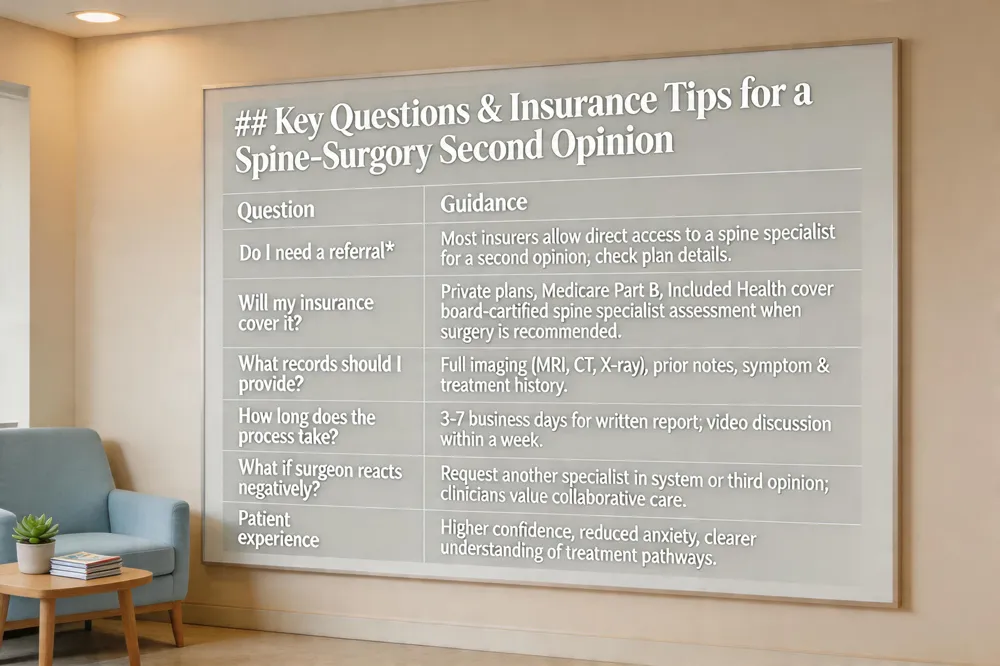 Insurance typically supports a second‑opinion consultation, especially when the first recommendation involves major surgery. Programs such as Included Health provide free, expert reviews, while most private plans and Medicare Part B cover a board‑certified spine specialist’s assessment. The Orthopedic Spine Institute of St. Louis offers a dedicated Second Opinion Program that most patients are off‑of‑pocket or through standard benefits.
Physicians generally view a second opinion as part of patient‑centered care. Most doctors expect patients to seek additional input and will not be offended; they often welcome the fresh review because it can confirm a diagnosis or uncover less invasive options. If a clinician reacts negatively, patients can request a referral to another specialist within the same hospital or practice, ensuring continuity of records and a seamless, collaborative decision‑making process.
Take Control of Your Spine Health Today
Getting an early second opinion can cut thousands of dollars by steering you toward physical therapy, injections or minimally invasive procedures instead of costly fusion surgery. It also reduces medical‑error risk, boosts confidence, and eases anxiety about the treatment plan. To begin, gather all imaging, records and medication lists, then contact a board‑certified spine specialist—many clinics, including the Orthopedic Spine Institute of St. Louis, offer covered, patient‑first consultations for you today.