A Patient‑First Overview of Surgical Options
Before moving to surgery, patients with lumbar degenerative disease must complete at least six months of conservative care—physical therapy, medication, injections, and activity modification—because most individuals improve without an operation. When pain persists, the decision between lumbar disc replacement (ADR/LDR) and spinal fusion hinges on several clinical factors. Key considerations include the integrity of the facet joints, the presence or absence of segmental instability (translational motion >3 mm or angular motion >10°), bone quality (osteoporosis is a contraindication for disc replacement), and the number of affected levels (single‑level disease favors ADR, multilevel disease often requires fusion). Patient activity level and overall health are equally critical; younger, active patients with good bone density and BMI prefer ADR to preserve motion and reduce adjacent‑segment degeneration, whereas older or less active individuals with instability or severe arthritis are better served by fusion. This patient‑first approach ensures the chosen procedure aligns with the individual’s anatomy, lifestyle, and long‑term goals.
Who Is an Ideal Candidate for Artificial Disc Replacement?
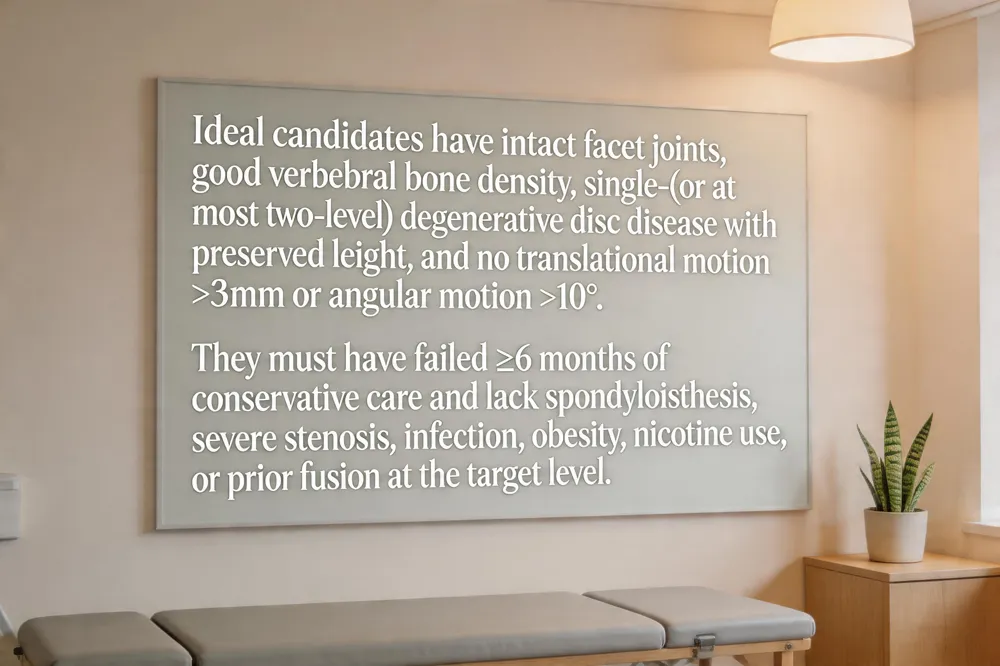 Bone quality, facet joint health, and spinal stability – Ideal candidates have a healthy, intact facet joint complex and adequate vertebral bone density to support the prosthesis. Imaging (MRI, CT, dynamic X‑rays) must show single‑level (or at most two‑level) degenerative disc disease with preserved disc height, minimal facet arthropathy, and no translational motion >3 mm or angular motion >10°. Absence of spondylolisthesis, severe stenosis, or deformity is essential.
Common reasons surgeons may hesitate – Multi‑level degeneration, significant facet arthritis, osteoporosis, active infection, prior fusion at the index level, severe obesity, or ongoing nicotine use are major red flags. Insurance coverage can be restrictive, and the need for meticulous patient selection often limits the frequency of lumbar disc replacement.
What is the age limit for disc replacement surgery? – There is no fixed cutoff; eligibility depends on health, bone quality, and spinal condition rather than a specific age.
Who is a candidate for artificial disc replacement? – A patient with at least six months of persistent back pain unrelieved by conservative care, isolated one‑ or two‑level disc disease, healthy facet joints, good bone density, and no major spinal instability.
Who is not a good candidate for lumbar disc replacement? – Those with multi‑level disease, severe instability, osteoporosis, infection, poor overall health, high BMI, nicotine use, or prior surgery at the same level.
Why don’t more doctors do disc replacement in the lower back? – Narrow selection criteria and limited insurance reimbursement have kept utilization low despite the procedure’s benefits.
Clinical Outcomes: Disc Replacement vs. Fusion
 Pain relief and functional improvement
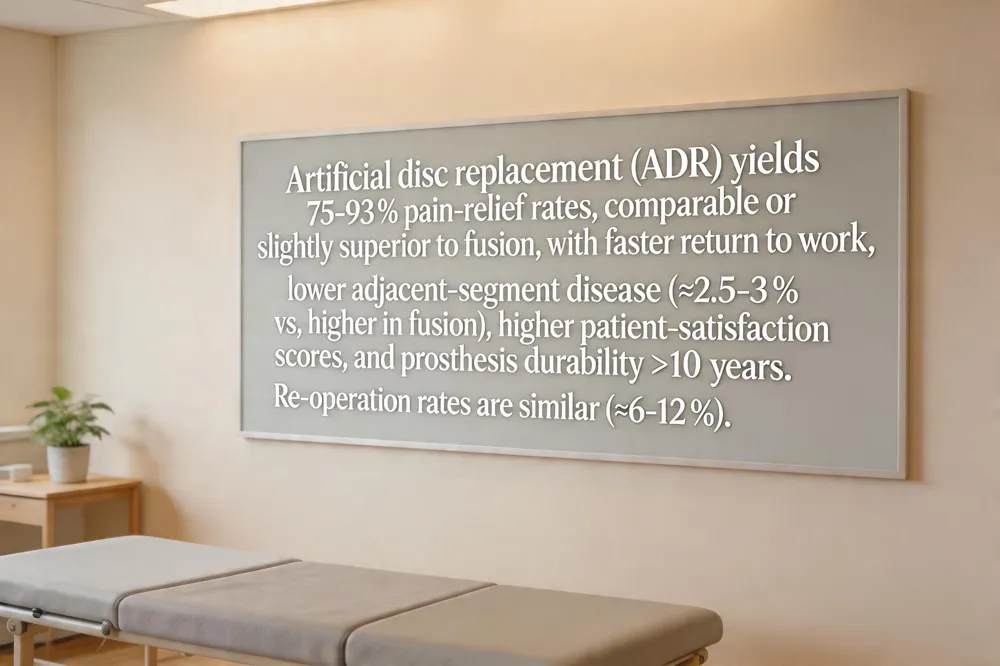
Lumbar artificial disc replacement (ADR) and spinal fusion both achieve substantial pain reduction for patients with single‑level degenerative disc disease who have failed at least six months of conservative care. Large series report that 75‑93 % of disc‑replacement patients experience marked relief and restored mobility, comparable to or slightly better than fusion outcomes. Younger, active individuals often return to work sooner because ADR preserves motion and eliminates the prolonged bone‑healing phase required for fusion.
Adjacency segment disease risk
Preserving segmental motion with ADR lowers stress on the levels above and below the treated disc, reducing the incidence of adjacent‑segment degeneration (ASD). Long‑term follow‑up (up to 10 years) shows ASD rates as low as 2.5‑3 % after disc replacement, whereas fusion patients experience higher rates of new‑level degeneration, sometimes necessitating additional surgery.
Patient satisfaction and long‑term durability
Patient‑reported satisfaction scores are consistently higher after disc replacement, reflecting the benefit of retained spinal flexibility. Modern prosthetic discs made of metal‑plastic composites have demonstrated durability exceeding 10 years, with re‑operation rates comparable to fusion (≈6‑12 %). The most common complications—implant malposition, wear, or subsidence—are infrequent when strict selection criteria (intact facet joints, adequate bone quality, no instability) are applied.
Key Q&A highlights
- L5‑S1 disc replacement success rate: Satisfaction 75‑93 %, with over 90 % of properly selected patients achieving good‑to‑excellent outcomes.
- Lumbar disc replacement vs. fusion: Both relieve pain, but ADR offers faster recovery, motion preservation, and lower ASD risk, while fusion provides maximal stability for unstable or multi‑level disease.
- L5‑S1 fusion vs. disc replacement: Fusion eliminates motion and may lead to higher ASD; ADR maintains motion, yields higher satisfaction, and is preferred for younger patients without instability.
- Cervical disc replacement vs. fusion: Similar principles apply—ADR preserves neck motion and reduces adjacent‑level wear, whereas fusion offers stability but limits flexibility.
Choosing the optimal procedure requires individualized assessment of anatomy, activity level, and long‑term goals, a discussion best guided by an experienced spine surgeon such as Dr. David S. Raskas at the Orthopedic Spine Institute of St. Louis.
Recovery, Rehabilitation, and Safety After Disc Replacement
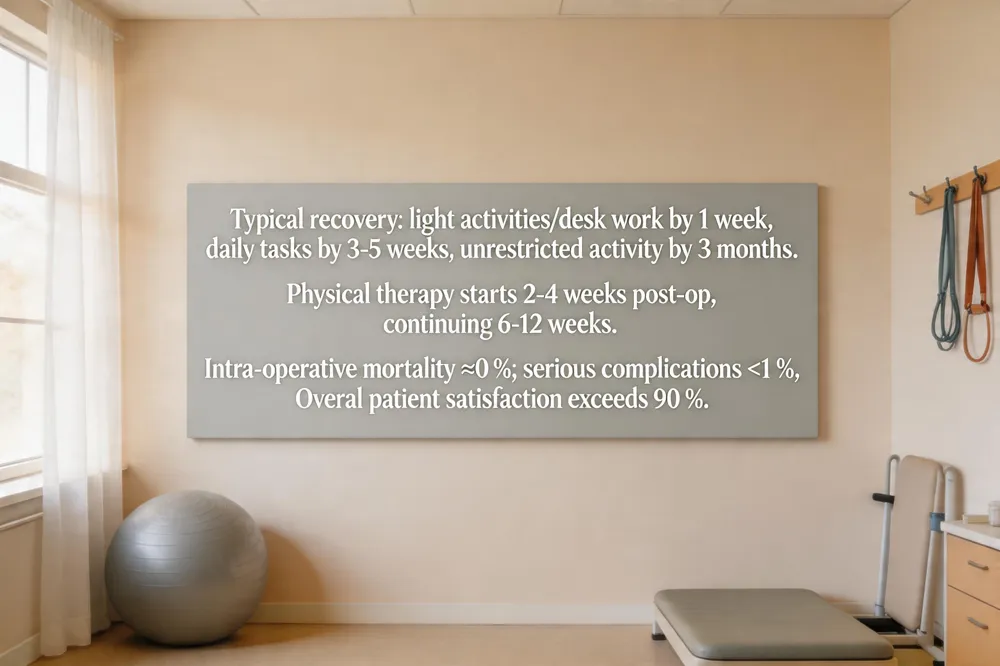 Recovery after lumbar disc replacement follows a predictable timeline. For an L4‑L5 procedure, patients typically return to light activities and desk work within one week, feel comfortable with daily tasks by 3‑5 weeks, and achieve full unrestricted activity by three months. Physical therapy usually begins 2‑4 weeks post‑op, progressing over the next 6‑12 weeks to restore strength, flexibility, and core stability, while incision care and pain control are managed at home and follow‑up visits occur at 1‑2 weeks and 4‑6 weeks.
Is disc replacement surgery safe? Large multi‑center studies show a 0 % intra‑operative death rate and serious complications in less than 1 % of cases. Post‑operative issues such as temporary dysphagia, minor blood loss, or infection are uncommon and resolve quickly. Patient satisfaction exceeds 90 %, reflecting a favorable safety profile when performed by an experienced spine surgeon.
Problems with artificial disc replacement can include infection, excessive bleeding, anesthesia reactions, implant malposition, loosening, wear, heterotopic ossification, and rare device failure or vascular injury that may require revision surgery or conversion to fusion.
Posterior lumbar disc replacement accesses the diseased disc from the back, preserving ligaments and muscles, which can reduce adjacent‑level degeneration and allow faster return to daily activities. Ideal candidates have isolated low‑back pain from one or two degenerated discs, no significant scoliosis or instability, and an acceptable BMI. Risks remain infection, nerve injury, implant malposition, and possible revision surgery, but the minimally invasive posterior approach often results in a shorter hospital stay and quicker recovery.
Surgical Techniques, Imaging, and Practical Considerations
 Pre‑operative imaging and patient screening
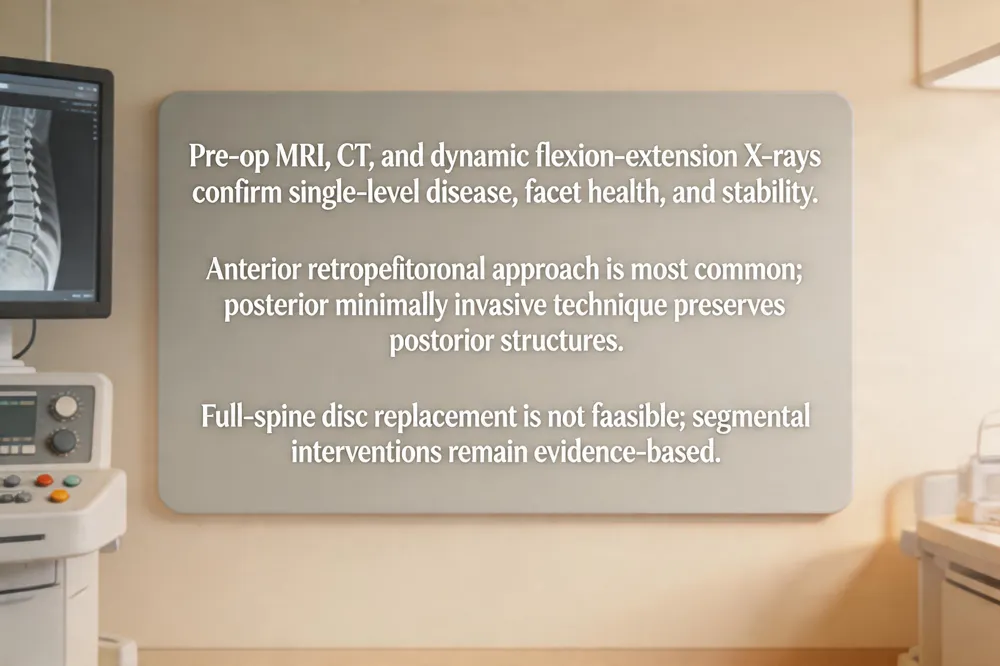
Accurate MRI, CT, and dynamic flexion‑extension X‑rays are essential to confirm single‑level degenerative disc disease, assess facet joint health, and rule out instability. Only patients with preserved facet integrity, adequate bone quality, and failed six months of conservative care meet criteria for artificial disc replacement (ADR).
Anterior vs. posterior approaches
The most common route for lumbar ADR is an anterior retroperitoneal incision, which provides direct disc access while sparing posterior musculature. A posterior minimally invasive technique is also available, allowing disc removal and prosthesis insertion through a small dorsal window; it preserves ligamentous tension and may reduce vascular risk. Surgeon expertise and individual anatomy dictate the optimal approach.
Limitations of full‑spine replacement
Replacing every intervertebral disc from cervical through lumbar is not a feasible or approved treatment. Technical challenges, high complication rates, and loss of essential spinal stability make full‑spine replacement impractical. Targeted motion‑preserving procedures (e.g., L4‑L5 disc replacement) or selective fusion remain the evidence‑based options.
L4‑L5 disc replacement surgery
L4‑L5 ADR removes the degenerated disc and implants a metal‑plastic prosthesis, preserving motion and reducing adjacent‑segment stress. Candidates have chronic low‑back pain localized to L4‑L5, no severe facet arthritis, and have exhausted non‑operative care. Benefits include quicker recovery and maintained flexibility; risks involve infection, nerve injury, or implant migration.
Can an L4‑L5 disc be replaced?
Yes. When imaging confirms isolated pathology and patient health meets criteria, a prosthetic disc can be placed at L4‑L5, offering motion preservation over fusion.
Full spine replacement
A total spinal‑column disc substitution is not currently viable; treatment focuses on segmental interventions.
Disc replacement surgery
Involves removing a damaged disc and inserting an artificial device to restore motion and relieve pain, with lower adjacent‑segment disease rates than fusion.
Posterior lumbar disc replacement
Posterior lumbar disc replacement
Patient Perspectives, Cost, and Insurance Realities
 Patient Satisfaction and Reviews
Patients who undergo lumbar disc replacement (LDR) frequently report high satisfaction, emphasizing restored flexibility, quicker return to daily activities, and reduced postoperative pain compared with spinal fusion. Clinical studies show comparable operative times, blood loss, and hospital stay between LDR and interbody fusion with a statistically significant reduction in back‑pain scores for LDR patients while leg‑pain outcomes remain similar. Patients do note typical surgical risks—infection, bleeding, nerve injury—and the need for ongoing monitoring of implant durability.
Comparative Cost Analysis
In the United States, artificial disc replacement is generally more expensive than fusion. A lumbar LDR typically costs $40,000–$80,000, whereas a single‑level fusion ranges from $20,000–$40,000. The higher price reflects the cost of the prosthetic device and specialized surgical technique. Fusion relies more on bone graft material and fewer hardware expenses. Both procedures are usually covered by major insurers, but patients must meet deductibles, copays, and out‑of‑pocket maximums. Because LDR patients often return to work sooner, they may incur lower indirect costs from lost wages, partially offsetting the higher implant price. Cost of lumbar artificial disc replacement ranges $40‑80k, higher than fusion but may reduce indirect costs from faster return to work.
Insurance Coverage and Authorization
Insurance carriers often require documentation of at least six months of failed conservative care, specific radiographic criteria (single‑level disease, intact facet joints, no significant instability), and proof of good bone quality. Prior authorization is common; however, when these criteria are met, both LDR and fusion are considered medically necessary and are reimbursed under most U.S. health plans. Insurance coverage for lumbar disc replacement varies; many U.S. payers require documentation of failed conservative care and specific radiographic criteria.
Making an Informed Decision at the Orthopedic Spine Institute
Choosing between lumbar disc replacement and spinal fusion begins with a clear understanding of the key factors that influence outcomes. Important considerations include the level and severity of disc degeneration, the health of facet joints, presence of spinal instability, bone quality, patient age, activity level, and any prior surgeries or comorbidities. When these criteria favor a motion‑preserving approach, artificial disc replacement can maintain flexibility and lower the risk of adjacent‑segment disease; otherwise, fusion provides the stability needed for more complex pathology. At the Orthopedic Spine Institute of St. Louis we invite you to schedule a comprehensive, patient‑first evaluation that includes detailed imaging, functional testing, and a personalized discussion of goals. Our minimally invasive techniques aim to maximize recovery while respecting your lifestyle and health.