Understanding Laminectomy and Its Goals
A lumbar laminectomy is a surgical decompression that removes a portion of the vertebral lamina—the bony arch protecting the spinal cord—to relieve pressure on the nerves in the lower back. The procedure is indicated for conditions such as lumbar spinal stenosis, herniated discs, bone spurs, or arthritis that cause leg pain, numbness, weakness, or walking difficulty when conservative treatments have failed. Most patients stay in the hospital only one to two days; minimally invasive techniques often allow same‑day discharge, while open procedures may require up to three days for monitoring, pain control, and ambulation. Discharge criteria include stable vital signs, the ability to walk short distances with assistance, control of pain with oral medications, and a clean, dry incision. Before leaving, patients receive detailed instructions on wound care, activity restrictions, and follow‑up appointments to ensure a safe recovery.
Early Post‑Operative Care: Incision, Pain, and First Walks
Early Post‑Operative Care Summary
| Aspect | Recommendation |
|---|---|
| Incision Care | Keep wound clean & dry 5 days. Warm soapy water once daily, pat dry. Leave adhesive tape/steri‑strips until they fall off (~1 week). After day 5 change dressing every other day or as directed. No creams, lotions, or submerging until fully healed. |
| Pain Management | Opioid as prescribed, with food. Transition to acetaminophen/ibuprofen only with surgeon approval. Non‑pharmacologic: low‑setting heat packs (never on incision or while sleeping), gentle stretching. |
| Early Ambulation | Walk 3×/day starting 5 min, gradually increase distance. Change position every 30‑45 min to prevent stiffness & DVT. Normal walking distance by 4‑6 weeks; unrestricted walking by 3‑6 months with PT. |
| Key Q&A | When can you walk normally? Day after surgery; normal pace 4‑6 weeks; unrestricted 3‑6 months. |
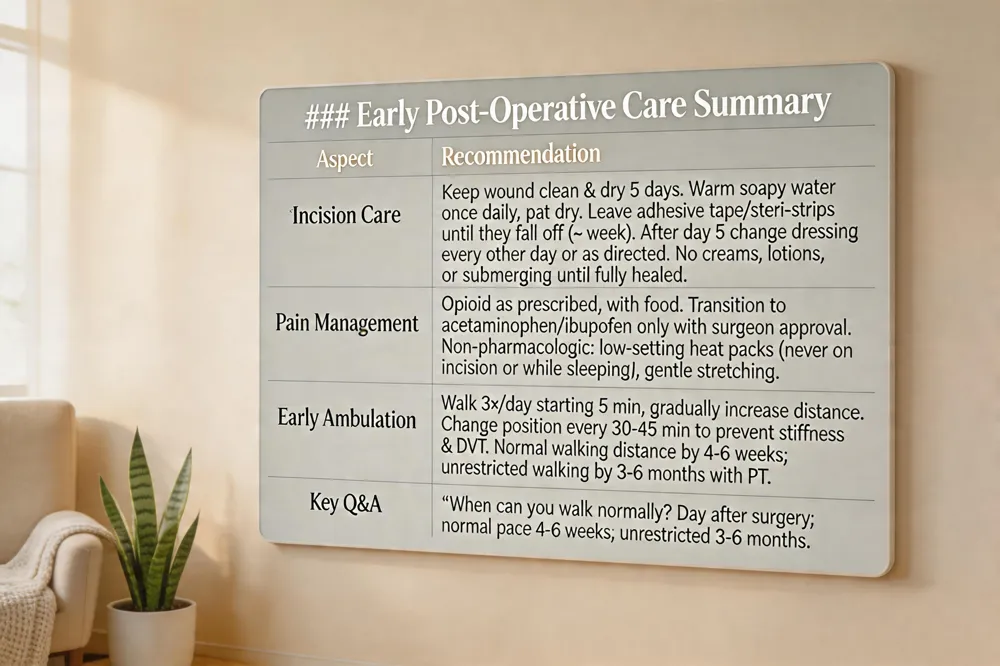 Incision care begins with keeping the wound clean and dry for the first five days. Use warm, soapy water to wash the area once daily, pat dry, and leave any adhesive tape or steri‑strips in place until it falls off (usually about a week). After day 5, change the dressing every other day or as instructed, and avoid creams, lotions, or submerging the incision until it is fully healed.
[Pain management] follows a prescribed schedule: take opioid pain relievers exactly as directed, preferably with food to reduce stomach upset, and transition to over‑the‑counter acetaminophen or ibuprofen only after surgeon approval. Non‑pharmacologic relief includes low‑setting [heat packs] (never directly on the incision or while sleeping) and gentle stretching.
[Early ambulation] is critical. Patients are encouraged to [walk three times daily], starting with short 5‑minute trips and gradually increasing distance. Changing sitting or standing position every 30‑45 minutes helps prevent stiffness and deep‑vein thrombosis. By [4‑6 weeks] most patients can walk longer distances without significant pain, and full, normal walking typically returns between [3‑6 months] with guided physical therapy.
How long does it take to walk normally after laminectomy? Most [begin walking the day after surgery]; normal walking distance and pace resume by 4‑6 weeks, with unrestricted walking achieved in 3‑6 months depending on health and therapy.
Post‑laminectomy op nursing care: Keep the incision clean and dry, monitor for [infection signs], encourage three daily walks and position changes, use compression stockings until ambulation is steady, [manage pain] per prescription, [restrict lifting] > 10 lb, teach proper sleep positioning, advise against [driving while on narcotics], and schedule [follow‑up] for dressing removal and activity clearance.
Activity Restrictions and Permanent Limitations
Activity Restrictions & Permanent Limitations
| Restriction | Rationale | Practical Guidance |
|---|---|---|
| Lift ≤10 lb for life | Prevent intra‑abdominal pressure spikes that strain lamina. | Use assistive devices; avoid grocery bags, heavy boxes. |
| No high‑impact sports | Sudden forces can undo decompression. | Avoid basketball, football, running on hard surfaces, vigorous aerobics. |
| Minimize bending/twisting | Reduces stress on healing spine. | Keep spine neutral; use knee bend for lifting; use straight‑back chair. |
| Do’s | Walk daily, stay hydrated, follow medication schedule, attend follow‑ups. | |
| Don’ts | Drive until off narcotics, lift >10 lb, jog, heavy weight‑lifting, sit/stand >30 min without break. |
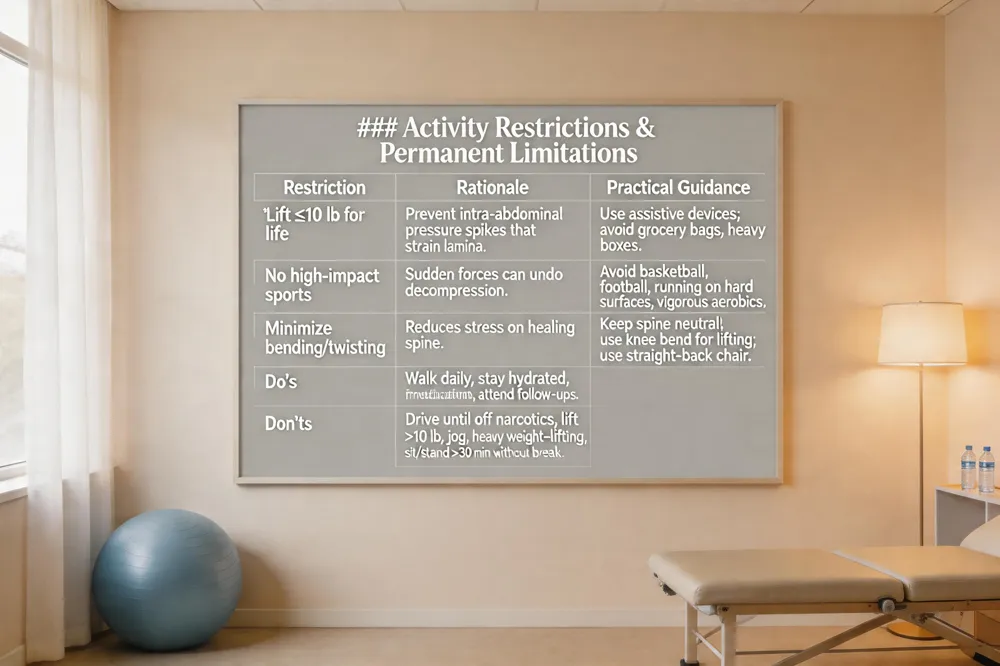 After a lumbar laminectomy, most surgeons set clear, long‑term activity limits to protect the decompressed spine. Heavy‑lifting ceiling and rationale – Patients are generally instructed never to lift more than 10 lb (about a gallon of milk) for the rest of their life. Even modest loads can increase intra‑abdominal pressure and strain the repaired lamina, raising the risk of recurrent stenosis or a new disc herniation. Impact of high‑impact sports and jarring motions – Contact and high‑impact sports such as basketball, football, running on hard surfaces, or vigorous aerobics are usually prohibited indefinitely. The sudden, repetitive forces transmitted through the lumbar spine can undo the decompression and cause pain flare‑ups. Long‑term posture and bending guidelines – Frequent bending, stooping, or twisting at the waist should be minimized; patients are encouraged to keep the spine in a neutral position while sitting, standing, or lifting. Using a straight‑back chair, changing position every 30 minutes, and employing proper body mechanics when lifting light objects help maintain spinal alignment.
Permanent restrictions after laminectomy – In addition to the heavy‑lifting ceiling, lifelong avoidance of jarring activities, heavy manual labor, and high‑impact sports is advised. Light walking, low‑impact exercises (e.g., stationary cycling, swimming), and household chores are permissible when performed with good posture and without excessive twisting.
Do's and Don'ts after laminectomy – Do: walk daily and gradually increase distance, stay hydrated, follow the prescribed pain‑medication schedule, and attend all follow‑up appointments. Don't: drive for 2–4 weeks or until off narcotic pain relievers, lift objects heavier than about 10 lb, engage in jogging, heavy weight‑lifting, or high‑intensity aerobic exercise until cleared, and sit or stand in the same position for longer than 30 minutes without a break. Following these guidelines helps sustain the surgical benefit and reduces the likelihood of future back or nerve complications.
Physical Therapy, Core Strength, and Structured Exercise
Physical Therapy Progression
| Time Post‑Op | Goals | Sample Exercises |
|---|---|---|
| Days 1‑3 | Gentle circulation & clot prevention | Ankle pumps, short walks, pelvic tilts, abdominal hollowing (spine neutral). |
| Weeks 3‑6 | Light strengthening & core activation | Bridges, bird‑dog, dead‑bug, clamshells, wall squats, supine crunches. Continue walking, avoid deep flexion, twisting, >20 lb lifts. |
| Weeks 6‑12 | Low‑impact cardio & functional drills | Stationary bike, swimming, standing from chair, safe knee‑bends, plank variations. Limit sitting to 30‑45 min, change position every ½ h, no scar massage <3 months. |
| Ongoing | Posture, hydration, weight management, smoking cessation | Maintain balanced diet, stay hydrated, avoid smoking, monitor red‑flag symptoms. |
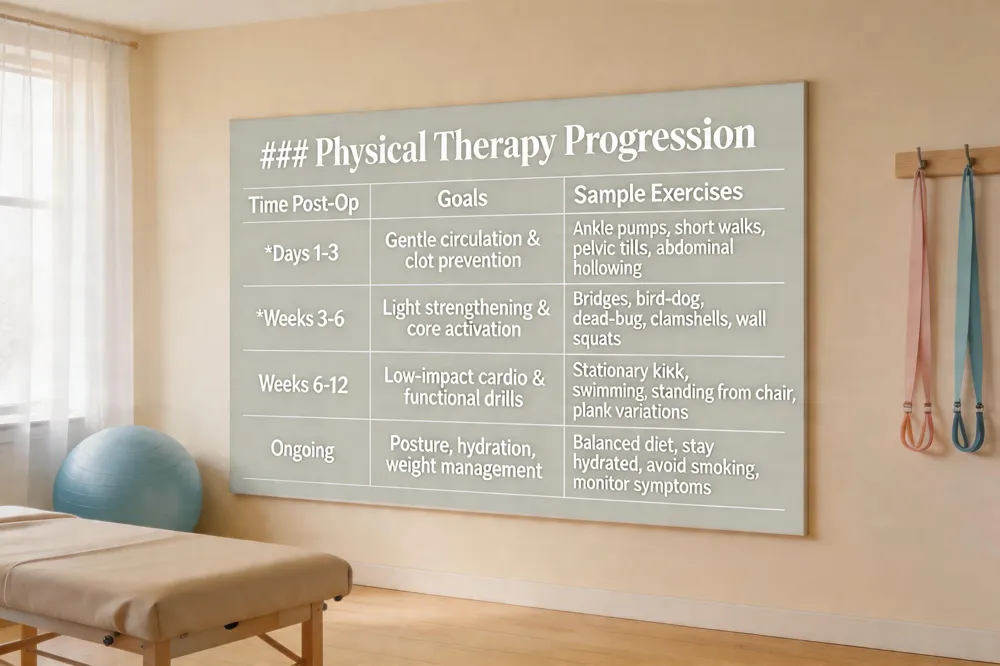 After a lumbar laminectomy, early mobility is essential. Begin the first few days with gentle walking and ankle‑pump exercises to promote circulation and prevent blood clots. Keep the spine neutral while performing basic core‑activation moves such as pelvic tilts and abdominal hollowing.
Around weeks 3‑6, under a physical therapist’s guidance, progress to light strengthening: bridges, bird‑dog, dead‑bug, clamshells, wall squats, and supine abdominal crunches. Continue walking, increasing distance gradually, and avoid deep flexion, twisting, or lifting more than 20 lb.
By week 6‑12, add low‑impact cardio (stationary bike, swimming) and functional drills like standing from a chair, safe bending with the knees, and plank variations. Throughout, limit sitting to 30‑45 minutes, change position every half hour, and refrain from scar massage for three months.
Laminectomy recovery tips: follow surgeon‑prescribed pain medication, balance rest with gentle movement, and attend all physical‑therapy sessions. Maintain a balanced, hydrated diet, a healthy weight, and avoid smoking to support tissue healing. Watch for red‑flag symptoms—new leg numbness, increasing pain, fever, or incision drainage—and contact your surgeon promptly. Consistent, therapist‑directed rehab restores lumbar stability, improves posture, and enables a safe return to daily activities.
Recovery Timeline: Walking, Driving, Work, and Full Activity
Recovery Timeline Milestones
| Milestone | Approx. Time Frame | Notes |
|---|---|---|
| First ambulation | 24‑48 h post‑op | Short 5‑10 min walks 2‑3×/day. |
| Normal walking distance | 4‑6 weeks | Walk longer distances at normal pace. |
| Unrestricted walking | 3‑6 months | Full endurance, no pain. |
| Driving | 2‑4 weeks (off narcotics, trunk control) | Limit trips ≤30 min, frequent stops early on. |
| Sedentary work | 2‑4 weeks | Light office tasks, avoid prolonged sitting. |
| Physically demanding work | 4‑8 weeks (or longer) | No heavy lifting >10‑15 lb, bending, twisting until cleared. |
| Full functional recovery | 3‑6 months (6‑12 months if fusion) | Return to sports, heavy lifting, high‑impact activities. |
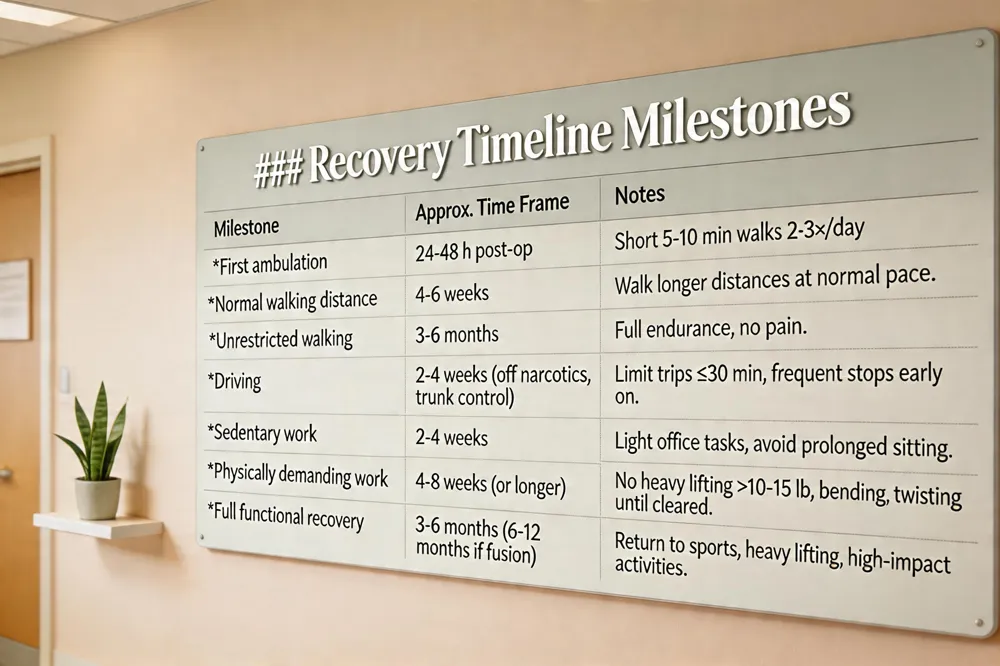 After a lumbar laminectomy most patients are encouraged to begin gentle ambulation within the first 24‑48 hours.(Early ambulation — getting out of bed and walking as soon as tolerated)
Short, frequent walks (5‑10 minutes, 2‑3 times daily) promote circulation, lower pneumonia risk, and help prevent constipation.(Walking daily, gradually increasing distance, promotes blood flow, prevents pneumonia and constipation)
By 4‑6 weeks most can walk longer distances at a normal pace, and full unrestricted walking typically returns between 3 and 6 months, depending on age, overall health, and whether the surgery was minimally invasive.(Walking daily, gradually increasing distance, promotes blood flow, prevents pneumonia and constipation
Driving is usually postponed until the patient is off narcotic pain medication, has full trunk control, and can make an emergency stop safely.(Driving is typically prohibited for 2 to 4 weeks post‑operation, and car trips should be limited to 30 minutes with frequent stops
Most surgeons clear patients for driving 2‑4 weeks post‑operation, with car trips limited to 30‑minute segments and frequent stops during the early weeks.(Driving is typically prohibited for 2 to 4 weeks post‑operation, and car trips should be limited to 30 minutes with frequent stops
Return‑to‑work schedules vary by job demands.(Return to work may take 2–4 weeks for sedentary jobs and 4–8 weeks for physically demanding occupations
Sedentary office work often resumes after 2‑4 weeks, while physically demanding occupations may need 4‑8 weeks or longer.(Return to work may take 2–4 weeks for sedentary jobs and 4–8 weeks for physically demanding occupations
Light household tasks can be performed within 2‑3 weeks, but heavy lifting (>10‑15 lb), bending, and twisting should be avoided until cleared by the surgeon.(Patients should avoid lifting heavy objects and strenuous activities (e.g., jogging, weightlifting) until cleared by their surgeon
Full functional recovery—including the ability to engage in sports, heavy lifting, and high‑impact activities—generally occurs 3‑6 months after a standalone laminectomy.(Full functional recovery may take six months or longer, especially with a structured core‑strengthening program)
If the procedure is combined with spinal fusion, recovery may extend to 6‑12 months.(Combined laminectomy with spinal fusion may take up to 6 months for full recovery
Throughout the recovery period, adhering to incision care, adequate hydration, a balanced diet, and a structured physical‑therapy program (core strengthening, flexibility, and gait training) is essential for optimal outcomes.(Incision care includes keeping the site clean and dry, washing daily with warm soapy water, and leaving any adhesive tape in place for a week or until it falls off
Key Q&A
-
Walking normally: Starts day‑after surgery; normal pace by 4‑6 weeks; unrestricted walking 3‑6 months.(Walking daily, gradually increasing distance, promotes blood flow, prevents pneumonia and constipation
-
Laminectomy + discectomy: Expect gradual pain reduction, early short walks, avoid heavy lifting 2‑4 weeks, PT for core strength, light work by 4‑6 weeks, full activity 3‑6 months.(Full functional recovery may take six months or longer, especially with a structured core‑strengthening program
-
Nerve healing: Nerves regenerate ~1 mm/day; functional improvement 3‑6 months, complete resolution up to 12 months.
-
Recovery timeline: Early ambulation 24‑48 h, PT weeks 2‑4, normal activities 4‑6 weeks, full return 3‑6 months.(Early ambulation—getting out of bed and walking as soon as tolerated
-
Resume normal activities: Light tasks by 2‑3 weeks, driving 2‑4 weeks, office work 4‑6 weeks, demanding jobs 8‑12 weeks, unrestricted activity 3‑6 months.(Return to work may take 2–4 weeks for sedentary jobs and 4–8 weeks for physically demanding occupations
Red‑Flag Symptoms and Emergency Situations
Red‑Flag Symptoms & Immediate Actions
| Symptom | Significance | Recommended Action |
|---|---|---|
| New/worsening leg/arm weakness, numbness, tingling | Possible nerve compression or cord involvement. | Call surgeon ASAP; go to ER if severe. |
| Saddle anesthesia or loss of bladder/bowel control | Spinal cord emergency. | Call 911 immediately. |
| Incision fever, redness, swelling, drainage | Surgical site infection. | Seek urgent medical evaluation. |
| Chest pain, shortness of breath, severe headache | Possible PE, cardiac event, or CSF leak. | Call 911. |
| Calf swelling or pain | Deep‑vein thrombosis risk. | Prompt evaluation; ultrasound if needed. |
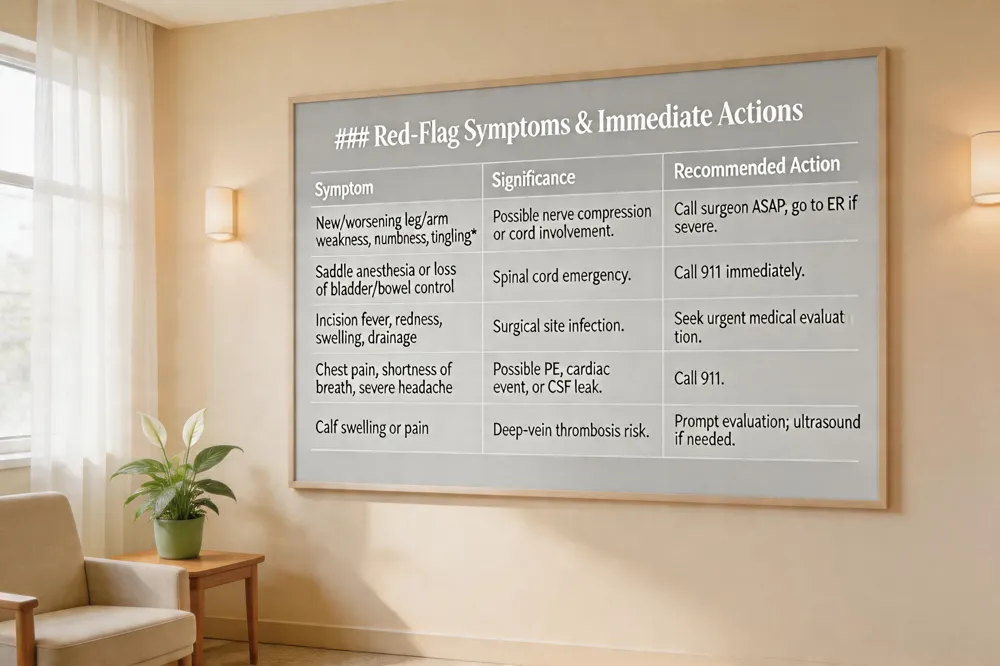 After a lumbar laminectomy, recognizing red‑flag symptoms is critical for preventing serious complications.
Neurological warning signs – New or worsening weakness, numbness, or tingling in the legs, arms, or the “saddle” area (perineal region) may indicate nerve compression or spinal cord involvement. Loss of bowel or bladder control is an emergency.
Incision infection indicators – Fever (≥101 °F), increased redness, swelling, warmth, or drainage/pus from the surgical site signal infection and require prompt evaluation.
Systemic emergencies – Sudden chest pain, shortness of breath, severe headache, or calf swelling (possible blood clot) are life‑threatening and demand immediate medical care.
What are the red flags after a laminectomy? Seek urgent attention for any new or worsening neurological deficits, loss of bladder/bowel function, fever, or any rapid change in incision appearance. Contact your surgeon or call 911.
What does immediate medical attention look like after laminectomy? Call your surgeon or emergency services for leg/arm weakness, loss of sphincter control, severe pain, fever, swelling or drainage from the incision, calf swelling, or shortness of breath.
Buttock pain after laminectomy Persistent buttock pain may stem from post‑laminectomy syndrome, piriformis irritation, scar tissue, or recurrent stenosis. Evaluation by your spine specialist is advised; treatment may include physical therapy, anti‑inflammatories, targeted injections, or minimally invasive revision procedures.
Complications, Long‑Term Effects, and Outlook
Complications & Long‑Term Outlook
| Complication | Frequency | Typical Management |
|---|---|---|
| Incision/spinal infection | Common | Antibiotics, possible drainage or re‑operation. |
| Dural tear/CSF leak | Rare | Bed rest, possible epidural blood patch, surgery if persistent. |
| Nerve injury | Rare | Physical therapy, pain meds, sometimes revision surgery. |
| Adjacent‑segment disease | Long‑term | Monitoring; may need future decompression or fusion. |
| Post‑laminectomy syndrome (chronic pain) | Variable | Multimodal pain management, PT, injections, possible revision. |
| Blood clot (DVT/PE) | Low | Early ambulation, compression stockings, anticoagulation if indicated. |
| Long‑term outcome | Generally good pain relief & mobility | with adherence to activity restrictions and rehab. |
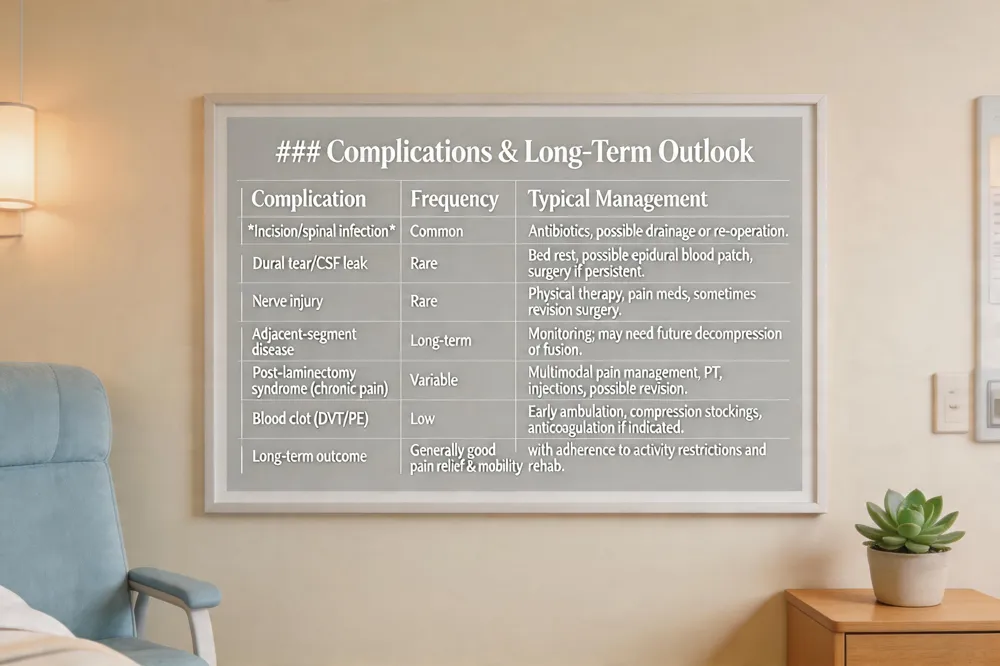 Laminectomy complications
Complications after a lumbar laminectomy can range from common to rare. The most frequent issues are incision or deeper spinal infection, bleeding that may need transfusion or re‑operation, and a dural tear that results in cerebrospinal‑fluid leakage. Nerve injury can produce new weakness, numbness, or pain, while postoperative spinal instability or adjacent‑segment disease may cause recurring discomfort and sometimes necessitate additional surgery. Less common but serious risks include blood‑clot formation, pulmonary complications, and chronic postoperative pain known as post‑laminectomy syndrome. Patients should discuss these possibilities with their surgeon before proceeding.
Laminectomy complications
Complications after a lumbar laminectomy can range from common to rare. The most frequent issues are incision or deeper spinal infection, bleeding that may need transfusion or re‑operation, and a dural tear that results in cerebrospinal‑fluid leakage. Nerve injury can produce new weakness, numbness, or pain, while postoperative spinal instability or adjacent‑segment disease may cause recurring discomfort and sometimes necessitate additional surgery. Less common but serious risks include blood‑clot formation, pulmonary complications, and chronic postoperative pain known as post‑laminectomy syndrome. Patients should discuss these possibilities with their surgeon before proceeding.
Long‑term effects of lumbar laminectomy Most patients enjoy lasting pain relief and improved mobility, especially when the procedure addresses spinal stenosis or a herniated disc. Over time, however, adjacent‑segment degeneration can develop, leading to new symptoms at levels above or below the operated site. Some individuals experience persistent low‑back pain or a recurrence of leg pain—collectively termed post‑laminectomy (failed back surgery) syndrome. In such cases, revision decompression or minimally invasive fusion may be required. Regular follow‑up and a conservative care plan are essential for monitoring and managing these late sequelae.
What happens if you bend too much after a laminectomy? Excessive forward bending places undue stress on incised muscles, ligaments, and any implanted hardware, potentially irritating tender tissues, increasing pain and swelling, and jeopardizing early bone healing or fusion. Over‑bending can also loosen screws or rods, leading to hardware failure and delaying recovery. For this reason, surgeons typically advise patients to avoid prolonged bending for several months while the spine stabilizes.
What about nerve recovery after laminectomy? After decompression, spinal nerves regenerate at roughly one millimeter per day, so functional recovery unfolds over several months. Most patients notice gradual relief of radiating pain and tingling within the first 3‑6 months, with continued improvement up to a year for severely compressed nerves. Early signs include reduced numbness, restored sensation, and stronger muscle function. Factors such as pre‑operative compression duration, age, overall health, and adherence to physical therapy influence recovery speed. While mild residual tingling may persist, a steady downward trend in symptoms indicates successful nerve regeneration.
Key Takeaways for a Successful Laminectomy Recovery
Follow the surgeon’s activity and lifting limits – avoid heavy objects and twisting for the first 2‑4 weeks, and keep driving, jogging, or weight‑lifting off‑limits until cleared. Prioritize early ambulation; walk short distances several times daily, gradually increasing duration to boost circulation, prevent pneumonia and constipation, and reduce muscle stiffness. Begin the prescribed physical‑therapy program as soon as possible, focusing on gentle core‑strengthening, range‑of‑motion, and proper lifting mechanics. Watch for red‑flag symptoms such as new or worsening leg pain, numbness, weakness, loss of bladder or bowel control, fever, increasing incision redness, swelling, or drainage, and contact your surgeon or emergency services immediately. Understand that while many patients feel significant improvement within 4‑6 weeks, full functional recovery may take 3‑6 months, especially after fusion. Maintain a balanced diet, stay well‑hydrated, use fiber supplements to prevent constipation, and quit smoking to support long‑term spinal health.