Setting Expectations for a Smooth Comeback
Recovery after a microdiscectomy is fastest when you follow a clear, step‑by‑step plan. A written roadmap reduces anxiety, keeps you on track with medication, incision care and activity limits, and helps you recognize normal versus warning signs. In the first week expect gentle walking, daily incision cleaning, and pain control with prescribed meds; avoid lifting more than 5 lb, twisting, or prolonged sitting. By weeks two to four you should increase walking distance, begin light core‑strengthening exercises, and transition to short driving trips after surgeon clearance. Weeks five to eight focus on returning to light work, changing positions every 30 minutes, and continuing physical therapy. Use this guide as a checklist: follow each milestone, adjust as needed, and contact your surgeon promptly if pain worsens, drainage appears, or neurological symptoms develop.
Post‑Surgical Precautions and Early Recovery
Key Precautions (First 2‑4 weeks)
| Activity | Recommendation |
|---|---|
| Incision care | Keep clean & dry; wash daily with warm soapy water; change dressings with sterile strips. |
| Showering | Shower until wound dry (≈3‑5 days); avoid submerging for ~3 weeks. |
| Bending / Twisting | Avoid completely. |
| Lifting | ≤5 lb. |
| Position changes | Change sitting/standing every 30 min. |
| Walking | Short walks twice daily, gradually increase distance. |
| Medications | Take analgesics as directed; taper opioids ≤3 months; avoid NSAIDs ≥10 days. |
| Driving | Do not drive on narcotics or if drowsy; obtain surgeon clearance (usually 2‑4 weeks). |
| Red‑flag signs | Increasing pain, drainage, fever, calf swelling, new numbness/weakness, bladder/bowel loss → call surgeon/911. |
| Nutrition | High‑protein, high‑fiber diet; adequate fluids; vitamin C, calcium; stool softeners if needed. |
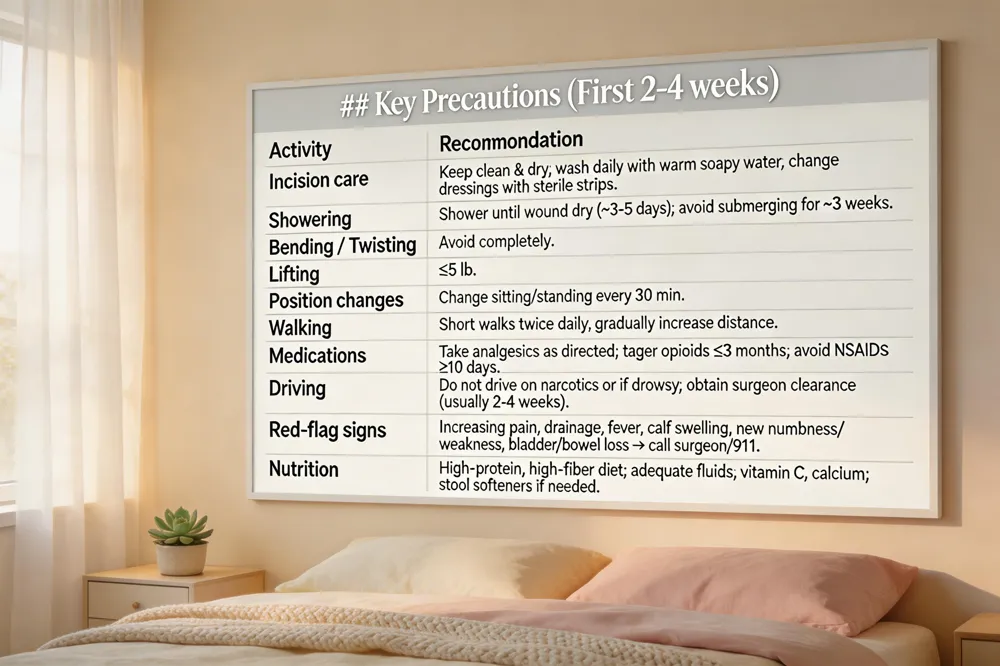 After a microdiscectomy, keep the incision clean and dry; wash daily with warm, soapy water, pat dry, and change any gauze dressing with sterile strips. Shower until the wound is dry (≈3‑5 days) and avoid submerging for about three weeks. Activity restrictions are critical: for the first 2‑4 weeks avoid bending, twisting, and lifting more than 5 lb; change sitting or standing positions every 30 minutes and walk short distances twice daily, increasing gradually. Medication management includes taking prescribed analgesics exactly as directed, tapering opioids within three months, and avoiding NSAIDs for at least ten days. Do not drive while on narcotics or feeling drowsy; obtain surgeon clearance, usually 2‑4 weeks post‑op. Watch for red‑flag symptoms such as increasing pain, wound drainage, fever, calf swelling, new numbness, weakness, or loss of bladder/bowel control—call the surgeon or 911 immediately. Support healing with a high‑protein, high‑fiber diet, ample fluids, vitamin C, calcium, and stool softeners if needed.
After spinal surgery precautions: Follow surgeon’s instructions, wear any prescribed brace, keep incision clean, limit bending, twisting, heavy lifting for 6‑8 weeks, walk early, avoid driving on narcotics, and monitor for infection or neurological changes.
What can you never do again after back surgery?: Permanently avoid forward‑bending, waist twisting, heavy lifting, high‑impact activities (running, jumping, contact sports) and prolonged poor‑posture sitting that stress the healing spine.
What can you never do again after a microdiscectomy?: While most daily activities resume, you must continue to avoid heavy lifting and high‑impact sports that could re‑injure the disc.
Managing Buttock Pain and Early Discomfort
Buttock Pain Management (First 2 weeks)
| Strategy | Details |
|---|---|
| Analgesics | Take prescribed meds exactly as directed. |
| Incision care | Keep clean & dry; change dressings daily. |
| Activity | Short frequent walks 5–10 min, multiple times/day. |
| Restrictions | No bending, twisting, or lifting >5–8 lb. |
| Therapy | Gentle stretching or heat/cold as tolerated. |
| Warning signs | Worsening pain, new numbness/tingling, fever, drainage → contact surgeon. |
| Progression | Increase walk duration as tolerated; stop if pain/fatigue/swelling worsens. |
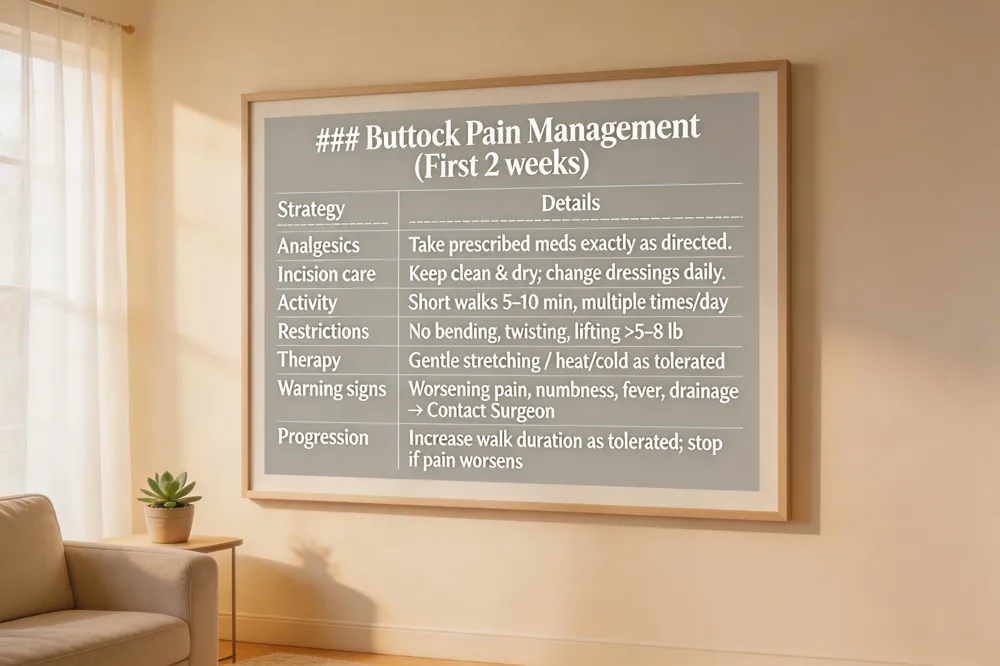 Buttock pain after a microdiscectomy is usually a normal part of healing, caused by residual inflammation, muscle spasm, or mild irritation of the sciatic nerve as it recovers from compression. In most cases the discomfort fades within a few weeks and can be eased with gentle stretching, heat or cold therapy, and short walks to keep the muscles active. During the first week focus on pain management by taking prescribed analgesics as directed, keeping the incision clean and dry, and changing dressings daily. Begin short, frequent walks of 5–10 minutes several times a day to promote circulation, but avoid bending, twisting, or lifting more than 5–8 pounds. Walking too much can increase swelling and stress on the surgical site; limit walks to the tolerated duration and stop if pain, fatigue, or swelling worsens. Persistent, worsening pain, new numbness, tingling, weakness, fever, or drainage may signal infection, scar tissue, or a recurrent disc problem and should prompt an immediate call to your surgeon. Gradual activity progression, good posture, and adherence to post‑op instructions are key to minimizing buttock pain and ensuring a smooth recovery.
Typical Recovery Timeline – Week by Week
Weekly Milestones
| Week | Primary Focus |
|---|---|
| 1 | Incision care, pain control, short walks (5‑10 min). Avoid BLT (bending, lifting, twisting). |
| 2 | Extend walks to 20‑30 min/day; begin gentle stretching/low‑impact exercise (surgeon approved). |
| 3‑4 | Supervised PT: core activation, nerve‑gliding, gradual activity increase; maintain BLT limits. |
| 5‑6 | Light sedentary work & household tasks; longer walks, light resistance; heavy lifting & contact sports still restricted. |
| 7‑8 | Normal non‑strenuous activities, light recreational sports; walking independence achieved. |
| 9‑12 | Transition to unrestricted daily duties; heavy labor & high‑impact sports cleared after surgeon approval (≈8‑12 weeks). |
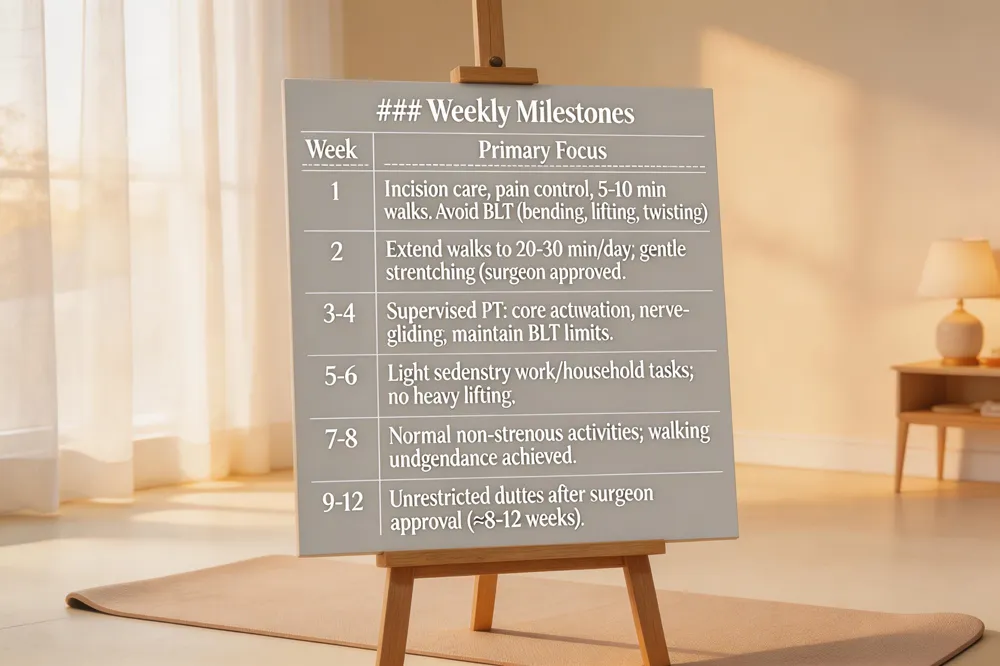 Microdiscectomy recovery is best understood as a series of weekly milestones.
Week 1 – Focus on incision care, pain control and short, frequent walks (5‑10 min). Avoid bending, lifting, or twisting.
Week 2 – Extend walks to 20‑30 min daily; begin gentle stretching or low‑impact exercises as your surgeon approves.
Weeks 3‑4 – Start a supervised physical‑therapy program emphasizing core activation, nerve‑gliding moves and gradual activity increase while still observing bending‑lifting‑twisting (BLT) limits.
Weeks 5‑6 – If cleared, return to light, sedentary work and household tasks; longer walks and light resistance are tolerated, but heavy lifting and contact sports remain off‑limits.
Weeks 7‑8 – Progress to normal, non‑strenuous activities and possibly light recreational sports; most patients achieve walking independence and can resume most daily duties.
By three weeks patients typically walk short distances unaided and experience markedly reduced pain, though occasional stiffness may linger. Full “normal” strength and unrestricted movement usually arrive by 6‑8 weeks, with a gradual taper to three months for optimal healing. Early ambulation, proper incision care and adherence to physical‑therapy instructions are key to a safe, successful recovery.
Specific Segment Recoveries and Movement Limits
Segment‑Specific Guidance
| Segment | Hospital Stay | Early Restrictions | Return to Work/Activities |
|---|---|---|---|
| L4‑L5 | 1 night | Avoid heavy lifting, bending, prolonged sitting for 2‑4 weeks. Light walking immediately. | Light household tasks by 6‑8 weeks; heavy labor up to 3 months. |
| L5‑S1 | 1‑2 nights | Same BLT limits for 2‑4 weeks. | Light duties & driving ~2 weeks; most return to work/school by 6 weeks; vigorous sport 8‑12 weeks. |
| Bending & Twisting | — | Avoid significant waist bending/twisting for 6 weeks. | Very light controlled bending may start weeks 4‑6 if pain‑free; full rotation cleared 8‑12 weeks. |
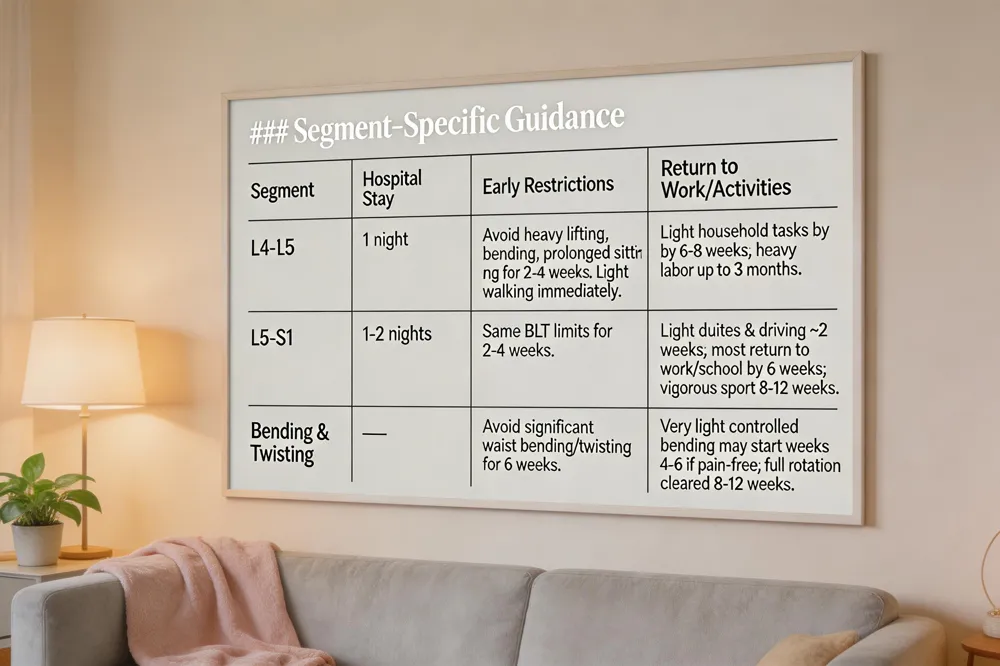 L4‑L5 discectomy recovery – Most patients stay one night in the hospital and then begin a 2‑4‑week period of limited lifting, bending and prolonged sitting. Keep the incision clean and dry, change dressings daily. Light walking starts immediately; a physiotherapist will guide core‑strengthening and safe body mechanics. Pain usually eases within the first few weeks, and by 6‑8 weeks normal daily activities and many work duties are tolerated. Full return to heavy labor or vigorous sport may take up to three months.
L5‑S1 discectomy recovery time – Hospital discharge typically occurs after 1‑2 days. For the first 2‑4 weeks avoid heavy lifting, bending, and twisting while gradually increasing light walking. Driving and light duties often resume around two weeks; most return to work or school by six weeks. Strenuous labor, contact sports, or heavy lifting usually require 8‑12 weeks, depending on healing and adherence to therapy.
How long after microdiscectomy can I bend and twist? – Surgeons advise avoiding significant waist bending or twisting for the first six weeks. Gentle walking and prescribed PT are permissible. Around weeks 4‑6, very light, controlled bending may be introduced if pain‑free, but full rotational movements remain restricted. Unrestricted twisting and heavy lifting are generally cleared after eight to twelve weeks, once the surgeon confirms adequate tissue healing.
Mid‑Term Milestones – 6 Months and Beyond
Mid‑Term Recovery (≥6 months)
| Aspect | Expectation |
|---|---|
| Pain | Marked reduction in sciatica; occasional mild discomfort possible. |
| Nerve healing | Tingling/numbness may linger; peripheral nerves regenerate ~1 mm/day; full recovery up to 1 year. |
| Exercise | Structured core‑strengthening & flexibility program; PT focuses on gentle stretching, aerobic activity. |
| Restrictions | Heavy lifting (>20 lb), high‑impact sports, repetitive twisting avoided until clearance. |
| Success rates | 80‑90 % leg‑pain relief; 70‑90 % overall improvement; ~83 % maintain success at 10 years. |
| Long‑term care | Low‑impact activities, maintain core strength, periodic PT check‑ins. |
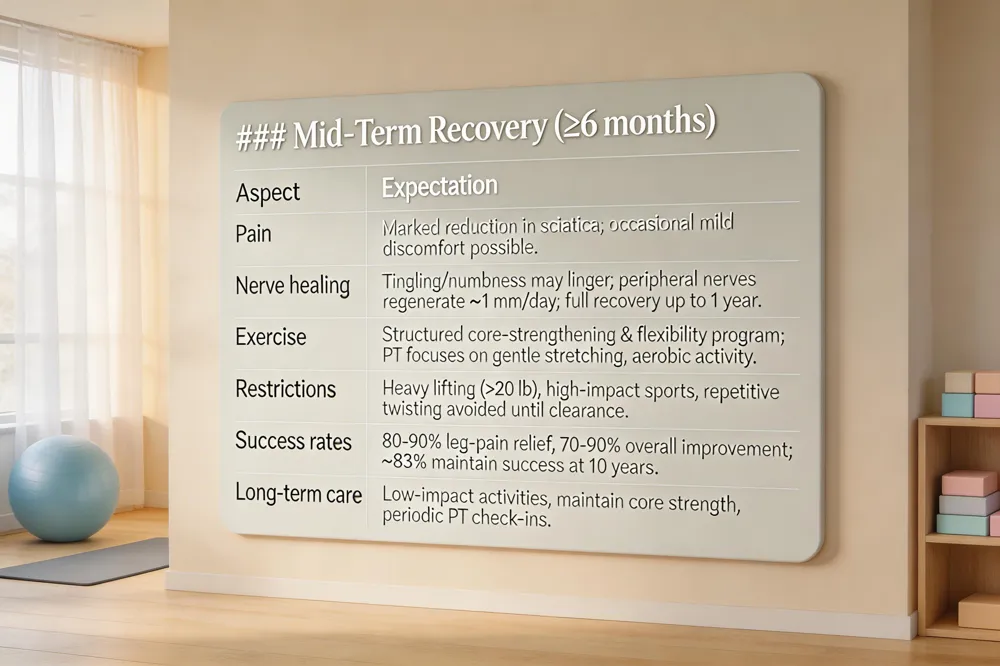 Six months after a microdiscectomy most patients report a marked reduction in sciatica or nerve‑related pain and can resume normal daily activities with only mild, occasional discomfort. Nerve healing continues beyond this point—tingling or numbness may linger but usually improves as strength and stability increase. Peripheral nerves regenerate at about 1 mm per day, so full sensory and motor recovery can take up to a year, especially after severe compression.
A structured core‑strengthening and flexibility program is essential. Physical‑therapy sessions focus on gentle stretching, core activation, and gradual aerobic activity to protect the spine and prevent future flare‑ups. Heavy lifting, high‑impact sports, and repetitive twisting should be avoided until your surgeon or therapist gives clearance, typically after a thorough functional evaluation.
Microdiscectomy success rates are high: 80‑90 % of patients experience relief of leg pain, and 70‑90 % report overall improvement in pain and function. Long‑term data show about 83 % of patients maintain success ten years post‑op. Permanent restrictions usually limit heavy lifting to ≤20 lb and advise low‑impact activities to preserve the repaired disc.
Complications, Red‑Flag Symptoms, and When to Call
Red‑Flag Symptoms & Action Plan
| Symptom | Why it matters | Immediate Action |
|---|---|---|
| Increasing wound redness/drainage | Possible infection | Call surgeon; consider 911 if severe. |
| Fever ≥38 °C | Systemic infection or DVT | Contact surgeon urgently. |
| Calf swelling/pain | DVT risk | Seek emergency care. |
| New/worsening leg numbness, tingling, weakness | Nerve injury or re‑herniation | Call surgeon immediately. |
| Loss of bladder/bowel control | Cauda‑equina syndrome | Call 911. |
| Uncontrolled pain despite meds | Possible complication | Surgeon evaluation. |
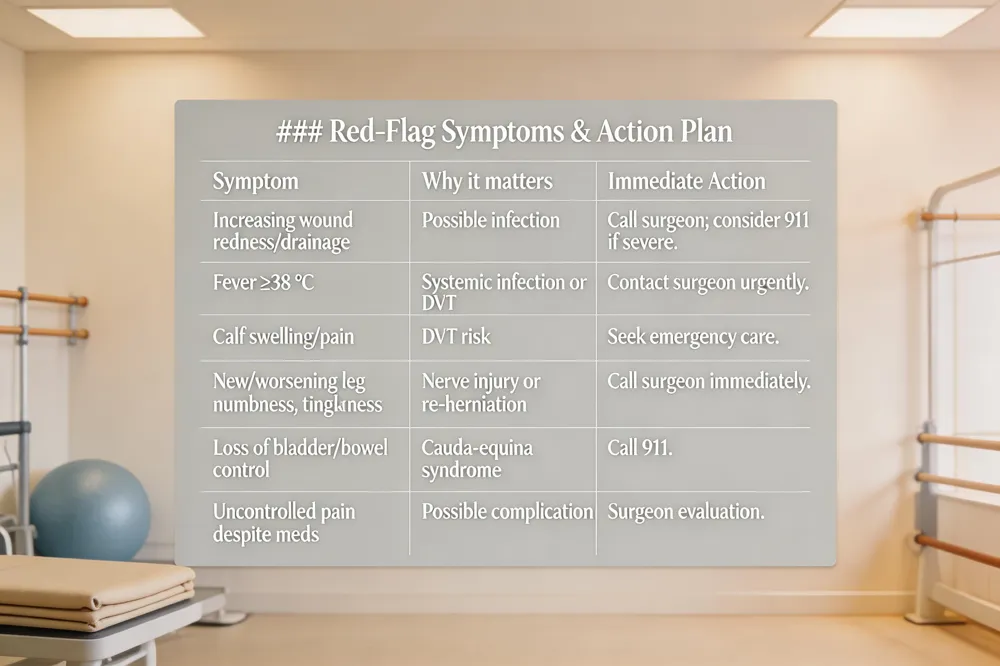 After a microdiscectomy, the first 48‑72 hours are usually the most painful as anesthesia wears off and inflammation peaks; day 3 often feels the worst, with swelling and limited mobility persisting through days 4‑7 and a secondary pain peak around days 7‑14. Watch for red‑flag signs: increasing wound redness, drainage, fever, or calf swelling may indicate infection or deep‑vein thrombosis (DVT); new or worsening leg pain, numbness, tingling, weakness, or loss of bladder/bowel control can signal reherniation or nerve injury. Medication side‑effects include constipation, nausea, sore throat from intubation, and rare allergic reactions; avoid NSAIDs for several months if a fusion was performed. Nursing care responsibilities encompass daily sterile dressing changes, pain‑medication titration, encouraging gentle ambulation and spirometry, reinforcing activity restrictions (no lifting > 5 lb, change position every 30 min), and educating on diet, hydration, stool softeners, and when to call the surgeon or emergency services. Most patients stay in the hospital 1‑2 days for monitoring and early mobilization before safe discharge.
Lifestyle, Nutrition, and Long‑Term Care
Lifestyle & Nutrition Guidelines
| Recommendation | Details |
|---|---|
| Diet | High‑protein, high‑fiber, plenty of water; vitamin C (500 mg BID) for 3 months; calcium if fusion performed. |
| Foods to avoid | Sugary treats, refined carbs, trans‑fat foods, excess caffeine/alcohol, salty processed items, heavy dairy (constipation risk). |
| Sleep ergonomics | Back sleepers: pillow under knees; side sleepers: pillow between knees; change position every 30‑45 min. |
| Smoking | Quit immediately; nicotine impairs healing. |
| Activity | Begin gentle walking 24‑48 h post‑op; increase gradually; avoid lifting >5 lb, bending/twisting 4‑6 weeks. |
| Ergonomics | Use sturdy chair with armrests; keep hips back; avoid prolonged poor posture. |
| Supplements | Vitamin C, calcium (if needed); consider multivitamin. |
| Monitoring | Daily dressing changes, pain‑med titration, encourage spirometry, hydration, stool softeners. |
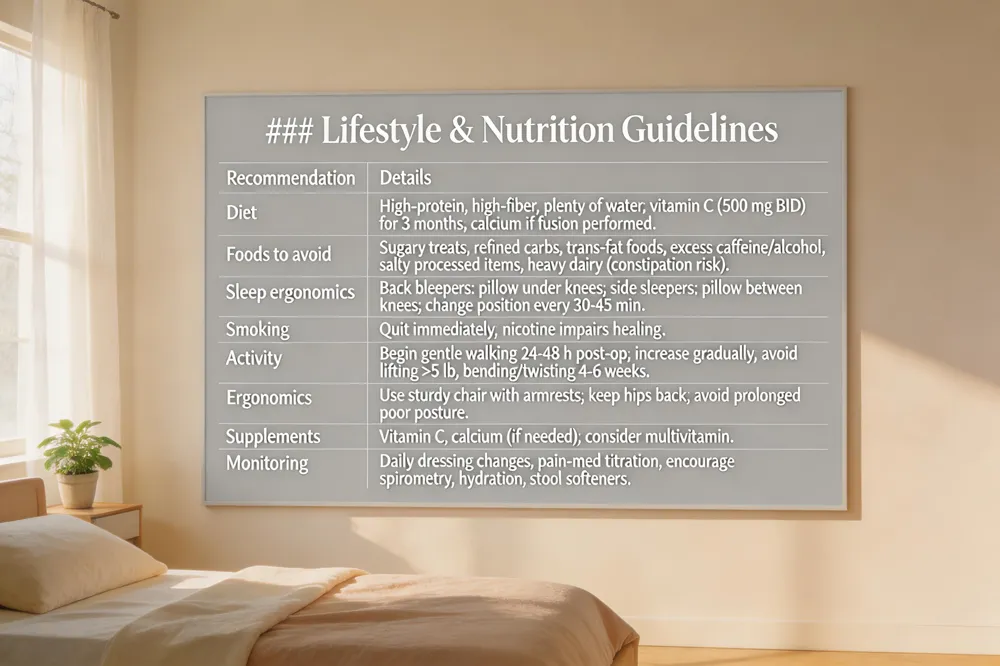 A successful microdiscectomy recovery hinges on good nutrition, safe ergonomics, and gradual activity changes.
Dietary recommendations and foods to avoid – Focus on lean protein, colorful vegetables, whole grains, and plenty of water. Limit sugary treats, refined carbs, trans‑fat‑rich foods, excessive caffeine, alcohol, and salty processed items that can increase inflammation or cause fluid retention. Dairy and heavy cheeses may worsen constipation, especially when opioids slow gut motility.
Sleep positioning and ergonomics – Sleep on your back with a pillow under the knees or on your side with a pillow between the knees to keep the spine neutral. Use a sturdy chair with armrests, keep hips pushed back, and change position every 30‑45 minutes to reduce static loading.
Smoking cessation and vitamin supplementation – Quit smoking immediately; nicotine impairs blood flow and delays tissue repair. Vitamin C (500 mg twice daily) for three months and adequate calcium (if fusion was performed) support wound healing.
Post‑operative activity modifications – Begin gentle walking within the first 24‑48 hours, increase distance gradually, and avoid lifting more than 5 lb, bending, or twisting for 4‑6 weeks.
FAQ
- Foods to avoid after spine surgery: Sugary treats, refined carbs, trans‑fat foods, excess caffeine/alcohol, salty processed foods, and heavy dairy that can cause constipation.
- Spinal surgery recovery tips: Rest, follow medication plan, keep incisions clean, stay hydrated, walk frequently, engage in therapist‑guided low‑impact exercise, eat protein‑rich antioxidant foods, quit smoking, and arrange a supportive home environment.
- Can you sit in a recliner after a laminectomy?: Limit sitting to 20 minutes per hour for the first three weeks; a recliner is acceptable if you avoid bending or twisting at the waist.
- What can you never do again after a microdiscectomy?: Heavy lifting and high‑impact activities such as running should be avoided to protect the healing spine.
Putting It All Together for a Successful Comeback
Microdiscectomy recovery unfolds in three clear phases. In the first weeks, focus on incision care, gentle walking, and pain control while avoiding lifting, twisting, and prolonged sitting. Weeks two through four emphasize increasing walking distance, beginning light physical‑therapy exercises, and maintaining regular bowel habits with fiber and hydration. By weeks five to eight, patients can resume most daily activities, return to desk work, and slowly re‑introduce light household tasks, always listening to pain cues. Follow‑up appointments at two, six, and twelve weeks let the surgeon monitor healing, adjust medications, and address any red‑flag symptoms promptly. Open communication with the care team ensures timely interventions and personalized guidance. Long‑term spine health thrives on core‑strengthening routines, ergonomic workstations, smoking cessation, and periodic check‑ins to catch early signs of recurrence before they become problems. for your continued well‑being today.