A Patient‑First Approach to Spine Health
Orthopedic spine surgery is a specialized field that diagnoses and treats disorders of the cervical, thoracic, and lumbar spine—including herniated discs, spinal stenosis, spondylolisthesis, and deformities—using both traditional and minimally invasive techniques. Minimally invasive procedures such as endoscopic discectomy, tubular decompression, and percutaneous fusion employ small incisions, specialized cameras, and image‑guided navigation to reduce muscle trauma, blood loss, and recovery time while still achieving symptom relief comparable to open surgery.
At the Orthopedic Spine Institute of St. Louis, a patient‑first care model places the individual’s goals and safety at the center of every decision. Dr. David S. Raskas and his multidisciplinary team begin with a comprehensive evaluation, education, and shared decision‑making. Conservative treatments—physical therapy, core‑strengthening exercises, lifestyle modifications, NSAIDs, and targeted injections—are always explored first. This stepwise approach not only respects the body’s natural healing capacity but also helps identify the exact source of pain through imaging and diagnostic blocks, ensuring that surgery is pursued only when it is truly necessary.
By prioritizing non‑operative care and reserving minimally invasive surgery for cases that fail to improve, the Institute delivers safer outcomes, faster returns to activity, and a personalized pathway toward lasting spine health.
Defining the Orthopedic Spine Surgeon and Who Treats Cervical Stenosis
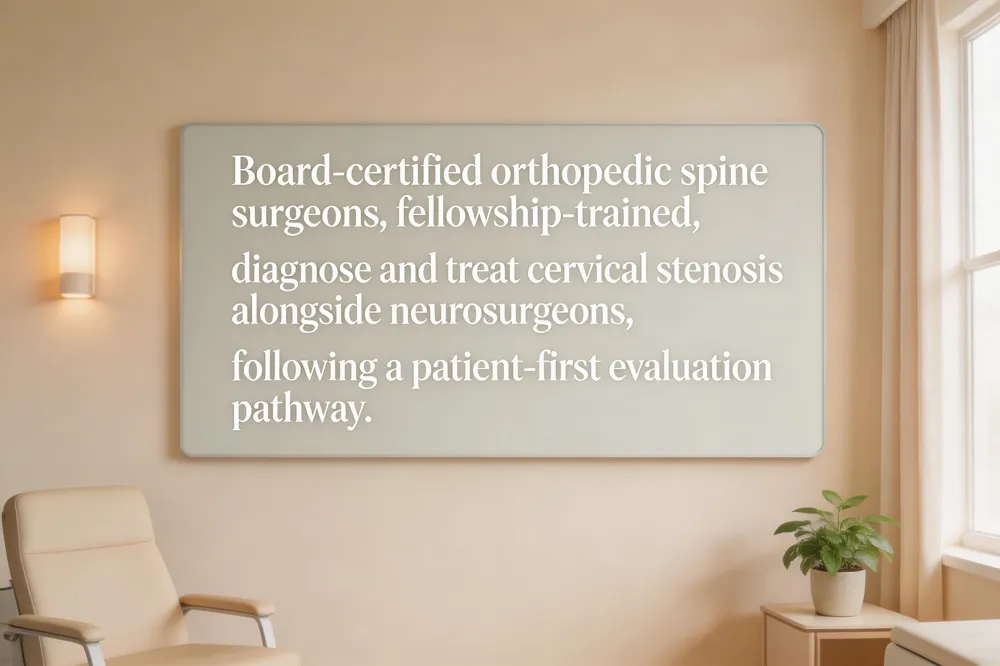 An orthopedic spine surgeon is a board‑certified orthopedic surgeon who has completed an additional fellowship focused on spinal disorders. After a full orthopedic residency, the surgeon gains expertise in diagnosing and treating back, neck, and radiating arm or leg pain, covering conditions such as degenerative disc disease, herniated discs, spinal fractures, scoliosis, tumors, and infections. Orthopedic spine surgery is the subspecialty that spans non‑operative care—NSAIDs, physical therapy, lifestyle changes, and injections—to surgical options when conservative measures fail. The patient‑first model, emphasized by centers like the Orthopedic Spine Institute of St. Louis, begins with thorough evaluation, imaging (X‑ray, MRI, CT) and a trial of therapy before progressing to minimally invasive procedures that use small incisions, tubular retractors, and image‑guided navigation to reduce muscle trauma and speed recovery.
Cervical stenosis, a narrowing of the cervical spinal canal, is typically managed by spine specialists such as orthopedic spine surgeons or board‑certified neurosurgeons. Primary‑care physicians often make the initial diagnosis and refer patients to these experts, who may also work with neurologists, physiatrists, and pain‑management teams. Candidates for minimally invasive spine surgery are patients whose pain persists despite adequate conservative treatment and who have pathologies—such as herniated discs, spinal spinal stenosis, spondylolisthesis, or compression fractures—that can be safely addressed through small‑corridor techniques. Ideal candidates are generally in good overall health, have a reasonable body mass index, and are motivated to participate in postoperative rehabilitation to achieve the best outcomes.
Minimally Invasive Spine Surgery: Options and Patient‑First Access
 Minimally invasive spine surgery (MISS) uses small incisions, tubular retractors or endoscopic cameras, and image‑guided navigation to treat spinal disorders while sparing muscle, reducing blood loss, and shortening recovery. Common MISS procedures include endoscopic discectomy, micro‑decompression, percutaneous vertebral augmentation, and minimally invasive fusion techniques such as MIS‑TLIF or lateral interbody fusion.
At the Orthopedic Spine Institute of St. Louis, the patient‑first pathway starts with a comprehensive evaluation, conservative therapies (physical therapy, medication, injections) and education. If symptoms persist, the multidisciplinary team—led by Dr. David S. Raskas—uses advanced imaging to pinpoint the exact pathology and then offers the least disruptive surgical option, often an endoscopic or percutaneous technique. The institute streamlines insurance verification, provides secure online intake forms, and allows patients to book appointments through a user‑friendly portal.
Finding minimally invasive spine surgery near you is straightforward: the Institute serves the Greater St. Louis region and partners with facilities such as Washington University Medicine and Atrium Health, ensuring access to state‑of‑the‑art operating rooms and post‑operative rehabilitation programs.
Minimally invasive spine surgery near me
If you’re looking for minimally invasive spine surgery near you, the Orthopedic Spine Institute of St. Louis provides state‑of‑the‑art procedures for back, neck and sciatica pain. Their patient‑first approach begins with conservative care and progresses to minimally invasive techniques such as endoscopic discectomy, micro‑decompression and percutaneous spinal fusion when surgery is necessary. Dr. David S. Raskas and his multidisciplinary team use advanced imaging and tiny incisions to reduce muscle damage, blood loss, postoperative pain and recovery time. The practice accepts most insurance plans, offers easy online appointment scheduling, and provides secure forms for new patients.
What is the most minimally invasive spine surgery?
The most minimally invasive spine surgery today is percutaneous endoscopic spinal surgery, often performed as an endoscopic discectomy or foraminotomy. It uses a tiny (< 5 mm) skin puncture and a thin, flexible endoscope that is guided through a natural tissue corridor, eliminating the need for a large muscle‑splitting incision. A tubular retractor or cannula creates a protected tunnel, allowing the surgeon to work under high‑definition video with micro‑instruments while preserving surrounding muscle and ligament. Because the approach is essentially “keyhole” and performed under continuous imaging, blood loss, postoperative pain, and recovery time are dramatically reduced compared with even traditional minimally invasive (tubular) techniques.
Types of Minimally Invasive Spine Surgery and Recovery Timelines
 Types of minimally invasive spine surgery
Minimally invasive spine surgery (MISS) includes microdiscectomy, foraminotomy and laminectomy performed through small tubular retractors or endoscopic cameras. Percutaneous lumbar fusion (e.g., MIS‑TLIF) uses screws and rods placed through tiny incisions, while kyphoplasty/vertebroplasty repair compression fractures with bone cement. Advanced endoscopic techniques also allow disc arthroplasty, tumor resection, and spinal cord stimulator implantation.
Types of minimally invasive spine surgery
Minimally invasive spine surgery (MISS) includes microdiscectomy, foraminotomy and laminectomy performed through small tubular retractors or endoscopic cameras. Percutaneous lumbar fusion (e.g., MIS‑TLIF) uses screws and rods placed through tiny incisions, while kyphoplasty/vertebroplasty repair compression fractures with bone cement. Advanced endoscopic techniques also allow disc arthroplasty, tumor resection, and spinal cord stimulator implantation.
Minimally invasive spine surgery L4‑L5 recovery time A microdiscectomy or lumbar laminectomy at L4‑L5 typically lets patients go home the same day or within 24‑48 hours. Light daily activities can resume in a few days; most surgeons advise a 2‑3‑week “laid‑up” before heavy lifting or driving. Full recovery—return to unrestricted work and exercise—occurs in 6‑10 weeks for a discectomy and up to 8‑12 weeks for a laminectomy. If a minimally invasive fusion is performed, the timeline extends to 3‑6 months, with limited activity for the first 3‑4 weeks.
Minimally invasive spine surgery recovery time (overall) Compared with open surgery, MISS shortens healing. Microdiscectomy patients usually achieve light‑activity status within days and full recovery in 6‑10 weeks. Laminectomy follows a similar schedule, often adding a week or two for complete independence. Minimally invasive lumbar fusion requires 3‑6 months before normal daily activities, with a 3‑4‑week period of activity restriction. Early mobilization, guided physical therapy, and adherence to postoperative instructions are essential for optimal outcomes.
Leading Spine Specialists in North Carolina and Charlotte
 Best spine doctors in Charlotte, NC
Charlotte’s premier spine care is provided by OrthoCarolina’s Spine Center, featuring fellowship‑trained orthopedic surgeons such as Dr. David T. Anderson, Dr. Stephen Barchick, and Dr. Todd M. Chapman Jr. These physicians perform thousands of minimally invasive procedures annually, treating cervical, thoracic, and lumbar disorders ranging from disc disease to complex deformities. The SpineFirst network adds board‑certified experts like Dr. Anthony L. Asher, Dr. Michael Bohl, and Dr. Ben Boudreaux, offering a full spectrum of non‑operative and operative options.
Top spine surgeons in North Carolina
Across the state, leading surgeons include Dr. Anthony L. Asher (renowned for minimally invasive techniques), Dr. Matthew J. McGirt (expert in complex reconstructions), Dr. John C. Ziewacz (spinal oncology and deformity), Dr. Timothy C. Gooldy (spinal trauma and advanced fusion), and Dr. Michael Bohl (degenerative disease and biologics). Their research contributions and high surgical volumes ensure cutting‑edge care.
Orthopedic spine surgeon Charlotte NC
The primary orthopedic spine team in Charlotte operates out of OrthoCarolina’s Spine Center at 2001 Randolph Rd. Their patient‑first model begins with conservative therapy and progresses to minimally invasive surgery when needed, handling over 2,000 surgeries and 4,000 interventional procedures each year.
OrthoCarolina spine surgeons
The OrthoCarolina team, board‑certified and fellowship‑trained, treats scoliosis, disc disease, stenosis, fractures, tumors, and deformities with both minimally invasive and complex reconstructive techniques.
Novant Spine specialist Charlotte NC
Novant Health offers same‑day/next‑day appointments at 2801 Randolph Rd. 7825 Ballantyne Commons Parkway, providing diagnostic imaging, minimally invasive surgery, pain‑management, and rehabilitation without referral.
Spine specialist Ballantyne
Carolina Neurosurgery & Spine Associates at Ballantyne Corporate Place delivers cervical and lumbar MIS, fusions, and injections, led by Dr. Joseph Cheatle and Dr. S. Harrison Farber.
Spine specialist Randolph Rd
The Randolph Rd clinic offers comprehensive back, neck, and sciatica care, including conservative treatment, MIS, and insurance assistance, with easy online scheduling and secure intake forms.
Financial Considerations and Risks of Minimally Invasive Spine Surgery
 When patients explore minimally invasive spine surgery (MISS) at the Orthopedic Spine Institute of St. Louis, the first financial question is the cost. Without insurance, a typical MISS discectomy ranges from $15,000 – $35,000, a minimally invasive laminectomy falls between $50,000 – $90,000, spinal fusion procedures can exceed $80,000 – $150,000, and disc‑replacement implants vary from $20,000 – $70,000. Insurance coverage dramatically reduces out‑of‑pocket expenses, but the exact amount depends on each patient’s deductible, co‑pay, and plan‑specific limits. The institute’s online portal lets patients verify coverage and submit insurance information securely before the first visit.
Despite the smaller incisions and faster recovery, MISS is not without downsides. Complications can include nerve injury, durotomy (a tear in the dura), misplaced hardware, infection, bleeding, and, in some cases, incomplete decompression due to the limited visual field. Patients with severe obesity, extensive scar tissue, or complex spinal deformities may not be ideal candidates. The technology‑intensive nature of MISS also means longer operative times and increased radiation exposure for the surgical team.
The Orthopedic Spine Institute of St. Louis offers patient‑first resources such as detailed cost estimates, insurance verification tools, and a secure patient portal to streamline paperwork. Patients are encouraged to discuss anticipated costs, coverage details, and potential risks during the initial consultation to make an informed decision about their spine care.
Recovery, Rehabilitation, and Future Innovations
 After spine surgery, the Orthopedic Spine Institute of St. Louis follows a patient‑first pathway that moves quickly from the operating room to a structured, outpatient physical‑therapy program. Patients begin with gentle core‑strengthening and flexibility exercises, progress to functional drills that mimic daily activities, and receive education on proper body mechanics, ergonomic workstations, and weight‑management strategies that protect the healing spine.
Looking ahead, the institute is integrating emerging technologies such as robotic‑assisted screw placement, high‑resolution endoscopic cameras, and computer‑guided navigation to make minimally invasive procedures even less invasive. These platforms allow surgeons to work through 1‑cm incisions, preserve muscle tissue, and shorten hospital stays, while delivering the same precision as traditional open surgery.
Research and education are woven into every step of care. Clinical trials at Washington University and UPMC evaluate new spinal implants, biologics, and artificial‑disc replacement, and the institute’s partnership with the APTA and local universities provides ongoing CEU opportunities for therapists and surgeons alike. By combining rigorous post‑operative rehab with cutting‑edge technology and a culture of continuous learning, patients receive faster relief, better long‑term function, and a clear roadmap to a healthier spine.
Putting the Puzzle Pieces Together
At the Orthopedic Spine Institute of St. Louis, every step of care is built around a patient‑first philosophy. First, we perform a thorough history and physical exam, followed by targeted imaging (X‑ray, MRI, CT) and, when needed, nerve studies such as EMG. This diagnostic puzzle lets us pinpoint the exact source of back or neck pain—whether it’s a herniated disc, spinal stenosis, arthritis, or a muscular strain. Once the problem is identified, we begin with evidence‑based conservative treatments: activity modification, physical‑therapy‑prescribed core‑strengthening and posture‑correction exercises, NSAIDs, muscle relaxants, and, if appropriate, image‑guided injections. Only when these measures fail and the patient meets clear medical‑necessity criteria do we move to minimally invasive spine surgery, which uses small incisions, tubular retractors, and real‑time imaging to protect tissue and accelerate recovery.
Key take‑aways for patients: 1) Early, accurate diagnosis guides effective treatment; 2) Conservative care is the first line and often resolves symptoms; 3) Minimally invasive surgery is a safe, efficient option when needed; 4) A multidisciplinary team—including physiatrists, pain specialists, and physical therapists—collaborates to personalize each plan.
If you’re experiencing persistent back or neck pain, don’t wait. Schedule an appointment today through our secure online portal or call our office at (555) 123‑4567 to start your personalized, patient‑first journey toward lasting relief.