Why a Second Opinion Matters
A second opinion in spine care is a formal review of a patient’s diagnosis, imaging, and proposed treatment plan by another qualified spine surgeon. At the Orthopedic Spine Institute of St. Louis, this review is rooted in a patient‑first philosophy: the team first exhausts conservative options such as physical therapy, injections and lifestyle changes, and only then considers surgery—preferably minimally invasive—when it is truly necessary. By obtaining a second specialist’s perspective, patients gain clearer insight into the accuracy of the diagnosis, the range of non‑surgical and surgical alternatives, and the risks and benefits of each approach. This collaborative, evidence‑based process builds confidence, reduces anxiety, and often leads to better outcomes—whether that means avoiding an unnecessary fusion, selecting a less invasive technique, or confirming that surgery is the optimal path.
Understanding the Process and Options
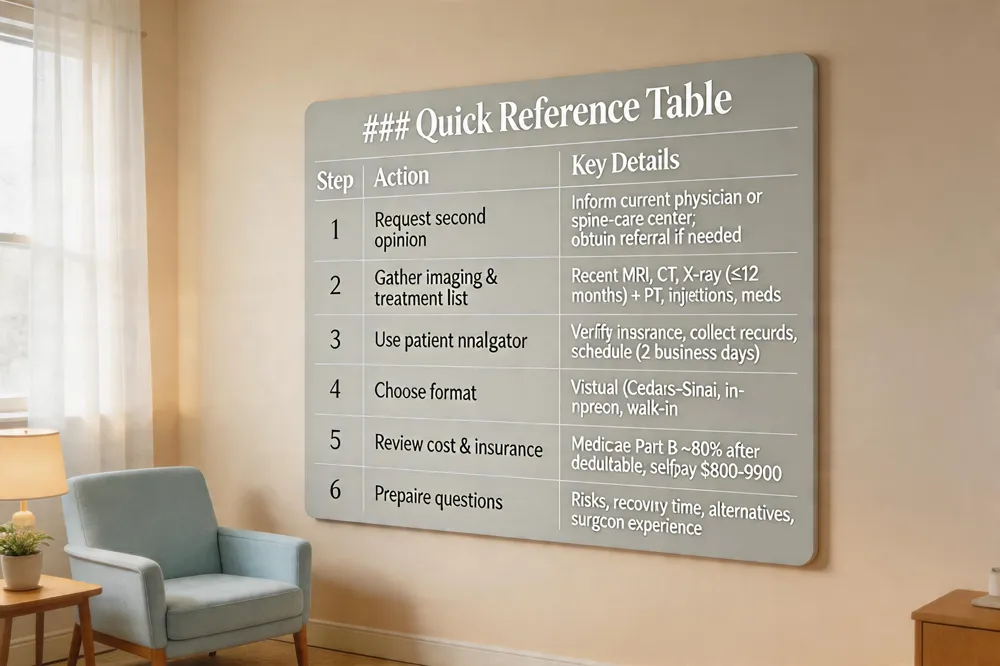
Quick Reference Table
| Step | Action | Key Details |
|---|---|---|
| 1 | Request second opinion | Inform current physician or call spine‑care center; obtain referral if needed |
| 2 | Gather imaging & treatment list | Recent MRI, CT, X‑ray (≤12 months) + list of PT, injections, meds |
| 3 | Use patient navigator | Verify insurance, collect records, schedule (often within 2 business days) |
| 4 | Choose format | Virtual portal (e.g., Cedars‑Sinai), in‑person, or walk‑in based on distance |
| 5 | Review cost & insurance | Medicare Part B covers ~80 % after deductible; private insurers similar; out‑of‑pocket $800‑$900 for remote written reports |
| 6 | Prepare questions | Risks, recovery time, alternatives, surgeon experience |
 Remote and virtual second‑opinion services let you get expert spine care without leaving home. Orthopedic Spine Institute’s secure online portal, Cedars‑Sinai’s Virtual Second Opinion, NYU Langone’s online orthopedic review, and Grand RR’s employer‑based program all accept uploaded MRIs, CTs and X‑rays, then provide a written report (often within a few business days) and an optional video consult to discuss diagnosis, non‑surgical alternatives and minimally‑invasive surgical options.
To request a second opinion, start by informing your current physician and asking for a referral or simply call the spine‑care center of your choice. Gather recent imaging (MRI, CT, X‑ray) and a list of all nonsurgical treatments (physical therapy, injections, medications). Many programs assign a patient navigator—Northwestern Medicine, University Orthopedics, SpineFirst—to verify insurance, collect records and schedule the appointment, often within two business days. Bring a prepared list of questions about risks, recovery time and alternative therapies.
Cost and insurance coverage vary. Medicare Part B typically pays 80 % of a medically necessary second‑opinion fee after the deductible; most private insurers follow a similar model, covering the bulk of the charge while you pay any copay or coinsurance. Out‑of‑pocket fees for fully remote written opinions range from $800–$900, and many patients use HSA/FSA funds. Virtual programs often have transparent flat fees and may be covered when the service is deemed medically necessary. Confirm network status and any pre‑authorization requirements before scheduling to avoid unexpected expenses.
Clinical Evidence and Cost Impact
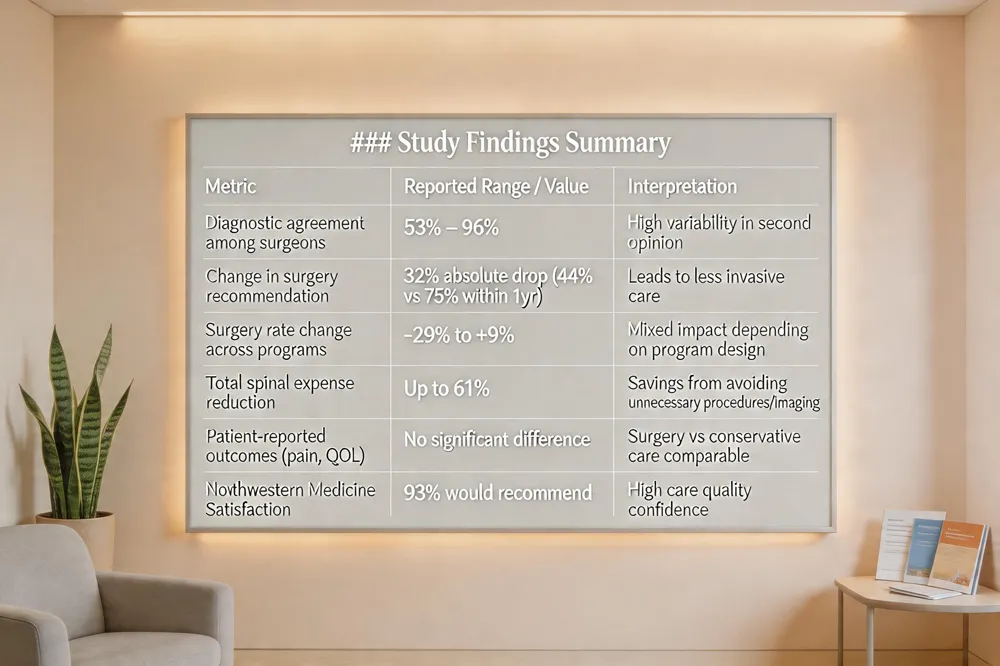
Study Findings Summary
| Metric | Reported Range / Value | Interpretation |
|---|---|---|
| Diagnostic agreement among surgeons | 53 % – 96 % | High variability in second |
| Change in surgery recommendation after second opinion | 32 % absolute drop (44 % vs 75 % within 1 yr) | Second opinion often leads to less invasive care |
| Surgery rate change across programs | -29 % (reduction) to +9 % (increase) | Mixed impact depending on program design |
| Total spinal‑related expense reduction | Up to 61 % | Savings from avoiding unnecessary procedures/imaging |
| Patient‑reported outcomes (pain, disability, QOL) | No significant difference between surgery and conservative groups | Clinical effectiveness comparable |
| Patient satisfaction (Northwestern Medicine) | 93 % would recommend | High confidence and perceived care quality |
 Second opinions for spinal surgery: a scoping review - PMC - NIH
Observational studies show wide diagnostic agreement (53‑96%) and even broader disagreement on surgery necessity (0‑83%). When a second spine surgeon reviews the case, recommendations often shift toward less invasive care, especially avoiding spinal fusion. One study reported a 32% absolute drop in surgery rates (44% vs 75% within a year) after a second‑opinion consult.
Second opinions for spinal surgery: a scoping review - PMC - NIH
Observational studies show wide diagnostic agreement (53‑96%) and even broader disagreement on surgery necessity (0‑83%). When a second spine surgeon reviews the case, recommendations often shift toward less invasive care, especially avoiding spinal fusion. One study reported a 32% absolute drop in surgery rates (44% vs 75% within a year) after a second‑opinion consult.
Second opinions for spinal surgery: a scoping review - PMC Insurance‑driven second‑opinion programs have mixed effects: some achieve a 29% reduction in surgeries, others a modest 9% increase over several years. Cost analyses are more consistent—total spinal‑related expenses can fall up to 61%, largely by cutting unnecessary procedures and imaging while modestly increasing conservative services such as injections or physiatrist visits.
Second opinions for spinal surgery: a scoping review - NIH Patient‑reported outcomes after a second opinion are comparable across groups: pain, disability, and quality‑of‑life scores do not differ significantly between those who proceed to surgery and those managed conservatively, despite limited long‑term follow‑up. High satisfaction rates (e.g., 93% of Northwestern Medicine patients would recommend their surgeon) suggest that the reassurance and shared decision‑making provided by a second opinion improve overall patient confidence and perceived care quality.
Regional Expertise and Surgeon Networks
New England Spine Specialists
| State | Doctor(s) | Affiliation(s) | Specialty / Notable Technique |
|---|---|---|---|
| Massachusetts | Dr. Christopher Bono, MD | Harvard Med School, Mass General Hospital | Executive VP, orthopedic surgery; broad expertise |
| Massachusetts | Dr. Frank X. Pedlow Jr., | Harvard‑trained, MGH | Minimally invasive spine surgery, athletic injuries |
| Rhode Island | Dr. Ziya Gokaslan, MD | Rhode Island Hospital, The Miriam Hospital | Neurosurgery chief, complex spine cases |
| Rhode Island | Dr. Adetokunbo Oyelese, MD, PhD, FAANS | Norman Prince Spine Institute | Director, advanced surgical programs |
| Rhode Island | Dr. Keith Scarfo, DO, MS | Norman Prince Spine Institute | Minimally invasive & endoscopic spine procedures |
| Rhode Island | University Orthopedics Center for Spine Health | Multiple Providence locations | Artificial‑disc replacement, robotic‑assisted fusion, multidisciplinary care |
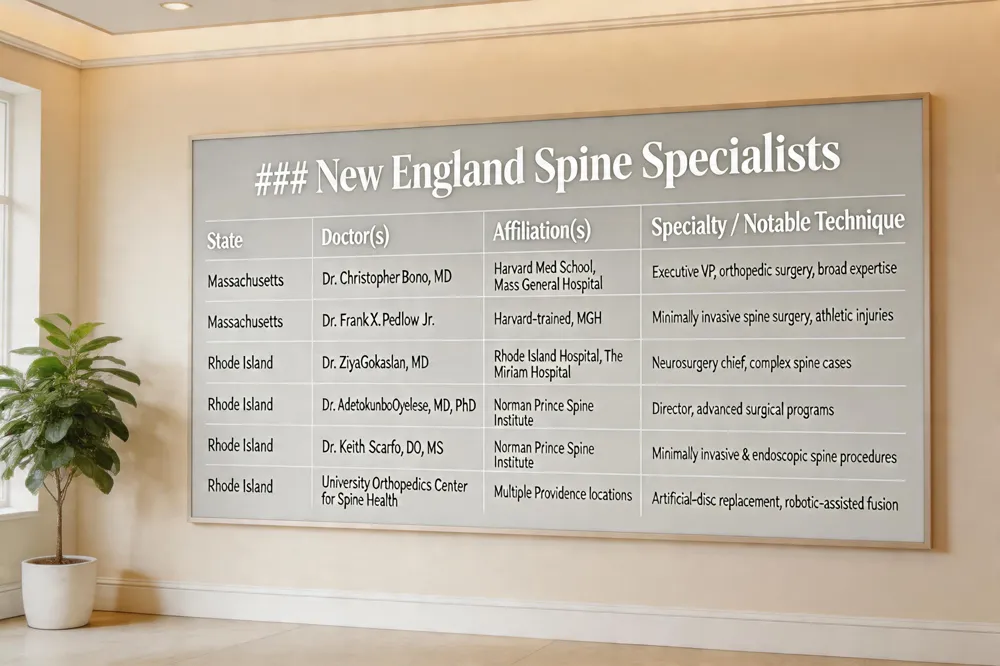 When seeking spine care in New England, patients have access to a concentration of nationally recognized surgeons. In Massachusetts, leading physicians include Dr. Christopher Bono, MD, executive vice‑chair of orthopaedic surgery at Harvard Medical School and a faculty member at Massachusetts General Hospital, and Dr. Frank X. Pedlow, Jr., MD, a Harvard‑trained specialist renowned for minimally invasive techniques and athletic spine injuries. Both consistently receive top patient ratings and extensive insurance acceptance.
Rhode Island’s spine expertise is anchored by Dr. Ziya Gokaslan, MD, Neurosurgeon‑in‑Chief at Rhode Island Hospital and The Miriam Hospital, and Dr. Adetokunbo Oyelese, MD, PhD, FAANS, director of the Norman Prince Spine Institute. Dr. Keith Scarfo, DO, MS, leads the institute’s minimally invasive and endoscopic programs. The University Orthopedics Center for Spine Health adds a multidisciplinary team of fellowship‑trained orthopedic spine surgeons across Providence, East Greenwich, East Bay, and other locations, offering artificial‑disc replacement, robotic‑assisted fusion, and comprehensive non‑surgical options.
These networks provide patients with coordinated access to advanced imaging, injections, physical therapy, and both traditional and minimally invasive surgical interventions, ensuring a patient‑first, evidence‑based approach to back, neck, and sciatica pain throughout the region.
Patient Stories and Practical Tips
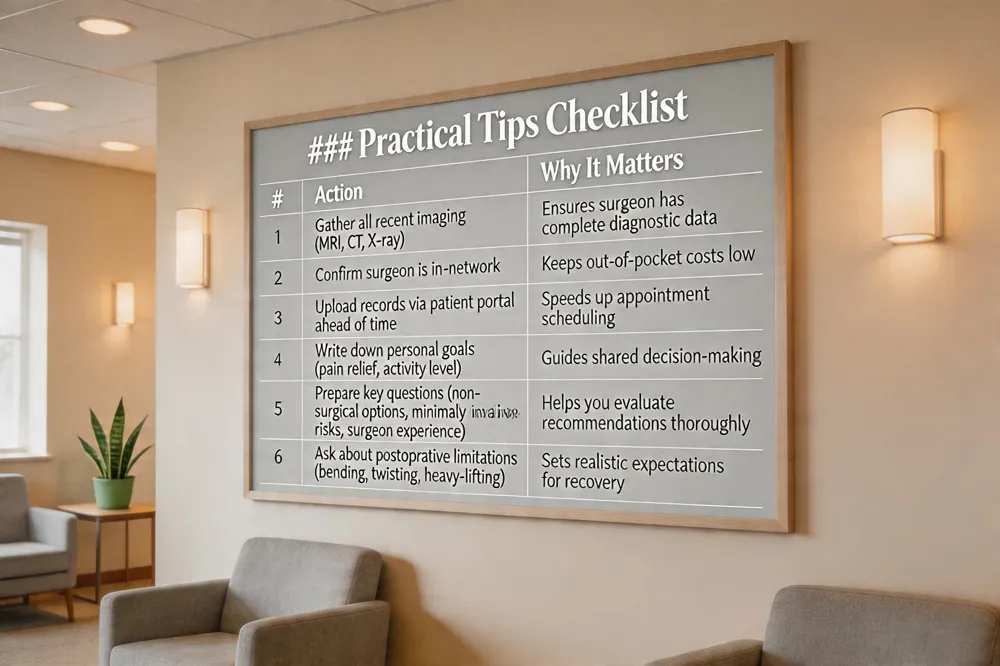
Practical Tips Checklist
| # | Action | Why It Matters |
|---|---|---|
| 1 | Gather all recent imaging (MRI, CT, X‑ray) | Ensures surgeon has complete diagnostic data |
| 2 | Confirm surgeon is in‑network | Keeps out‑of‑pocket costs low |
| 3 | Upload records via patient portal ahead of time | Speeds up appointment scheduling |
| 4 | Write down personal goals (pain relief, activity level) | Guides shared decision‑making |
| 5 | Prepare key questions (non‑surgical options, minimally invasive feasibility, risks, surgeon experience) | Helps you evaluate recommendations thoroughly |
| 6 | Ask about postoperative limitations (bending, twisting, heavy‑lifting) | Sets realistic expectations for recovery |
 When Mary, a 58‑year‑old with chronic lumbar stenosis, sought a second opinion at Northwestern Medicine, the new spine specialist confirmed her diagnosis but recommended a minimally invasive decompression instead of the multi‑level fusion originally suggested. By avoiding an extensive fusion, Mary returned to light activities within four weeks and reported less postoperative pain.
Preparing for a consultation
- Gather recent MRI, CT, and X‑ray images and a list of all nonsurgical treatments (physical therapy, injections, medications).
- Verify that the consulting surgeon is in‑network to keep costs low.
- Use the patient portal or upload records in advance; many centers (e.g., Cedars‑Sinai, Orthopedic Spine Institute of St. Louis) offer virtual uploads.
- Write down your goals (pain relief, activity level) and any concerns about recovery time.
Key questions to ask
- What non‑surgical options remain that could delay or replace surgery?
- Is a minimally invasive technique feasible for my condition?
- What are the specific risks, recovery timeline, and expected outcome of the proposed surgery?
- How many similar cases has the surgeon treated, and what were the results?
Answers to common queries
- Should you get a second opinion for spine surgery? Yes—different specialists may suggest less‑invasive treatments that match your goals and reduce complications.
- What can you never do again after back surgery? Unrestricted bending, twisting, heavy‑lifting, high‑impact sports, and any motion that creates excessive compression, shear, or rotation on the operated segment are permanently limited.
- How to get a second‑opinion orthopedic doctor? Call the Orthopedic Spine Institute of St. Louis (or use its online portal), upload your imaging, verify insurance coverage, attend the appointment (in‑person or virtual), and compare the new recommendations with your original plan.
Putting It All Together: A Step‑by‑Step Guide
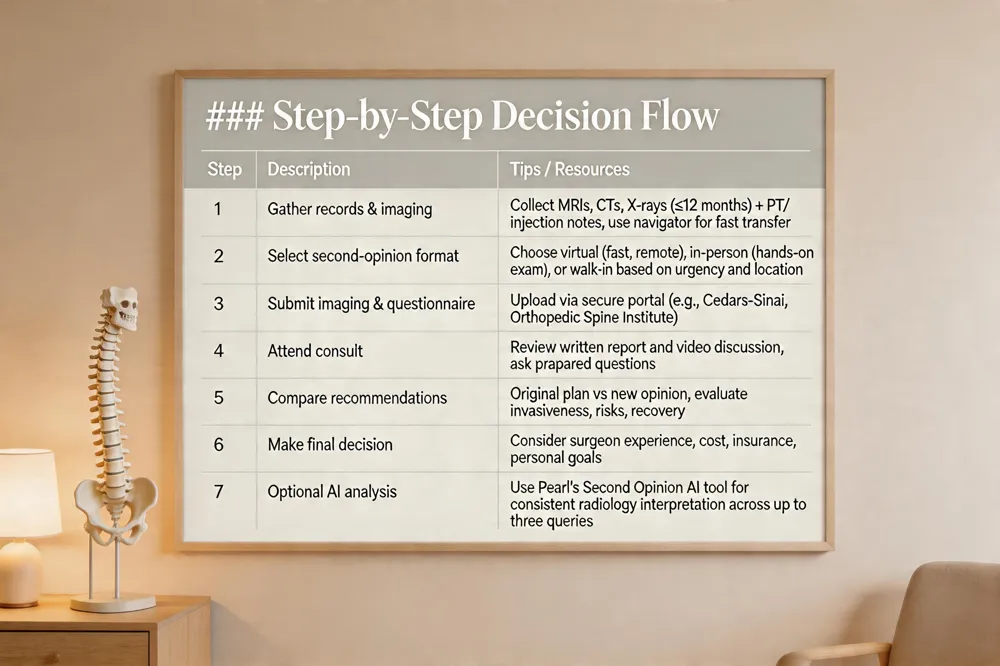
Step‑by‑Step Decision Flow
| Step | Description | Tips / Resources |
|---|---|---|
| 1 | Gather records & imaging | Collect MRIs, CTs, X‑rays (≤12 months) + PT/injection notes; use navigator for fast transfer |
| 2 | Select second‑opinion format | Choose virtual (fast, remote), in‑person (hands‑on exam), or walk‑in based on urgency and location |
| 3 | Submit imaging & questionnaire | Upload via secure portal (e.g., Cedars‑Sinai, Orthopedic Spine Institute) |
| 4 | Attend consult | Review written report and video discussion; ask prepared questions |
| 5 | Compare recommendations | Original plan vs new opinion; evaluate invasiveness, risks, recovery |
| 6 | Make final decision | Consider surgeon experience, cost, insurance, personal goals |
| 7 | Optional AI analysis | Use Pearl’s Second Opinion AI tool for consistent radiology interpretation across up to three queries |
 Gathering records and imaging
Gather recent MRIs, CTs, X‑rays (within 12 months) and notes on physical therapy, injections or other nonsurgical care. A navigator can expedite record transfer.
Gathering records and imaging
Gather recent MRIs, CTs, X‑rays (within 12 months) and notes on physical therapy, injections or other nonsurgical care. A navigator can expedite record transfer.
Choosing the right second‑opinion format Select in‑person, virtual video, or walk‑in based on distance and urgency. Virtual visits (e.g., Cedars‑Sinai) are fast; in‑person exams allow hands‑on assessment.
Making an informed final decision After review, compare the original plan with the new recommendation, discuss minimally invasive options, surgeon experience, and recovery timeline before committing.
Second opinion Pearl Pearl’s Second Opinion is an AI‑powered radiology tool that automatically analyzes dental X‑rays, highlighting disease with color‑coded overlays. It delivers 94 % accurate results, flags poor‑quality images, and visualizes disease extent to aid patient communication, ultimately reducing uncertainty and supporting patient‑focused care.
Patients may request this AI analysis for each of the three identical queries, ensuring consistent interpretation across reviews.
Take the Next Step with Confidence
Obtaining a second opinion before spine surgery gives you a clearer picture of your condition, confirms the accuracy of the diagnosis, and uncovers any non‑surgical alternatives such as physical therapy, injections, or activity modification. It can identify less invasive options—like minimally invasive decompression or artificial disc replacement—that may reduce recovery time, lower complication risk, and preserve motion. When two qualified spine specialists agree, your confidence in the treatment plan grows, and you avoid unnecessary fusion procedures that carry higher costs and longer rehab. For patients in St. Louis, the Orthopedic Spine Institute offers a patient‑first, evidence‑based approach: we review your imaging, discuss all conservative and surgical choices, and tailor a plan that matches your goals. Call us today to schedule your second‑opinion consultation and move forward with peace of mind. Our expert team will guide you through every step of recovery process.