Introduction
Epidural steroid injections (ESIs) deliver a corticosteroid, often mixed with a local anesthetic, directly into the epidural space surrounding the spinal nerves. By suppressing inflammatory mediators such as prostaglandins and leukotrienes, they reduce swelling and nerve‑root irritation, providing rapid pain relief. ESIs are most commonly employed for radicular pain from disc herniation, spinal stenosis, or postoperative scar tissue, allowing patients to regain mobility, engage in physical therapy, and potentially postpone surgery, while minimizing the need for high‑dose oral pain medication.
How Epidural Steroid Injections Work
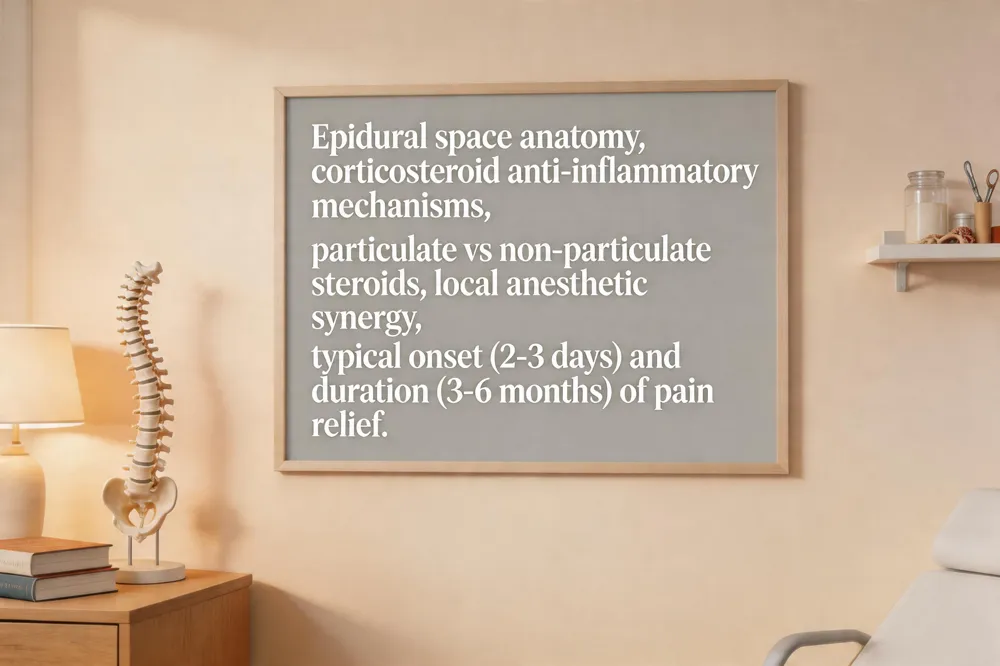 Anatomy of the epidural space The epidural space is a 3‑6 mm thick, fat‑filled sleeve that lies just outside the dura mater. It contains the spinal nerve roots, dorsal root ganglia, blood vessels, connective tissue, and the dural sac. This location allows medication to act directly on inflamed nerves without entering the spinal canal.
Anti‑inflammatory mechanisms of corticosteroids Corticosteroids inhibit phospholipase A₂, suppressing the synthesis of prostaglandins, leukotrienes, and cytokines. By reducing these mediators, steroids shrink nerve‑root edema, stabilize neuronal membranes, and diminish ectopic discharges, thereby dampening pain signals from irritated nerves.
Particulate vs non‑particulate steroids Particulate steroids (e.g., triamcinolone) (e.g., triamcinolone, methylprednisolone) have larger particles that can aggregate at the site of inflammation, creating a depot effect and often yielding longer‑duration relief. Non‑particulate steroids such as dexamethasone are water‑soluble, have smaller particles, and tend to disperse more quickly, providing shorter‑term pain control but a lower risk of embolic spinal‑cord injury.
Local anesthetic synergy Mixing a local anesthetic (lidocaine or bupivacaine) with the steroid gives immediate numbness by blocking sodium channels, confirming correct needle placement, and providing early pain relief while the steroid’s anti‑inflammatory effect builds over the next few days.
Epidural steroid injection how long does it take to work? Most patients notice pain relief within the first 2‑3 days, with maximal benefit typically occurring between one and two weeks post‑injection.
Epidural steroid injection how long does it last? Relief generally persists for three to six months; occasional reports describe benefit lasting up to a year.
The truth about epidural steroid injections ESIs safely reduce nerve inflammation and can provide short‑to‑medium‑term pain relief in 50‑84 % of appropriately selected patients, but they are temporary and must be part of a broader, plan.
Do epidural steroid injections really work? Yes—especially for radicular pain from disc herniation or stenosis—though long‑term outcomes are modest and not all patients respond.
Is epidural steroid injection worth it? It offers brief relief that may be insufficient for major functional gains in many individuals.
Epidural steroid injection name The generic term is “epidural steroid injection (ESI)”, with common approaches: caudal, transforaminal, and interlaminar.
Technique, Guidance, and Types of Injections
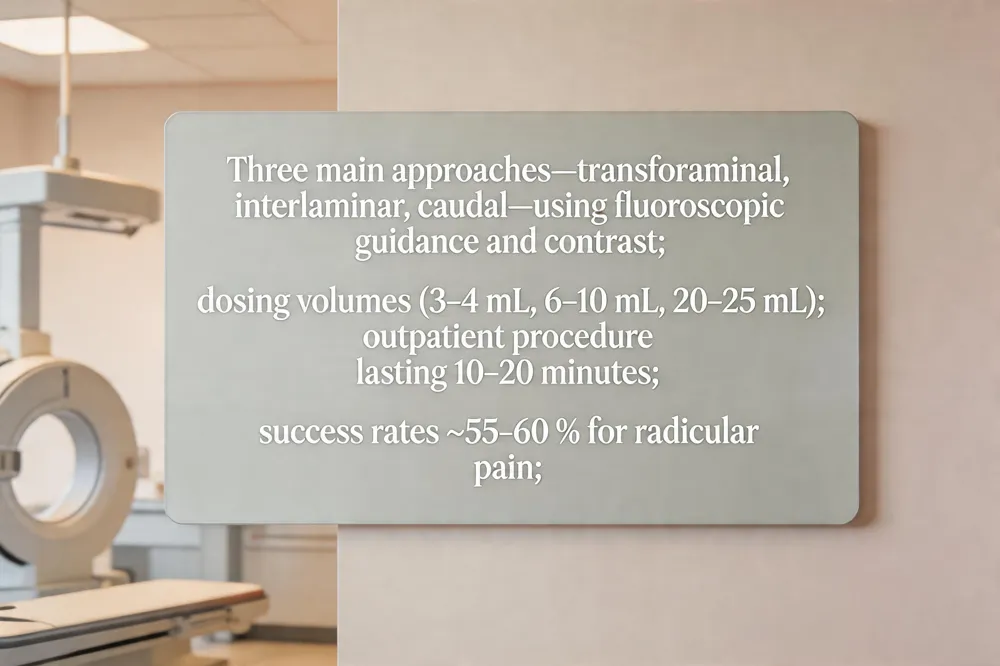 Epidural steroid injections (ESIs) are performed in three main ways—transforaminal, interlaminar, and caudal—each accessing the epidural space from a different anatomic route. The transforaminal approach places the needle within the intervertebral foramen, delivering medication closest to the affected nerve root and is considered most effective for sciatica caused by a disc herniation at L4‑L5. Interlaminar injections insert the needle between adjacent laminae, allowing a broader spread of steroid and anesthetic across the posterior epidural space, while caudal injections enter through the sacral hiatus, offering a technically easier and safer route for patients with altered lumbar anatomy.
Fluoroscopic guidance is standard for all approaches. A contrast dye is first injected to confirm accurate needle placement and to avoid intravascular injection, thereby minimizing the risk of vascular injury or embolic spinal cord infarction—particularly important when particulate steroids (e.g., triamcinolone, methylprednisolone) are used. Non‑particulate steroids such as dexamethasone are water‑soluble, smaller, and preferred for transforaminal injections to reduce embolic risk.
Typical dosing volumes vary: lumbar interlaminar injections use 6‑10 mL, transforaminal 3‑4 mL, and caudal up to 20‑25 mL of a steroid‑anesthetic mixture. The procedure is outpatient, lasts 10‑20 minutes, and patients can resume normal activities after a brief observation period.
L4‑L5 lumbar epidural steroid injection delivers corticosteroid directly to the inflamed nerve roots at the L4‑L5 level, providing rapid anti‑inflammatory relief for radicular pain. Success rates hover around 55‑60 % for meaningful pain reduction at three months, with peak relief occurring within the first week and lasting weeks to months. While the injection is generally safe, patients should be counseled about transient hyperglycemia in diabetics, mild blood‑pressure changes, and rare nerve irritation. Full videos of the procedure illustrate needle placement, fluoroscopic imaging, and contrast confirmation, helping patients understand what to expect before considering surgery.
Patient Experience, Pain Perception, and Recovery
 Epidural steroid injections are performed while you are awake and under a skin‑level anesthetic. The needle insertion is usually felt only as a brief pinch or mild burning because the skin is numbed; once the needle reaches the epidural space you may notice a pressure or heaviness in the lower back, but it is not sharply painful. The local anesthetic (lidocaine or bupivacaine) provides immediate pain relief, blocking sodium channels so you feel little discomfort during the short procedure.
After the injection, most patients experience mild soreness or tenderness at the injection site for one to two days, and occasionally a small bruise. This resolves quickly with rest, ice and light activity. Some people report a brief increase in pain or tingling as the anesthetic wears off before the steroid’s anti‑inflammatory effect begins (typically 2–7 days).
If anxiety about discomfort is a concern, IV sedation can be offered; it is safe when monitored by the procedural team, who observe vital signs and neurologic status throughout.
Frequently asked questions
- How painful is a lumbar epidural steroid injection? Most patients describe the experience as mild and short‑lived, feeling only a brief pinch and pressure after the skin is numbed.
- Leg weakness after epidural steroid injection? Sudden or worsening weakness, especially with numbness or bladder changes, warrants emergency evaluation for rare complications such as hematoma; transient tingling that resolves in hours is usually benign.
- L5 epidural steroid injection side effects? Expect mild soreness, temporary numbness, or a brief pain flare; serious complications like infection are rare.
- Epidural steroid injection side effects? Common mild effects include facial flushing, insomnia, and a short‑term pain increase; serious events are uncommon but should be reported promptly.
- Epidural steroid injection dose? Typical doses are 4–10 mg dexamethasone or 40–80 mg methylprednisolone, with lower doses often providing sufficient relief while minimizing systemic exposure.
Safety, Risks, Frequency, and Cost Considerations
 Epidural steroid injections (ESIs) are a minimally invasive option for radicular pain, but they carry a spectrum of risks. Potential complications and rare events include nerve injury, spinal cord infarction, dural puncture with headache, epidural hematoma, infection, allergic reaction, and, with particulate steroids, embolic spinal cord injury. Systemic effects such as transient hyperglycemia, fluid retention, and adrenal suppression may also occur. Contraindications and screening require exclusion of active infection, uncontrolled diabetes, coagulopathy, severe osteoporosis, known allergy to contrast, anesthetic, or steroid, and pregnancy (due to fluoroscopic radiation). A thorough medication review—especially anticoagulants—is essential before the procedure. Maximum 3‑4 injections per year is limited to three to four per 12 months to prevent tissue weakening, bone loss, and systemic steroid toxicity; repeated dosing offers diminishing returns and raises complication risk. Pricing, insurance, and out‑of‑pocket costs vary widely: national averages range from $600–$1,300, with outpatient hospitals averaging $1,100 and surgery centers $630. Insurance typically covers a portion, but high‑deductible or uninsured patients may face $700–$1,000 out‑of‑pocket expenses. At the Orthopedic Spine Institute of St. Louis we coordinate with insurers and provide transparent estimates before treatment. In summary, while ESIs can deliver short‑term pain relief, patients should weigh the modest benefit against rare but serious complications, adhere to recommended injection limits, and verify financial coverage beforehand.
Conclusion
Epidural steroid injections deliver corticosteroids into the epidural space, inhibiting phospholipase A₂, reducing prostaglandin and leukotriene production, and stabilizing inflamed nerves for pain relief. Fluoroscopic guidance with non‑particulate steroids for transforaminal access makes the procedure safe, avoiding embolic risk and respecting contraindications such as infection or anticoagulation. ESIs are indicated for radicular pain from disc herniation, spinal stenosis, or postoperative scar tissue after care. At Orthopedic Spine Institute, schedule consultation, bring imaging, and receive an injection from team followed by plan.