Understanding Minimally Invasive Options
Laser therapy and radiofrequency ablation (RFA) are two cornerstone minimally invasive treatments offered at our practice.
Laser therapy delivers focused light energy—often low‑level photobiomodulation—to the affected tissue. The photons stimulate cellular metabolism, reduce inflammation, and promote healing without the heat‑induced tissue damage of traditional lasers. It is painless, usually performed without anesthesia, and patients can resume normal activities immediately after a short session.
Radiofrequency ablation uses a thin needle probe to apply controlled radiofrequency currents, heating nerve tissue to 60‑80 °C. This creates a precise lesion that interrupts pain signals from facet joints, sacroiliac joints, or other spinal nerves, providing relief that typically lasts 6‑12 months. The procedure is performed under imaging guidance with local anesthesia, and most patients return to daily activities within one to two days.
Our patient‑first care model begins with a thorough evaluation, including imaging and conservative therapy, before recommending either laser or RFA. Treatment choices are individualized based on the pain source, vein size, and patient preferences, ensuring optimal outcomes while minimizing downtime.
Laser Therapy for Back Pain – Evidence, Cost, and Drawbacks
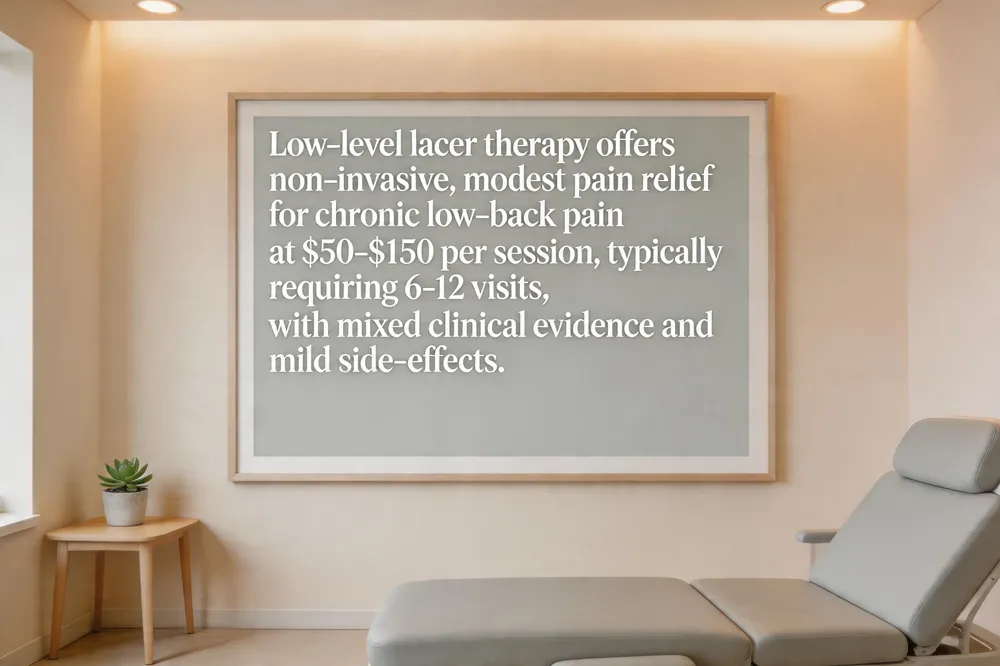 The Mayo Clinic describes low‑level laser therapy (LLLT) as a non‑invasive, painless option that uses specific wavelengths to reduce inflammation and promote cellular repair in chronic low‑back pain. Early trials show modest pain‑reduction, but LLLT remains an adjunctive, experimental approach after physical therapy and NSAIDs. A typical U.S. session costs $50‑$150; most patients need 6‑12 visits, bringing total out‑of‑pocket expenses to $300‑$1,800, with variable insurance coverage. Clinical evidence is mixed: some studies report 30‑50 % pain relief and functional gains, while others find no benefit over sham. Common drawbacks include the need for multiple appointments and unpredictable efficacy; side‑effects are usually mild—tingling, warmth, transient skin redness—rarely burns or nerve irritation. Patients in St. Louis often choose the Orthopedic Spine Institute, which offers Class IV laser treatments; reviews note modest improvement but stress that results vary and insurance may be limited.
Radiofrequency Ablation vs Laser Ablation – Technical Differences and Clinical Choice
 Radiofrequency ablation (RFA) and laser ablation both close targeted tissue with heat, but they differ in energy source. RFA delivers alternating radio‑frequency currents through a needle or catheter, automatically raising tissue temperature to 70‑90 °C, whereas laser ablation uses a fiber‑optic catheter to focus light energy that is converted to heat at the treatment site. This makes RFA slightly faster and easier to regulate, while laser offers higher precision by concentrating the beam on a very small area. Clinical studies in chronic venous insufficiency show comparable occlusion rates (≈95 % for laser, 90 % for RFA) with less post‑procedure bruising and quicker activity return after RFA. In spinal pain, RFA provides durable 6‑12‑month relief for facet‑mediated pain, whereas low‑level laser therapy offers short‑term inflammation reduction. Ablation, in general, refers to minimally invasive destruction of tissue by heat, cold, or other energy to interrupt abnormal signals or remove disease. Choosing between the modalities depends on anatomy, physician expertise, and patient preferences regarding recovery, bruising, and long‑term pain control.
Minimally Invasive Spine Surgery – Overview, Types, and Recovery
 Minimally invasive spine surgery (MISS) uses tiny incisions, tubular retractors, and image guidance to treat back, neck, and sciatica pain while preserving muscle, reducing blood loss, and shortening hospital stays.
Minimally invasive spine surgery pdf – Download a free, comprehensive overview here: https://www.atlantaspinedoc.com/pdf/minimally-invasive-spine-surgery.pdf. The guide explains the benefits of smaller incisions and lists common procedures such as lumbar decompression, tubular discectomy, and TLIF.
Types of minimally invasive spine surgery – Common techniques include discectomy, laminectomy, foraminotomy, percutaneous pedicle‑screw fusion, vertebroplasty/kyphoplasty, and endoscopic tumor removal. Each is chosen based on the patient’s specific pathology.
Minimally invasive spine surgery recovery time – Most patients return to light activities within days; full recovery ranges from 6‑10 weeks for microdiscectomy to 3‑6 months for fusion. Physical therapy accelerates healing.
Minimally invasive spine surgery cost – U.S. pricing averages $15‑35k for microdiscectomy, $50‑90k for laminectomy, and $80‑150k for fusion, with insurance often covering a large portion. Our team provides transparent estimates and financing options.
Targeted Pain Relief Strategies for Women and Acute Episodes
 Women with back pain benefit from a core‑strengthening routine (bridges, cat‑cow, knee‑to‑chest) and ergonomic habits—upright sitting, frequent micro‑breaks, and proper sleep pillows—to reduce strain. Upper‑back discomfort is first managed conservatively with NSAIDs, heat/ice, and posture‑corrective stretches; if pain persists, minimally invasive options such as radiofrequency ablation (RFA) can provide 6‑12 months of relief for facet‑joint irritation, while low‑level laser therapy (LLLT) offers short‑term, non‑thermal pain reduction. For instant relief, change posture, apply a 15‑minute cold pack followed by gentle stretching, and consider an over‑the‑counter NSAID if appropriate. Severe pain warrants alternating cold and warm compresses, brief rest, and early activation of low‑impact activities (walking, swimming) plus the core‑strength program; persistent severe symptoms should trigger a prompt evaluation for RFA or laser‑based interventions. Home‑based fast relief combines 15 minutes of targeted stretches, ice for the first 48‑72 hours, then heat, NSAIDs, and posture awareness to restore function quickly.
Medication Management and Strong Painkillers for Lower Back Pain
 When opioids are considered for lower back pain, they are reserved for severe, refractory cases that have not responded to over‑the‑counter analgesics, NSAIDs, or physical therapy. Strong painkillers for lower back pain are typically opioid medications, which are reserved for severe pain that does not respond to over‑the‑counter options or NSAIDs. Common prescription opioids include oxycodone (OxyContin, Percocet), hydrocodone (Vicodin), morphine, fentanyl patches, and hydromorphone, and they work by binding to brain receptors to block pain signals. Because they are habit‑forming and can cause serious side effects such as respiratory depression, constipation, and dependence, they should be used only under close supervision of a physician and generally for no more than one to two weeks. Risks and side‑effects include nausea, drowsiness, constipation, hormonal changes, and the potential for misuse or addiction. Guidelines for safe use emphasize the lowest effective dose, short‑duration therapy, a clear tapering plan, and strict patient education. Your provider may combine a low‑dose opioid with a muscle relaxant or an antidepressant to improve pain control while minimizing the opioid dose. Always discuss potential risks, drug interactions, and a clear tapering plan with your spine specialist before starting any strong painkiller.
Surgical Options for Disc Problems and Patient Eligibility
 For an isolated L4‑L5 disc bulge that compresses a nerve root and causes leg pain, microdiscectomy remains the preferred first‑line surgery because it removes the offending fragment while preserving most disc motion. If the disc is severely degenerated, the segment unstable, or facet arthritis is present, a lumbar fusion (instrumented posterolateral or TLIF) may be recommended to restore stability; artificial‑disc replacement is an option for select patients with healthy facet joints. At the L5‑S1 level, minimally invasive spine surgery (MISS) uses tubular retractors and real‑time imaging to remove herniated material, place an interbody cage, and/or add posterior instrumentation, yielding less pain, reduced blood loss, and faster return to activity than open surgery. Ideal candidates for MISS are patients who have failed conservative care, have imaging‑confirmed pathology amenable to a small surgical corridor, are in good overall health, and are motivated to engage in postoperative rehabilitation. Dr. David S. Raskas evaluates each case to match the most effective, patient‑first procedure to the individual’s anatomy and goals.
Practical Resources and Local Options for Spine Care in St. Louis
Minimally invasive spine surgery near me
If you’re looking for minimally invasive spine surgery in St. Louis, the Orthopedic Spine Institute of St. Louis offers patient‑first care with Dr. David S. Raskas. Small‑incision techniques treat lumbar stenosis, herniated discs, and more, often outpatient. Schedule a consultation online or by phone and explore insurance options.
Female lower back pain treatment
Initial management focuses on low‑impact activity, core‑strengthening, and posture. Ice/heat, weight control, and NSAIDs help reduce inflammation. If pain persists, physical therapy, injections, or minimally invasive procedures are considered. Dr. Raskas tailors treatment to each woman’s needs.
Laser therapy for back pain near me
Class IV laser therapy, a non‑invasive, drug‑free option, is available at the Orthopedic Spine Institute. Sessions last 5‑15 minutes with no downtime. Search “laser therapy for back pain St. Louis” or call the institute; ask about insurance coverage and payment plans.
Making the Right Choice – A Patient‑First Decision Framework
Laser therapy and radiofrequency ablation (RFA) are both minimally invasive, outpatient options for chronic back pain, but they differ in energy source, technique, and ideal indications. Laser therapy—often low‑level photobiomodulation—delivers light photons that stimulate cellular repair and reduce inflammation without generating heat; it is best for diffuse musculoskeletal or soft‑tissue pain and usually requires multiple, non‑invasive sessions. RFA uses a needle‑based probe that heats targeted nerves to 60‑80 °C, creating a controlled lesion that interrupts pain signals; it is most effective for facet‑joint or sacroiliac joint pain confirmed by diagnostic blocks and typically provides 6‑12 months of relief after a single session. Because outcomes depend on the underlying pathology, vein any comorbidities, and patient preferences, an individualized assessment is essential. At the Orthopedic Spine Institute of St. Louis, we begin with a thorough history, imaging, and trial of conservative care, then discuss the evidence‑based pros and cons of each modality. Our patient‑first philosophy ensures that the chosen treatment aligns with your specific diagnosis, lifestyle goals, and insurance considerations, fostering confidence and optimal long‑term results.