Why a 30‑Minute Laser Session Matters
Low‑level laser therapy (LLLT) is a non‑invasive, cold‑laser treatment that delivers photobiomodulation to spinal tissues. By emitting specific wavelengths (often 635 nm, 650 nm, 850 nm or 830 nm), the light penetrates skin and is absorbed by mitochondrial chromophores, boosting ATP production, reducing inflammatory mediators, increasing microcirculation and stimulating collagen synthesis. This cellular “reset” helps damaged disc, facet‑joint and paraspinal cells repair faster, easing pain and improving range of motion. The Orthopedic Spine Institute of St. Louis embraces a patient‑first, conservative philosophy: laser therapy is offered early in the care pathway, combined with physical therapy, ergonomic education and lifestyle counseling. A typical 30‑minute session targets the affected segments, is painless, requires no anesthesia, and allows patients to resume normal activities immediately. This brief, drug‑free intervention aligns with the Institute’s goal of maximizing non‑pharmacologic relief before considering more invasive options.
Understanding Low‑Level Laser Therapy (LLLT)
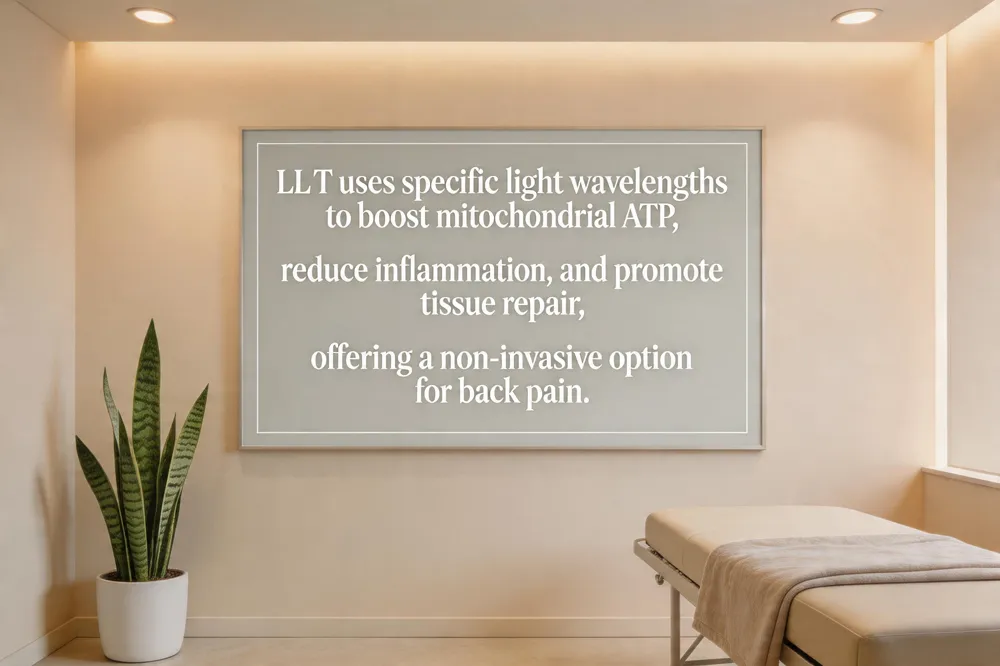 Low‑level laser therapy (LLLT), also called cold‑laser or photobiomodulation, works by delivering specific light wavelengths that are absorbed by mitochondrial chromophores in damaged cells. This absorption boosts ATP production, regulates inflammatory mediators, and stimulates DNA activity, leading to faster tissue repair and reduced pain. The most common wavelengths used for spinal applications are 635 nm (red), 650 nm (helium‑neon), and 850 nm (gallium‑aluminum‑arsenide), each penetrating to different depths and providing complementary effects—short‑wave red light promotes surface‑level collagen synthesis, while the near‑infrared 850 nm reaches deeper disc and facet‑joint tissue.
Is laser therapy good for your back?
LLLT can lessen pain and improve function for many patients with chronic low‑back or neck discomfort. Clinical trials report modest short‑term pain reduction—up to 70 % of participants experience meaningful relief—and functional gains when therapy is combined with physical therapy, posture correction, and lifestyle changes. Because it is non‑invasive, painless, and generally safe, laser therapy is offered as a complementary option within a broader conservative‑care plan rather than a stand‑alone cure. A spine specialist can determine if it is appropriate for a specific condition.
What does laser therapy do for your spine?
The photons penetrate spinal tissues, boost mitochondrial activity, increase ATP, and modulate inflammatory pathways. The result is reduced swelling, decreased pain‑signaling, and accelerated repair of muscles, ligaments, and intervertebral discs. Patients often notice improved mobility, less muscle spasm, and enhanced overall function after a few 20‑30‑minute sessions.
Side effects of laser therapy for back pain
LLLT is well‑tolerated. Most patients experience only mild, short‑lived reactions such as temporary skin redness, mild swelling, or a warm/tingling sensation. Rare adverse events include superficial skin irritation, blistering, or isolated nerve irritation, typically avoided with proper eye protection and dosage guidelines. Overall, side effects are uncommon, mild, and resolve quickly.
Safety profile and contraindications
The therapy is safe for most adults when used correctly. Contraindications include pregnancy, active malignancy, photosensitivity disorders, and certain skin conditions. Patients should discuss any health concerns with their physician before starting treatment.
Clinical Evidence and Benefits
 A growing body of research supports low‑level laser therapy (LLLT) as a non‑invasive option for chronic nonspecific low back pain. Key randomized trials, such as the 2020 double‑blind sham‑controlled study of 58 participants, demonstrated that 72.4% of patients receiving active LLLT achieved a clinically significant (≥30%) reduction in VAS pain scores, versus 27.6% in the sham group. 2022 systematic review and meta‑analysis that pooled dozens of RCTs confirmed modest short‑term pain relief and improvements in functional outcomes, including reduced Oswestry Disability Index scores and enhanced lateral flexion when two wavelengths (850 nm gallium‑aluminum‑arsenide and 650 nm helium‑neon) were combined in a 2017 trial. These combined‑wavelength protocols appear to maximize mitochondrial activation, collagen synthesis, and microcirculation, leading to better disability scores than single‑wavelength treatments.
Patient reviews often note modest pain relief and improved mobility after several laser sessions, especially when paired with exercise and lifestyle changes. The therapy is painless, carries minimal risk of adverse effects, and can be performed on an outpatient basis, making it an attractive adjunct to conventional physical therapy. However, there are notable drawbacks: multiple sessions (typically eight 20‑minute treatments) are usually required before meaningful relief appears, increasing time commitment and cost; response variability is high, with some patients experiencing only modest or no benefit. Insurance coverage is inconsistent, often leading to out‑of‑pocket expenses.
Cold‑laser therapy is not a hoax—it is an FDA‑cleared modality that stimulates cellular metabolism and reduces inflammation. While physiological effects such as increased ATP production are well documented, clinical efficacy varies, and outcomes depend on laser parameters, condition severity, and treatment adherence. Therefore, LLLT should be viewed as a complementary component of a comprehensive, evidence‑based back‑pain management plan, guided by a spine specialist such as Dr. David S. Raskas.
Potential Drawbacks and Limitations
 While laser therapy is attractive because it is non‑invasive and painless, several practical limitations should be considered before committing to treatment.
Need for multiple sessions – Most clinical protocols require a series of applications to achieve meaningful benefit. Studies of low‑level laser therapy (LLLT) for chronic low back pain report eight 20‑minute sessions over four weeks, and larger systematic reviews note that 6‑12 sessions are typical for chronic conditions. Patients who stop treatment early often see only transient relief, and the cost of a full course can add up quickly.
Insurance and cost considerations – In the United States a single laser session generally costs $75‑$250, depending on the clinic, geographic location, and technology (e.g., Class III cold laser versus Class IV high‑intensity laser). Some insurers reimburse a portion of the expense when the therapy is deemed medically necessary, but coverage is inconsistent; many plans label it “experimental.” The Orthopedic Spine Institute of St. Louis, for example, encourages patients to verify benefits and discuss any worker‑compensation, VA, or cash‑price options during the initial evaluation.
Variable efficacy across patients – Evidence quality ranges from low to moderate, and response rates differ widely. A 2020 sham‑controlled trial showed 72.4 % of participants experienced significant pain reduction, yet 27.6 % in the sham group reported no benefit. Systematic reviews confirm modest short‑term improvements but note that many patients—especially those with severe degenerative disease or large disc herniations—may not achieve lasting relief.
Frequently asked questions
What are the negatives to laser disc repair?
Laser disc repair (e.g., percutaneous laser disc decompression) is minimally invasive but can cause rare complications such as nerve injury, dysesthesia, postoperative painful syndrome, dural tears, bladder dysfunction, epidural or psoas hematoma, and segmental instability that may require additional surgery. Fibrosis occurs in ≈1‑2 % of cases, and the procedure does not stop the underlying degenerative process, so further intervention may be needed.
How much does laser therapy for back pain cost?
In the United States, laser therapy sessions typically range from $75 to $250 per visit, depending on the provider, geographic region, and equipment used. Many insurers cover part of the cost for medically necessary treatment, but coverage varies widely; patients should verify benefits with their plan. Clinics often offer discounted package rates for a series of sessions (e.g., eight 20‑minute sessions). For patients without coverage, cash‑price options and financing plans may be available.
Practical Guidance: Finding, Using, and Paying for Laser Therapy
 When you’re ready to explore laser therapy for back pain, start by locating a qualified provider who offers low‑level (cold) laser treatment. In the St. Louis area, the Orthopedic Spine Institute of St. Louis provides FDA‑cleared LLLT as part of its patient‑first, conservative care pathway. The clinic’s clinicians use photobiomodulation to reduce inflammation, stimulate mitochondrial ATP production, and promote tissue repair without incisions or anesthesia.
A typical therapeutic session lasts about 30 minutes, during which a cold laser (often 635 nm or a combination of 850 nm/650 nm wavelengths) is applied to the lumbar region. Protocols frequently involve eight 20‑minute sessions spaced two to three days apart, delivering a cumulative dose that has shown clinically significant pain reduction in up to 72 % of participants in sham‑controlled trials.
Insurance coverage for LLLT varies widely. Many U.S. plans list the treatment as a reimbursable physical‑therapy modality when documented as medically necessary, but several carriers still consider it experimental. Before scheduling, call the clinic’s billing office to verify benefits, request any required pre‑authorization, and discuss cash‑price or worker‑compensation options if coverage is limited.
Laser treatment for back pain near me – If you’re looking for laser treatment for back pain in the St. Louis area, the Orthopedic Spine Institute of St. Louis offers low‑level laser therapy as part of its patient‑first, conservative back‑pain program. Appointments can be booked online or by phone, and the staff will confirm whether laser therapy is appropriate for your specific condition.
How to relieve back pain fast at home – Begin with a 15‑20‑minute ice pack for the first 48‑72 hours, then switch to a heating pad for another 15‑20 minutes. Follow with gentle lumbar stretches (knee‑to‑chest, rotational, cat‑cow) 2‑3 times daily, use over‑the‑counter NSAIDs as needed, and stay lightly active with short walks. If pain persists beyond a few days, seek a professional evaluation.
How to relieve severe back pain – Start with a short, doctor‑prescribed course of anti‑inflammatory medication or muscle relaxants. Begin a supervised physical‑therapy program focusing on core stabilization and mobility drills, apply heat/ice 15‑20 minutes several times daily, and maintain good posture. If pain continues or radiates, schedule an evaluation with a spine specialist for possible minimally invasive options such as laser‑assisted decompression.
Complementary Natural Remedies and Lifestyle Strategies
 Back‑pain relief isn’t limited to lasers or drugs; a well‑rounded, non‑pharmacologic plan can amplify results and keep patients out of the operating room.
Anti‑inflammatory foods and drinks – Systemic inflammation fuels disc degeneration and facet‑joint irritation. Incorporating turmeric‑golden milk, ginger‑green tea, tart‑cherry juice, omega‑3‑rich salmon, leafy greens, and berries can blunt inflammatory pathways. Patients are advised to limit refined sugars and processed foods, which have been shown to increase C‑reactive protein levels.
Core‑strengthening and flexibility exercises – A stable core reduces mechanical load on the lumbar spine. Simple, low‑impact movements such as the pelvic‑tilt, bridge pose, and partial abdominal curl build deep abdominal muscles, while yoga‑style spinal twists, cat‑cow stretches, and gentle Pilates rolls improve inter‑segmental mobility. Aim for 2‑3 sessions per week, holding each pose for 5‑10 seconds and repeating 8‑12 times.
Mind‑body and posture techniques – Mindfulness meditation, deep‑breathing, and tai‑chi promote central pain modulation, lowering perceived intensity. Ergonomic cues—adjusting computer monitor height, using a lumbar roll while seated, and practicing the “chin‑to‑chest” stretch—help maintain a neutral spinal alignment throughout the day.
Natural remedies for back pain and inflammation – Acute flare‑ups benefit from brief ice application (15‑20 minutes) followed by heat to relax tight muscles. Topical anti‑inflammatory creams can be used sparingly. Combine these with the dietary and exercise strategies above for synergistic relief.
How to self‑realign your spine? – Eight easy at‑home exercises—Knee‑to‑Chest Stretch, Spinal Twist, Pelvic Tilt, Bridge Pose, Partial Abdominal Curl, Cat‑Cow Stretch, Shoulder Blade Squeeze, and Chin‑to‑Chest Stretch—target flexibility, core stability, and posture. Perform each slowly, hold 5‑10 seconds, and repeat 2‑3 times per session. Consistent practice supports a neutral spine, reduces pain, and complements any laser‑therapy regimen.
Patients should discuss any new supplement, diet, or exercise program with their physician to ensure safety and integration with existing treatments.
Special Considerations for Women and Complex Disc Issues
 Women experience lower‑back pain that often has distinct contributors such as hormonal fluctuations, pregnancy‑related biomechanical strain, and age‑related bone density loss. These factors can amplify disc degeneration at the L4‑L5 level and may require a treatment plan that first targets inflammation, core stability, and posture while respecting the patient’s hormonal and skeletal status. At the Orthopedic Spine Institute of St. Louis, the initial approach combines supervised physical‑therapy programs, low‑impact aerobic conditioning, and tailored stretching to improve lumbar support without overloading the disc. Over‑the‑counter analgesics and alternating ice‑heat packs are used for short‑term symptom control.
When conservative measures fall short, high‑intensity Class IV laser therapy becomes a valuable adjunct. Class IV devices deliver up to 45 watts of red and near‑infrared light, penetrating up to 5 cm of tissue to reach the nucleus pulposus and annulus fibrosis of the L4‑L5 disc. The photobiomodulation boosts mitochondrial ATP production, enhances microcirculation, reduces inflammatory cytokines, and promotes collagen synthesis, leading to decreased pain and improved disc nutrition. Clinical data show that a 30‑minute Class IV session can produce measurable pain relief within days and may reduce the need for systemic medications.
For patients whose disc pathology persists despite laser therapy, the Institute integrates minimally invasive laser‑assisted procedures—such as percutaneous laser disc decompression or laser‑guided micro‑discectomy—into a patient‑first pathway. This combined strategy leverages the anti‑inflammatory and reparative effects of Class IV laser while offering precise, tissue‑sparing decompression when necessary, ultimately delivering faster functional recovery and preserving spinal stability.
Putting It All Together – Your Path to a Reset Spine
A 30‑minute low‑level laser session delivers photobiomodulation that boosts ATP production, reduces inflammation, and eases nerve irritation, often producing noticeable pain relief within days. When combined with a structured physical‑therapy program—targeted core strengthening, flexibility work, and posture education—the laser’s cellular benefits translate into faster functional gains and lasting spinal stability. Lifestyle tweaks such as regular low‑impact exercise, ergonomic adjustments, and balanced nutrition further support tissue healing. At the Orthopedic Spine Institute of St. Louis, patients should schedule their initial laser series, discuss a personalized rehab plan with a therapist, and follow up for progress reviews to keep the recovery momentum moving forward.