Why Prompt Action Matters After a Car Crash
When a collision occurs, the first priority is to protect the spine. Emergency responders immobilize the neck with a rigid collar and place the victim on a spine board to prevent secondary cord damage. After the scene is secured, you must file a police report and exchange insurance information; this documentation becomes the backbone of any claim or legal case. Even if you feel fine, schedule a medical evaluation within hours—soft‑tissue and internal injuries often manifest days later and can be missed without imaging. A multidisciplinary team—orthopedic surgeons, neurologists, pain specialists, chiropractors, and physical therapists—collaborates to diagnose, stabilize, and start a tailored rehabilitation plan, dramatically improving outcomes and speeding return to normal activities.
Immediate Care: First‑Aid and Safety Steps
| Step | Action |
|---|---|
| 1 | Call emergency services (911) immediately |
| 2 | Keep the victim completely still; no movement of head, neck, or back |
| 3 | Stabilize the cervical spine – place rolled towels, a heavy blanket, a cervical collar on both sides of the neck, or gently hold the head in place |
| 4 | Remove helmet only if airway access is absolutely necessary; if vomiting or choking, roll the victim with a helper while maintaining alignment |
| 5 | If no breathing or pulse, begin CPR using a jaw‑lift technique to protect the spine |
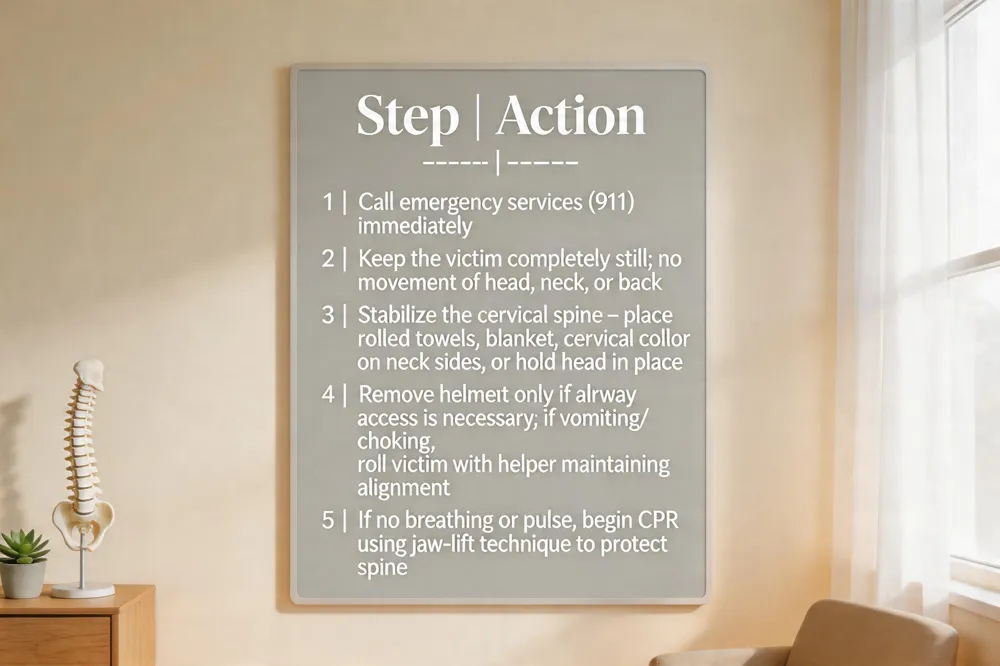 When a car crash raises suspicion of a spinal injury, act quickly and follow a five‑step protocol: (1) Call emergency services (911) without delay. (2) Keep the victim completely still; do not allow any movement of the head, neck, or back. (3) Stabilize the cervical spine by placing rolled towels, a heavy blanket, or a cervical collar on both sides of the neck, or gently hold the head in place. (4) Only remove a helmet if airway access is absolutely necessary; if the person is vomiting or choking, roll them only with the help of another responder while maintaining alignment. (5) If the victim shows no breathing or pulse, begin CPR using a jaw‑lift technique to protect the spine. These steps—calling for help, immobilizing the spine, using cervical collars or improvised supports, and avoiding movement until professionals arrive—are essential to prevent secondary injury and give the patient the best chance for a successful recovery.
Whiplash Mechanics and Early Spine Injury Phases
| Phase | Description | Typical Tissue Involvement |
|---|---|---|
| Retraction (rapid neck extension) | Head thrusts backward while torso stays forward | Posterior neck structures stretched |
| Extension (flexion) | Head snaps forward, over‑stretching anterior muscles, ligaments, discs | Anterior muscles, ligaments, intervertebral discs |
| Rebound | Head returns toward neutral, creating a second loading cycle | Aggravates already‑stretched tissues |
| Protraction (forward stretch) | Neck settles into normal alignment, completing motion | Final alignment, tissue relaxation |
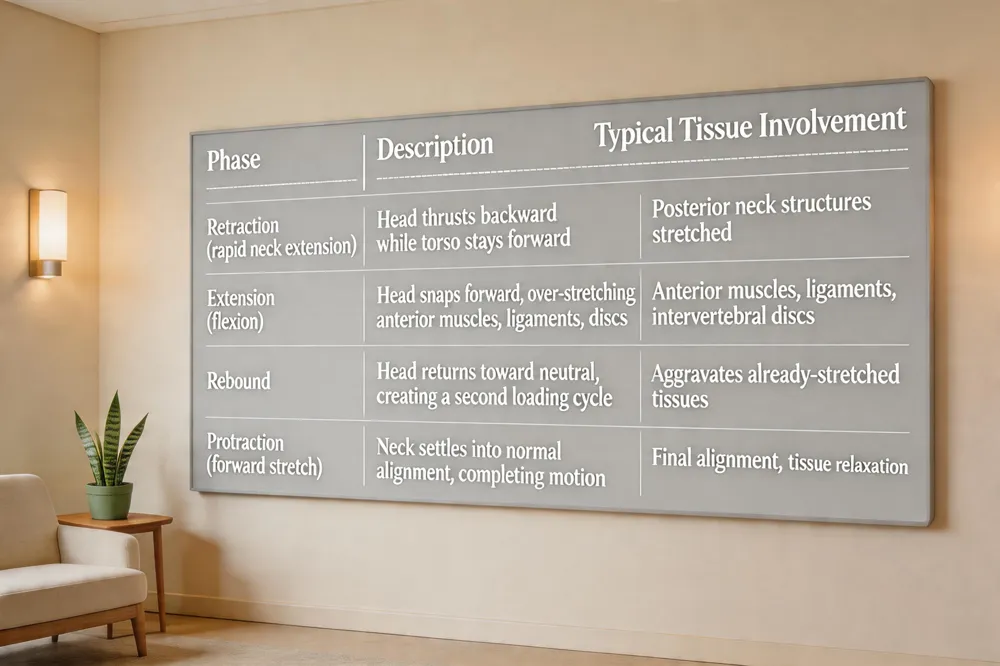 Whiplash is a complex motion injury that unfolds in four distinct kinematic phases during a rear‑impact crash. 1️⃣ Retraction (rapid neck extension) – the head is thrust backward while the torso remains forward, stretching the posterior neck structures. 2️⃣ Extension (flexion) – the head snaps forward, over‑stretching the anterior muscles, ligaments, and intervertebral discs. 3️⃣ Rebound – the head returns toward the neutral position, creating a second loading cycle that can aggravate already‑stretched tissues. 4️⃣ Protraction (forward stretch) – the neck gently settles into its normal alignment, completing the motion. These phases explain why soft‑tissue injuries such as muscle strains, ligament sprains, facet joint capsular tears, and disc bulges are common in rear‑impact collisions. Early assessment—ideally within the first 24–48 hours—allows clinicians to detect subtle neuromuscular damage before inflammatory processes become chronic, reduces the risk of persistent pain, and guides timely interventions like gentle mobilization, targeted strengthening, and pain‑modulating therapies. Prompt imaging and a thorough neurological exam are essential to rule out more serious spinal cord or vertebral injury, ensuring an individualized recovery plan that prevents long‑term disability.
Finding the Right Specialist in St. Louis
| Provider Type | Primary Focus | Typical Training | Example Practitioners |
|---|---|---|---|
| Spine Specialist | Disorders of vertebral column, spinal cord, nerves, discs | Fellowship in spine surgery (orthopedic or neurosurgical) | Dr. David S. Raskas (OSI), Dr. Ian G. Dorward, Dr. Michael J. Reiter |
| Orthopedic Doctor | Whole musculoskeletal system (bones, joints, muscles, ligaments, tendons) | Orthopedic residency; may have spine fellowship | Dr. Benjamin Crane (Orthopedic Spine Center), Orthopedic Associates of St. Louis |
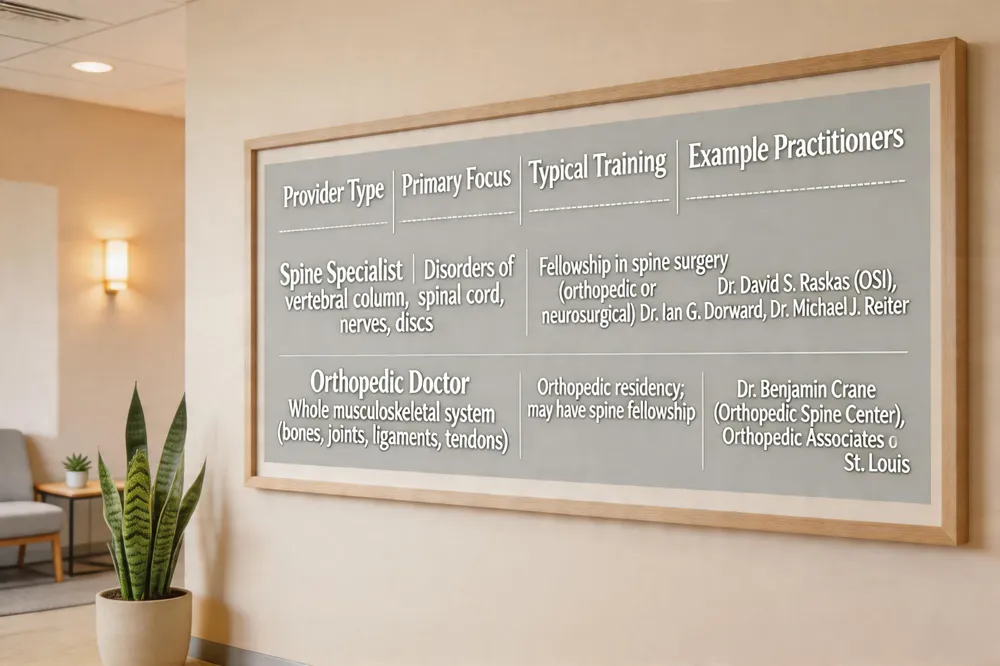 A spine specialist concentrates exclusively on disorders of the vertebral column, spinal cord, nerves and discs, often completing a fellowship that adds advanced training in minimally invasive surgery and non‑operative care. An orthopedic doctor treats the entire musculoskeletal system—bones, joints, muscles, ligaments and tendons—across the whole body, with the spine being only one part of a broader practice. In St. Louis, the Orthopedic Spine Institute (OSI) offers patient‑first care for back, neck and sciatica pain, beginning with evidence‑based conservative therapies such as physical therapy, injections and regenerative modalities. When surgery is needed, Dr. David S. Raskas and his multidisciplinary team perform endoscopic decompression, microdiscectomy and lumbar fusion using state‑of‑the‑art technology. Other top spine surgeons include Dr. Benjamin Crane (Orthopedic Spine Center), Dr. Ian G. Dorward (complex TLIF and deformity correction) and Dr. Michael J. Reiter (neurosurgical spine). Orthopedic Associates of St. Louis provides a multi‑specialty practice with same‑day injury clinics, telehealth and a full spectrum of orthopedic and spine services, emphasizing conservative treatment before minimally invasive surgery.
Diagnosis, Imaging, and Treatment Pathways
| Imaging Modality | Primary Use | Typical Timing |
|---|---|---|
| X‑ray | Detect obvious fractures | Immediate on scene or ER |
| CT | Detailed bone & disc anatomy | Within first hour after stabilization |
| MRI | Soft‑tissue, spinal‑cord assessment (gold standard) | Within 24‑48 hours if indicated |
| Treatment Decision | Conservative | Surgical |
|---|---|---|
| Mild injuries (strain, minor disc bulge) | Rest, NSAIDs, PT (pelvic tilts, bird‑dog, cat‑cow) | – |
| Persistent nerve compression, unstable fracture, severe disc herniation | – | Minimally invasive surgery (decompression, fusion) within 24‑48 hours |
| Recovery Timeline (lumbar) | Typical Duration |
|---|---|
| Mild strains | 2‑4 weeks |
| Disc herniation (conservative) | 4‑6 weeks |
| Disc herniation (post‑surgery) | 3‑6 months |
| Compression fracture (non‑surgical) | 8‑12 weeks |
| Compression fracture (post‑surgical) | up to 6 months |
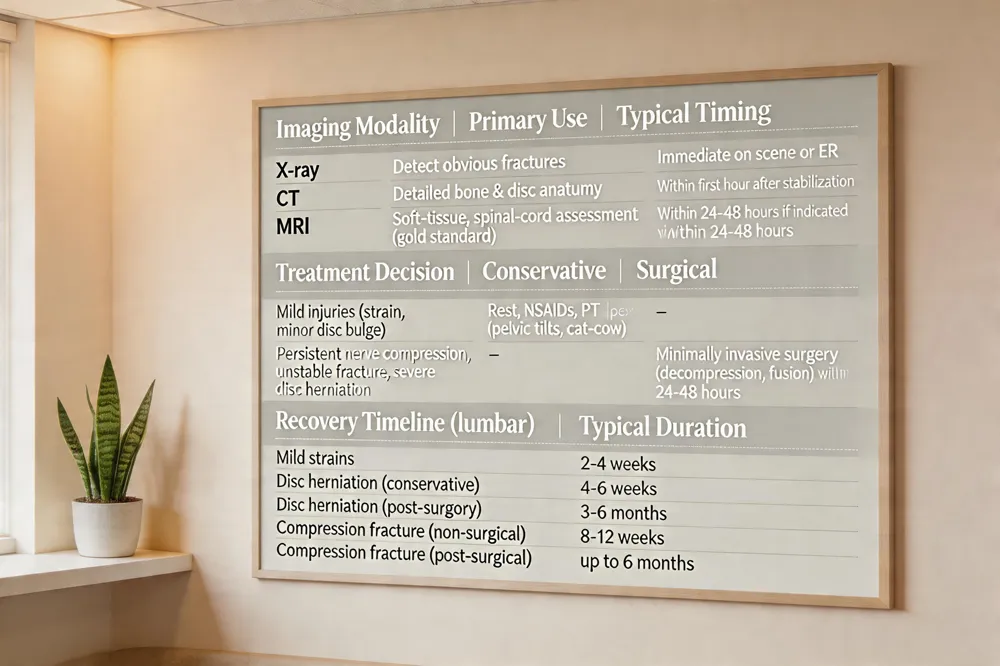 After a car crash, emergency responders immobilize the spine and transport the patient for rapid imaging. X‑ray quickly rules out obvious fractures, CT provides detailed bone and disc views, while MRI is the gold standard for soft‑tissue and spinal‑cord assessment.
Emergency imaging (X‑ray, CT, MRI) is essential for diagnosing fractures, disc herniation, or cord compression.
Conservative vs- surgical decisions: Most mild injuries heal with rest, NSAIDs, and a structured physical‑therapy program that includes core‑strengthening moves such as pelvic tilts, bird‑dog, and cat‑cow stretches. Persistent nerve compression, unstable fractures, or severe disc herniation may require minimally invasive surgery—often performed within 24‑48 hours to decompress the cord and stabilize the spine.
Recovery timelines for lumbar injuries:
- Mild strains: 2‑4 weeks
- Disc herniation: 4‑6 weeks (conservative) or 3‑6 months (post‑surgery)
- Compression fractures: 8‑12 weeks (non‑surgical) or up to 6 months (surgical stabilization).
Natural healing & early rehab: Early mobilization, proper nutrition, hydration, and sleep support tissue repair. A multidisciplinary rehab team—physiotherapists, occupational therapists, psychologists—optimizes functional gains, especially in the first six months when most neurological recovery occurs.
Key Q&A:
- Stages of spinal injury recovery: acute stabilization → rehabilitation → long‑term maintenance.
- Best treatment for spinal cord injury: immediate immobilization, early decompressive surgery when needed, followed by intensive multidisciplinary rehab.
- Can spine injury heal on its own?: Mild strains often do; serious injuries usually need medical intervention.
- How long does back healing take after a car accident?: Significant improvement typically within 6‑12 weeks for conservative care, with more severe cases requiring 3‑6 months or longer.
Rehabilitation, Long‑Term Care, and Daily Life Impact
| Aspect | Details |
|---|---|
| Inpatient rehab stay | Approx. 60‑70 days (2 months) depending on injury level & complications |
| Early milestones | Reduced swelling, return of tingling, brief muscle twitches, gradual reflex return |
| Later goals | Bladder/bowel control, transfers, wheelchair mobility, self‑care |
| Daily life changes | Need for wheelchair/brace, adaptive bathroom fixtures, assistance with dressing/bathing, emotional adjustments (anxiety, depression) |
| Outpatient/community therapy | 3‑6 months post‑discharge, focusing on strength, balance, independence |
| Typical functional gains | Steadier gait, improved hand coordination, fewer spastic episodes, return to work/school |
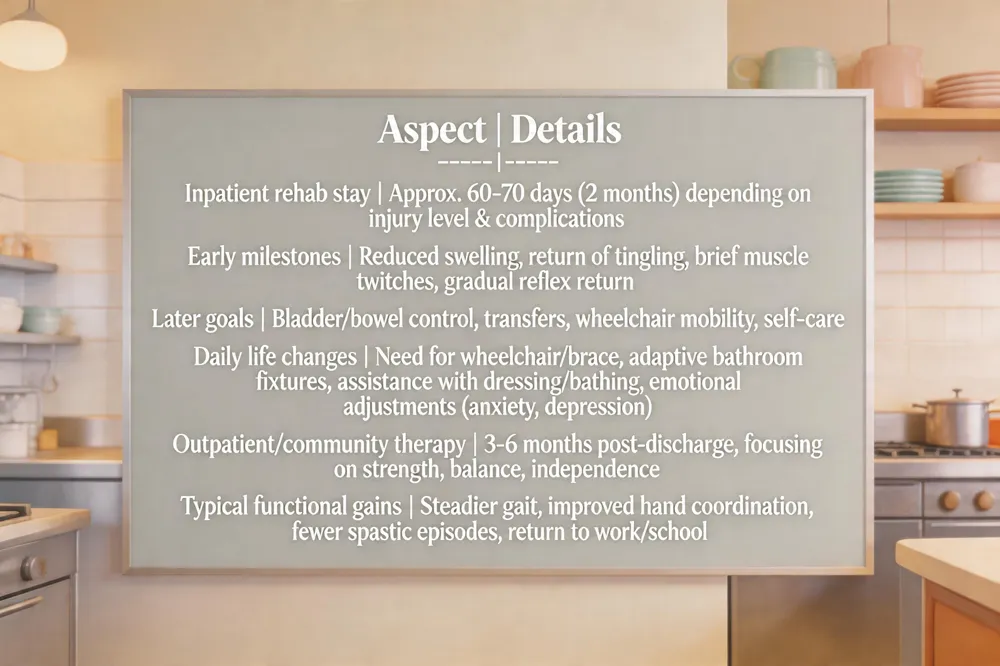 After a car‑crash spinal cord injury, the typical inpatient rehabilitation stay lasts about two months—roughly 60‑70 days—depending on injury level, completeness and complications. Early milestones include reduced swelling, return of tingling, emergence of brief muscle twitches, and gradual regain of reflexes; later goals focus on improving bladder/bowel control, transferring, wheelchair mobility and basic self‑care. Everyday routines shift dramatically: patients may need a wheelchair or braces, adaptive bathroom fixtures, and assistance with dressing, bathing and intimate activities. They also often experience emotional adjustments such as anxiety or depression. St. Louis offers a distinguished group of spine specialists for ongoing care, including Dr. David S. Raskas (Orthopedic Spine Institute of St. Louis), Dr. Benjamin Crane, Dr. Michael J. Reiter, Dr. Wilson Ray, Dr. Neill Wright, Dr. Lukas Zebala, Dr. Ian G. Dorward, Dr. Mirkin R. Peter, Dr. Lee Thomas and Dr. Brett A. Taylor. These surgeons provide both conservative and minimally invasive options and work with multidisciplinary teams to support long‑term recovery. After discharge, most patients engage in outpatient or community‑based therapy for 3‑6 months, refining strength, balance and independence. Recovery signs include steadier gait, improved hand coordination, and fewer spastic episodes, allowing participation in work or school.
Scoliosis Care and the Orthopedic Spine Institute’s Approach
| Severity | Management Strategy | Key Points |
|---|---|---|
| Mild curve | Monitoring with regular X‑rays; individualized PT (e.g., Schroth Method) | Aim to halt progression, improve posture |
| Moderate curve (growing adolescent) | Custom brace fitting | Allows activity while limiting further curvature |
| Severe/rapidly progressing curve | Multi‑level spinal fusion (minimally invasive when possible) | Performed by board‑certified spine surgeons; coordinated care with PT, pain management, insurance counselors |
| Patient Journey Steps | Description |
|---|---|
| Same‑day evaluation | Bring insurance info, discuss goals with care coordinator |
| Diagnosis | X‑ray, possibly MRI; shared decision‑making |
| Treatment | Conservative → brace → surgery (as indicated) |
| Long‑term follow‑up | Regular imaging, PT, counseling, and support from multidisciplinary team |
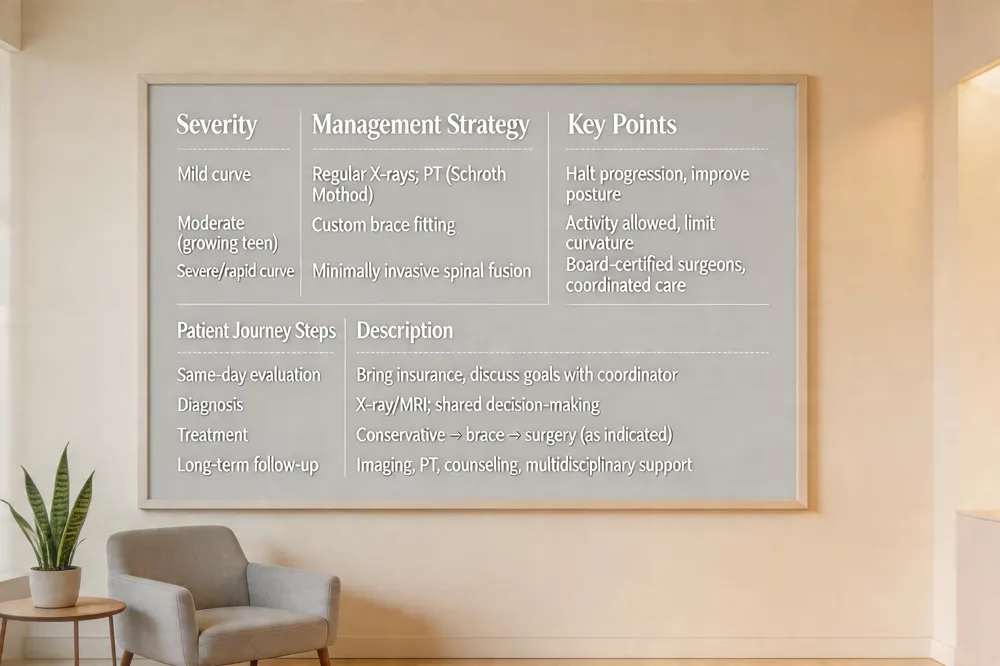 The Orthopedic Spine Institute of St. Louis (OSI) treats scoliosis at every severity level with a patient‑first philosophy. For mild curves, orthopedic specialists monitor progression with regular X‑rays and prescribe individualized physical‑therapy programs—such as the Schroth Method—to improve posture and halt growth. When a curve becomes moderate, especially in a growing adolescent, OSI fits a custom brace that limits further curvature while allowing normal activity. Severe or rapidly progressing deformities are managed with surgical options, most commonly multi‑level spinal fusion performed by board‑certified spine surgeons using minimally invasive techniques when appropriate. Throughout the journey, OSI emphasizes clear communication, shared decision‑making, and coordinated care with physical therapists, pain management experts, and insurance counselors. Patients start by scheduling a same‑day evaluation, bringing insurance information, and discussing goals with a dedicated care coordinator who guides them from diagnosis through treatment and long‑term follow‑up.
Your Path Forward – From Collision to Confidence
After a crash, follow the proven step‑by‑step roadmap: (1) report the accident and secure the police report; (2) obtain immediate medical evaluation to rule out hidden spinal or soft‑tissue injuries; (3) document photos, symptoms and all treatments for insurance and legal purposes; (4) begin a coordinated, patient‑first recovery plan that blends physical therapy, chiropractic care, pain management, nutrition and mental‑health support. At Apex Orthopaedics Spine & Neurology, Dr. David S. Raskas leads a multidisciplinary team that tailors each phase to your injury severity and personal goals. To schedule your first appointment, call the office or use the online portal—have your insurance details, accident report, and any imaging ready. Our staff also offers guides on claim filing, documentation checklists and ongoing counseling resources to keep you informed and empowered throughout healing.