Introduction to Sacroiliac Joint Fusion
What is SI Joint Fusion?
Sacroiliac (SI) joint fusion is a surgical procedure designed to permanently join the sacrum and ilium bones at the sacroiliac joint. This fusion stabilizes the joint, helping to reduce or eliminate pain caused by joint dysfunction.
Anatomy of the Sacroiliac Joint
The SI joint connects the spine (specifically the sacrum at the base of the spine) to the pelvis (ilium bones). It acts as a vital shock absorber, transferring weight and forces between your upper body and lower body during movement.
Purpose of the Procedure
SI joint fusion is recommended for patients suffering from severe lower back and pelvic pain that has not improved with conservative treatments like physical therapy, medication, or injections. By fusing the joint, the procedure aims to stabilize it, reduce painful motion, and improve the patient’s quality of life and mobility.
What is SI Joint Fusion and How is the Procedure Performed?
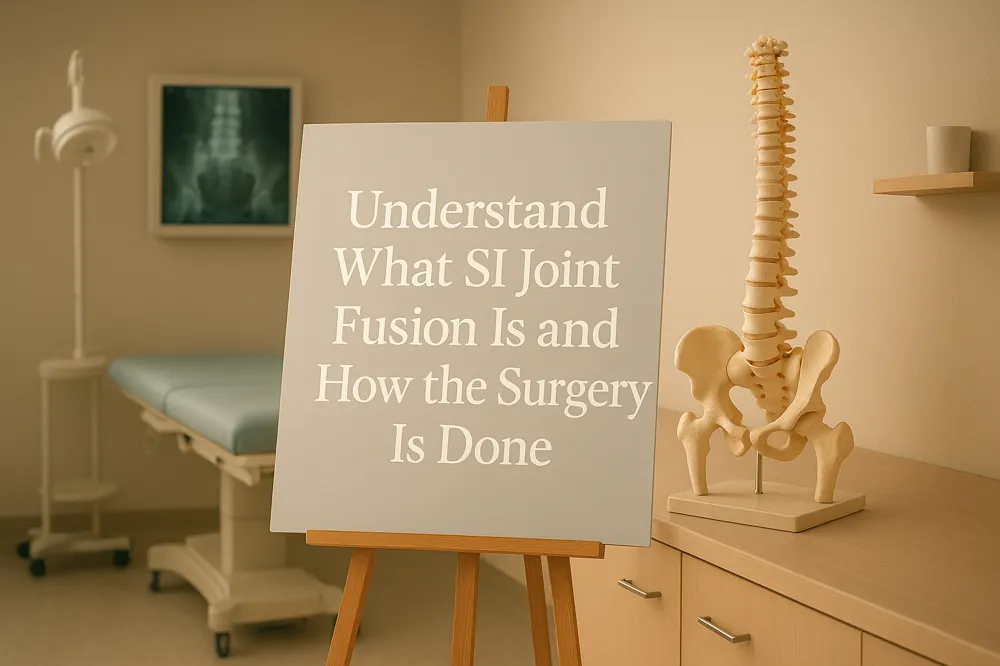
What is sacroiliac (SI) joint fusion and how is the procedure performed?
Sacroiliac (SI) joint fusion is a surgical intervention aimed at permanently stabilizing the SI joint, which connects the sacrum (base of the spine) to the ilium (pelvic bones). This joint acts as a shock absorber for transferring body weight between the torso and lower body, and dysfunction here can cause chronic pain.
Details of the surgical procedure
The surgery involves the insertion of titanium implants across the SI joint to fuse the sacrum and ilium together, thereby eliminating painful joint motion. Typically, this is done under general anesthesia using a minimally invasive SI joint fusion technique through a small incision on the lower back or buttock area. The surgeon uses imaging tools such as fluoroscopy or advanced 3D navigation to accurately place the implants.
Minimally invasive vs open surgery
While open surgery for SI joint fusion is available, it has largely been replaced by minimally invasive methods. The minimally invasive approach involves smaller incisions (2-5 cm), less tissue damage, reduced blood loss, and quicker recovery times. Patients often go home the same day or after a short hospital stay.
Use of titanium implants and navigation technology
Most commonly, triangular titanium implants like those in the iFuse Implant System are used. These implants have a porous surface that encourages bone growth and fusion. Navigation technologies such as fluoroscopy or cone-beam CT enhance precision, minimizing risks to nearby nerves and blood vessels.
Typical duration and outpatient nature
The procedure generally takes about 45 minutes to an hour. Due to its minimally invasive nature, most SI joint fusion surgeries are outpatient procedures allowing patients to return home the same day.
Primary goals and expected outcomes
The main goals are to stabilize the SI joint, reduce or eliminate pain, and improve overall quality of life. Over 80% of patients experience significant and lasting pain relief. Many regain mobility and can resume normal activities within three to four months post-surgery.
Associated risks and complications
While generally safe, potential risks of SI joint fusion include infection, bleeding, nerve or vascular injury, adverse reactions to anesthesia, implant migration, or incomplete joint fusion. These complications are rare and often manageable with prompt medical care.
In summary, SI joint fusion is a focused surgical procedure using state-of-the-art minimally invasive techniques and titanium implants to provide durable pain relief and improved function for patients with confirmed SI joint dysfunction resistant to nonsurgical treatments.
Benefits, Success Rates, and Types of SI Joint Fusion Approaches
What are the benefits and success rates of minimally invasive SI joint fusion?
Minimally invasive SI joint fusion offers notable advantages over traditional open surgery. It involves small incisions, often just 2-4 cm, and utilizes triangular titanium implants that stabilize and promote fusion between the sacrum and ilium. Patients benefit from reduced tissue trauma, lower infection risk, and shorter operative times—typically around an hour.
Clinical studies report success rates around 80-84%, with over 80% of patients experiencing significant, lasting pain relief. This translates into improved quality of life improvements post SI joint fusion, and return to normal activities within weeks to months. Minimally invasive techniques also show lower complication and reoperation rates (approximately 6%) compared to open procedures.
Patients usually begin walking within 24 hours post-surgery, with many resuming light activities within 2-6 weeks. Full recovery, including possible return to high-impact physical activities, often occurs between 3 to 6 months. Use of FDA-approved implants like the iFuse system has demonstrated durable outcomes, including pain reduction, functional improvement, and a decrease in opioid use.
What types or approaches of SI joint fusion are available?
SI joint fusion procedure is primarily performed via two minimally invasive approaches: lateral and posterior.
-
Lateral Approach: This method, exemplified by the iFuse and Tricor systems, involves placing triangular or screw-like implants through the ilium across the SI joint into the sacrum. Lateral fusion stabilizes the bony articulation, reduces micromotion, and encourages osseous fusion. Procedural times average around one hour, with patients often discharged the same day. Clinical evidence affirms its efficacy with sustained pain relief, low blood loss, and a strong safety profile.
-
Posterior Approach: Used in systems like Medtronic's Rialto, the posterior approach targets the ligamentous region of the SI joint via a smaller incision. This technique reduces tissue disruption further and may facilitate faster recovery. It is considered an alternative for select patients, supporting bone growth via bone grafts and implants inserted into the posterior joint space.
Both approaches promote fusion over a period of months, usually achieving stable joint fusion within six months. Choice of approach depends on patient anatomy, surgeon expertise, and clinical indications.
| Aspect | Lateral Approach | Posterior Approach |
|---|---|---|
| Incision Size | 2-4 cm | Typically smaller |
| Implant Type | Triangular titanium rods (e.g., iFuse) | Bone graft with screws (e.g., Rialto) |
| Recovery Time | Walking within 24 hours; light activity in weeks | Rapid recovery; less invasive |
| Fusion Location | Bony articulation | Ligamentous portion |
| Clinical Outcomes | >80% pain relief; durable outcomes (clinical studies) | Promising but less extensive data |
In summary, minimally invasive SI joint fusion, whether lateral or posterior, offers effective, safe options with high patient satisfaction. The iFuse system remains the most widely studied, delivering consistent results. Personalized care determines the most suitable approach for each patient, aiming to alleviate pain and restore mobility.
Recovery Expectations and Postoperative Restrictions Following SI Joint Fusion

What can patients expect during recovery after minimally invasive SI joint fusion?
Following minimally invasive SI joint fusion procedure, patients often begin walking within the first 24 hours to encourage healing and prevent complications. Light daily activities like cooking or gentle cleaning typically resume between 2 to 6 weeks post-surgery. Driving may be allowed after about two weeks if the patient is off pain medications and feels confident. Full recovery, including a return to high-impact activities such as running or jumping, can take up to six months. Recovery milestones depend on factors such as age, overall health, and careful adherence to medical advice.
What activities are restricted after SI joint fusion surgery, and how long do these restrictions last?
Post-surgery restrictions help the SI joint fuse properly and prevent problems. Patients should avoid bending, twisting, lifting heavy objects (generally over 5 to 10 pounds), and high-impact exercises like running or jumping. These restrictions usually last from 3 to 6 months. Walking and light activities are encouraged soon after surgery, but heavy or strenuous motions are limited until the surgeon allows a gradual return to normal movements. Participation in physical therapy following SI joint fusion and following the surgeon’s specific instructions are crucial for a smooth recovery.
How soon can patients resume driving after SI joint fusion surgery?
Driving is commonly resumed between 4 to 8 weeks after surgery, depending on individual progress. Patients must be free from narcotic pain medications and feel fully in control of the vehicle, capable of emergency maneuvers. Surgeons assess readiness at follow-up visits, usually around 2 to 6 weeks post-op, to ensure safety. Patients should never drive without medical clearance.
| Recovery Stage | Typical Timeline | Key Details |
|---|---|---|
| Immediate Mobilization | Within 24 hours | Walking encouraged; use of assistive devices if needed |
| Light Activities | 2 to 6 weeks | Cooking, light cleaning; driving may begin if pain controlled |
| Activity Restrictions | 3 to 6 months | Avoid heavy lifting, twisting, high-impact exercises |
| Return to Normal Activities | 3 to 4 months | Gradual resumption of usual tasks under guidance |
| Full Recovery | Up to 6 months | High-impact sports and heavy labor cautiously reintroduced |
Adhering closely to postoperative guidelines, including activity restrictions and physical therapy following SI joint fusion, optimizes healing and long-term outcomes after SI joint fusion procedure.
The Role of Physical Therapy and Long-Term Mobility after SI Joint Fusion
Is physical therapy necessary after SI joint fusion, and what does it involve?
Yes, physical therapy is a crucial part of recovery following SI joint fusion surgery. It focuses on restoring strength, stability, balance, and range of motion around the fused joint to ensure safe movement and protect the healing site. Therapy typically includes carefully guided exercises aimed at improving mobility and supporting muscles surrounding the SI joint. This rehabilitation process helps patients resume daily activities more quickly and lowers the risk of injury. A personalized physical therapy program, supervised by healthcare professionals, is essential for optimal recovery and preventing complications.
Typical physical therapy goals and activities
Physical therapy after SI joint fusion targets several key goals:
- Regaining functional strength in hip, pelvis, and lower back muscles
- Restoring balance and proprioception to prevent falls
- Enhancing flexibility while protecting the fusion
- Gradual progression from gentle range-of-motion exercises to more dynamic activities
- Education on proper body mechanics to avoid strain on the healing joint
Therapists design programs that are tailored to each patient's surgical outcomes, health status, and lifestyle needs.
How much mobility and normal activity can patients expect to retain after SI joint fusion?
Most patients retain significant mobility following SI joint fusion, especially when adhering to proper rehabilitation practices. While initial healing requires activity restrictions like avoiding heavy lifting and excessive twisting, many individuals gradually return to moderate activities within three to four months post-surgery. Patients often experience improved gait, better balance, and pain relief, contributing to enhanced functional mobility.
Long-term benefits on gait, balance, and pain
SI joint fusion reduces abnormal joint motion causing pain and instability, which contributes to improved walking patterns and balance over time. Patients report lasting pain relief and increased independence in daily tasks. Although some subtle changes in pelvic motion may persist, overall joint stability facilitates more comfortable and confident movement.
Patient outcomes regarding functional independence
With dedicated physical therapy and proper postoperative care, most patients regain the ability to perform their daily activities independently. The reduction in pain and improved joint stability help restore quality of life improvements post SI joint fusion allowing participation in work, hobbies, and mild sports. This functional independence is a primary goal and consistent outcome for individuals undergoing SI joint fusion.
Potential Complications, Long-Term Effects, and Signs of Failed SI Joint Fusion

What are the potential long-term effects or complications associated with SI joint fusion?
SI joint fusion generally offers long-term benefits, including sustained pain relief, improved joint stability, and enhanced function. Studies show that around 80% of patients report significant pain reduction lasting up to five years, with many experiencing improved mobility and quality of life improvements post SI joint fusion.
However, complications of SI joint fusion, while uncommon, can occur. Rare implant-related issues include loosening or migration of the hardware, reported in less than 1% of cases. Postoperative concerns may involve transient falls, trochanteric bursitis, or piriformis syndrome. These complications are typically manageable with medical intervention and physical therapy following SI joint fusion.
Ongoing postoperative care for SI joint fusion is critical to monitor implant positioning and joint stability, ensuring optimal outcomes over time. Proper patient selection and accurate diagnosis before surgery greatly reduce risk of risks of SI joint fusion.
What symptoms might indicate a failed SI joint fusion?
Signs of a failed fusion include persistent or worsening lower back, buttock, or hip pain that does not improve or intensifies over time. Patients may feel instability or looseness in the pelvic region and experience limited or abnormal movement.
Additional symptoms such as radiating pain into the thighs or legs, numbness, or tingling sensations may also arise. Sometimes, ongoing discomfort results from postoperative infection, incomplete fusion (non-union), or adjacent segment disease.
If any of these symptoms are present after surgery, prompt consultation with a healthcare provider is essential to evaluate the issue and discuss potential treatments or revisions, guided by knowledge of signs of complications after SI joint fusion and symptoms to watch after SI joint fusion.
Conclusion: Key Takeaways on SI Joint Fusion
Surgical Benefits
SI joint fusion offers a highly effective solution for persistent lower back and pelvic pain when nonsurgical treatments fail. Over 80% of patients experience significant and lasting pain relief after the procedure, which improves mobility and quality of life. Minimally invasive techniques reduce recovery time, scarring, and infection risks.
Diagnosis and Patient Selection
Accurate diagnosis is essential to ensure that the SI joint is the true source of pain. This typically involves physical exams, imaging tests, and diagnostic injections that provide targeted pain relief. Proper patient selection improves surgical success rates and outcomes.
Recovery and Physical Therapy
Recovery generally spans a few months, starting with early walking and gradually increasing activity under medical guidance. Physical therapy is integral to restoring function and strengthening surrounding muscles for long-term stability.
Pain Relief and Quality of Life
Patients often achieve a dramatic reduction in pain, enabling them to return to daily activities and enjoy an enhanced lifestyle. Benefits include improved independence and reduced reliance on pain medications.
Seeking Personalized Care
Consulting with specialized orthopedic or spine surgeons ensures individualized treatment plans. Specialists use advanced diagnostics and evidence-based therapies, tailoring care to each patient’s needs for optimal results.