Understanding Spinal Decompression
Spinal decompression therapy is a treatment that gently stretches the spine to relieve pressure on intervertebral discs, nerves, and the spinal cord. It is most often used for bulging or herniated discs, degenerative disc disease, sciatica, and spinal stenosis—conditions where displaced disc material or bone overgrowth compresses neural structures. Two main approaches exist: non‑invasive traction, performed on a motorized table that creates negative pressure within the disc to encourage retraction and nutrient flow; and surgical decompression, which physically removes bone, ligament, or disc tissue (e.g., laminectomy, discectomy, foraminotomy) to enlarge the neural canal. Modern practice follows a stepped‑care philosophy: patients first receive conservative therapies such as physical therapy, chiropractic care, acupuncture, or nonsurgical traction, progressing to minimally invasive surgery only when pain persists or neurological deficits worsen. This hierarchy minimizes risk, preserves anatomy, and maximizes functional recovery.
Recognizing Early Signs of L4‑L5 Compression
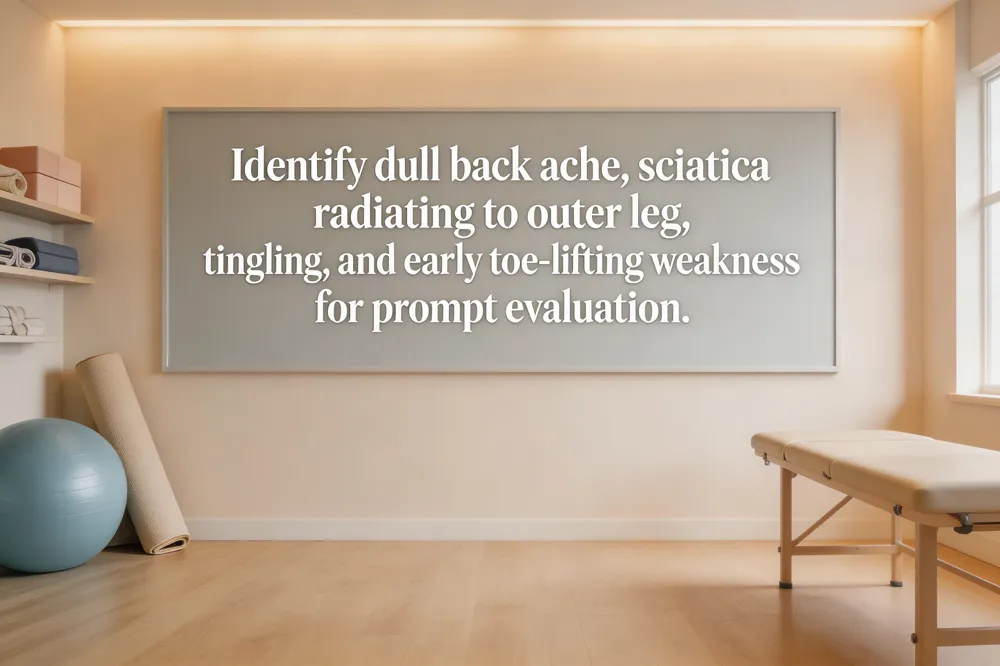 Lower‑back pain from L4‑L5 compression often begins as a dull, achy ache that worsens after prolonged standing, bending, or lifting. Within days, a sharp, shooting pain—classic sciatica—radiates from the buttock down the outer thigh, calf, and sometimes to the top of the foot. Neurological clues include tingling, numbness, or a “pins‑and‑needles” sensation along the same outer‑leg pathway, and early weakness when trying to lift the big toe or dorsiflex the foot, which may cause a stumbling gait. These symptoms precede more severe deficits such as marked muscle loss or bladder dysfunction, so prompt evaluation is essential. Early imaging (MRI or CT) and electrophysiological testing can pinpoint the exact level of compression, allowing clinicians to start a stepped‑care approach—starting with non‑invasive treatments and reserving surgery for refractory cases. Timely assessment not only relieves pain faster but also helps prevent permanent nerve damage and preserves function.
Therapeutic Options: From Conservative Care to Surgery
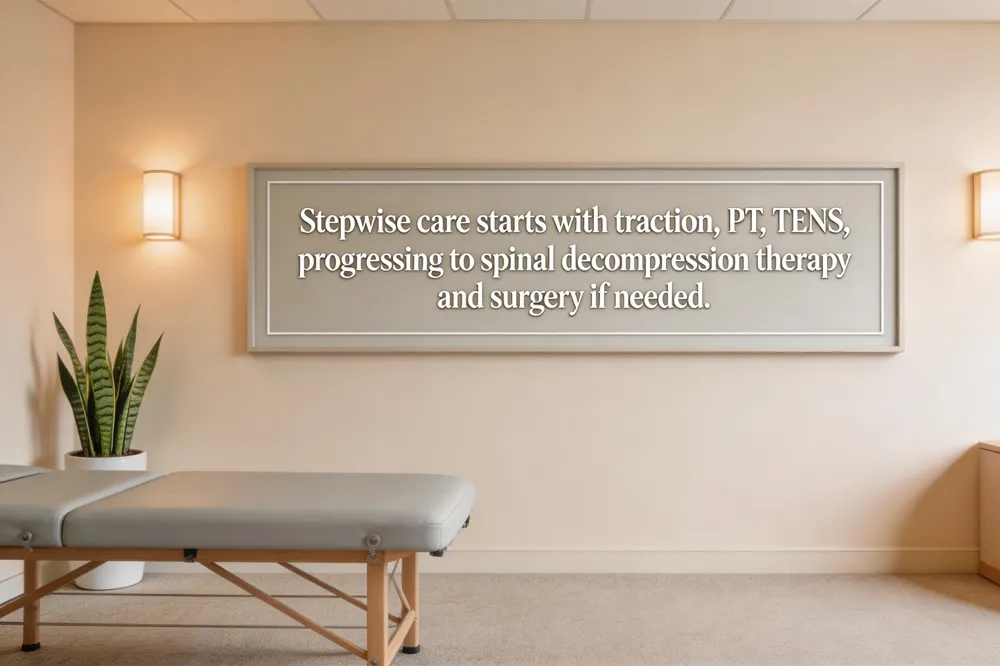 A stepped‑care approach begins with non‑invasive modalities—traction, acupuncture, chiropractic adjustments, physical therapy, and TENS—to address low‑back and neck pain before considering surgery. When conservative care fails, spinal decompression therapy is introduced.
How is spinal decompression done? The patient lies fully clothed on a motorized traction table. Pelvic and trunk harnesses secure the body while the computer‑controlled table applies a gentle, alternating pull‑and‑release force, creating negative pressure inside the disc. Sessions last 30‑45 minutes; a full course typically involves 20‑28 treatments over five to seven weeks, customized to the individual’s diagnosis and tolerance.
Spinal decompression therapy is a nonsurgical traction technique that stretches the spine, allowing herniated or bulging disc material to retract and promoting fluid, oxygen, and nutrient flow for healing. It is used for chronic back or neck pain, sciatica, degenerative disc disease, and spinal stenosis when other measures are insufficient.
Spinal decompression therapy cost ranges from $50‑$250 per session, with a complete series costing roughly $1,000‑$5,000. Insurance coverage is limited; many patients pay out‑of‑pocket or use flexible‑payment plans.
Spinal decompression hurts lower back? Most patients feel only a gentle stretch; severe pain is uncommon. If new or worsening pain occurs, stop the treatment and contact a physician.
Surgical Decompression Techniques and Minimally Invasive Options
 Spinal decompression surgery can be performed through traditional open approaches or through minimally invasive spine surgery (MISS). Open laminectomy removes the full lamina to open the canal, while a laminotomy spares most bone by excising only a small portion. Laminoplasty reshapes the lamina like a door, often in the cervical spine, and foraminotomy enlarges the nerve‑root opening. Microdiscectomy or discectomy extracts herniated disc material for targeted relief.
MISS uses tubular retractors, endoscopic cameras, and real‑time imaging to treat the same pathologies through skin incisions typically ≤1 cm. Benefits include less muscle disruption, reduced blood loss, shorter hospital stays (often outpatient or 1‑day), and faster return to activity. At the L4‑L5 level, MISS may involve a percutaneous discectomy or limited fusion while preserving surrounding tissue, allowing most patients to resume normal function within weeks.
Cost varies: a minimally invasive micro‑discectomy ranges $15,000‑$35,000, while invasive laminectomy can be $80,000‑$150,000 without insurance; insurers usually cover the bulk, leaving only copays or deductibles.
Ideal candidates are those whose pain persists after physical therapy, medication, or injections, have clear imaging‑confirmed pathology (e.g., herniated disc, stenosis, spondylolisthesis), are in good overall health, and are committed to postoperative rehabilitation.
Patients in St. Louis seeking these advanced options can consult the Orthopedic Spine Institute of St. Louis, where Dr. David S. Raskas offers a patient‑first, stepped‑care model that moves from conservative therapy to cutting‑edge minimally invasive decompression only when necessary.
Evidence, Success Rates, and Risks of Decompression
 Clinical studies consistently show high success rates for spinal decompression. Nonsurgical therapy reports symptom relief in 71‑89 % of patients, with some trials documenting up to 92 % pain reduction and measurable disc‑height restoration. [Surgical decompression]—most often a laminectomy—yields meaningful improvement in 70‑80 % of cases, and leg‑pain relief reaches 80‑90 % in many series. Long‑term follow‑up indicates that roughly two‑thirds of patients maintain benefits five years after surgery.
Both approaches are generally safe, but they carry distinct risks. [Nonsurgical therapy] is contraindicated in osteoporosis, fractures, spinal implants, or pregnancy; occasional mild soreness is the most common adverse effect. [Surgical decompression] is a major operation, though minimally invasive spine surgery has lowered blood loss, infection, and nerve‑injury rates. Potential complications include dural tears, nerve damage, spinal instability, blood clots, and rare neurologic injury; careful patient selection and postoperative monitoring are essential.
Pros of [spinal decompression] include non‑invasive pain relief, improved mobility, and avoidance of medication or extensive surgery. Cons involve the need for multiple sessions, limited evidence for long‑term durability, and exclusion criteria that restrict some patients. Activities that exacerbate L5 compression include heavy lifting, high‑impact sports, repetitive twisting, and prolonged poor‑posture sitting.
Recovery timelines vary: after an L4‑L5 [spinal decompression], most patients experience reduced pain by 6‑8 weeks, resume light duties by 12 weeks, and achieve full functional recovery in 3‑6 months. [Minimally invasive spine surgery] further shortens con, often allowing light activity within a few days and full recovery in 6‑10 weeks for microdiscectomy, while more extensive MISS procedures may require 3‑6 months for complete healing.
Supporting Resources and Patient Education
 Patients interested in minimally invasive spine surgery (MISS) can download peer‑reviewed PDFs such as the “Fundamental Concepts of Minimally Invasive Spine Surgery (MISS) and Purpose to Pursue” and a patient‑focused brochure that explain smaller‑incision techniques, benefits, and recovery expectations. A separate “[Spinal Decompression Exercises](https://my.clevelandclinic.org/health/treatments/10874-spinal-decompression-therapy)” PDF provides a step‑by‑step, doctor‑approved conditioning program with warm‑up, stretching, and core‑strengthening moves for back, neck, and sciatica recovery. To visualize the technology, short videos demonstrate a typical minimally invasive lumbar [spinal decompression](https://my.clevelandclinic.org/health/treatments/10874-spinal-decompression-therapy) and a full‑length [spinal decompression](https://my.clevelandclinic.org/health/treatments/10874-spinal-decompression-therapy) bed session, showing patient positioning, intra‑operative imaging, and quick closure. Equipment overviews cover two main device types: the [motorized spinal decompression table](https://my.clevelandclinic.org/health/treatments/10874-spinal-decompression-therapy) (dual‑section with independent upper and lower movement) and the [DRX9000® True Non‑Surgical Spinal Decompression™ machine](https://my.clevelandclinic.org/health/treatments/10874-spinal-decompression-therapy), both creating negative disc pressure to promote healing. All resources are freely downloadable from the Orthopedic Spine Institute of St. Louis website and can be accessed via the “Patient Resources” portal.
Practical Self‑Care and At‑Home Decompression
 Learning simple at‑home techniques can complement clinical spinal decompression therapy and help maintain relief. How to decompress spine by hanging? Find a sturdy pull‑up bar or gymnastics ring, grip it shoulder‑width apart, and let your body hang fully extended for 20‑30 seconds. Perform 2‑3 sets, 3‑4 times per week, stopping if sharp pain or dizziness occurs. How to decompress lower back? Start with gentle lumbar stretches—child’s pose, knees‑to‑chest, cat‑cow—followed by standing extensions or half‑cobra to arch the back. Add core‑stabilizing moves such as bird‑dog, glute bridge, and pelvic tilts, and finish with a McKenzie extension. Hold each stretch 15‑30 seconds, repeat 8‑12 times. L5‑S1 decompression exercises mirror the lower‑back routine, emphasizing knee‑to‑chest, child’s pose, standing extensions, bird‑dog, glute bridge, pelvic tilts, and the McKenzie extension to target the L5‑S1 segment. How to decompress spine while sleeping? Sleep on your back with a pillow under the knees or on your side with a pillow between the knees; use a firm mattress and a contoured pillow. A short pre‑bed stretch (child’s pose, cat‑cow, heel slides) can further lengthen the vertebrae before rest. These self‑care steps support spinal health and may reduce pain between sciatica.
Choosing the Right Path at Orthopedic Spine Institute
At the Orthopedic Spine Institute we put patients at the center of every decision. Our stepped‑care philosophy starts with the least invasive options—physical therapy, acupuncture, chiropractic adjustments, and motorized traction—progressing only when necessary to minimally invasive surgery. This approach minimizes risk, cost and downtime while preserving the natural healing capacity of the spine.
We understand that navigating insurance can be confusing. Our staff works directly with carriers to verify coverage, obtain pre‑authorizations, and provide clear, itemized estimates so you know exactly what your out‑of‑pocket expense will be. When a procedure is not covered, we discuss alternative financing or self‑pay packages to keep treatment accessible.
Scheduling a consultation with Dr. David S. Raskas is simple. Call our office or use the online portal, and a care coordinator will arrange a comprehensive evaluation, including imaging review and a personalized treatment plan.
Our commitment extends beyond the procedure. Through structured physical‑therapy programs, lifestyle counseling, and regular follow‑up, we aim to sustain spinal health and prevent recurrence for years to come.