Why Informed Choices Matter
A patient‑first approach places your goals, concerns, and lifestyle at the center of every treatment plan. By engaging in shared decision‑making, you and your spine specialist review the full range of options—medication, physical therapy, injections, and, when truly necessary, minimally invasive surgery—while weighing the benefits, risks, and personal preferences. This collaborative process is grounded in evidence‑based medicine; high‑quality studies consistently show that structured physical‑therapy programs can achieve pain relief and functional gains comparable to surgery for conditions such as lumbar spinal stenosis, with far fewer complications and lower cost. When you are fully informed and actively involved, the care you receive aligns with the best scientific data and your own priorities, leading to better outcomes and greater satisfaction.
Quick Home Strategies for Back Pain Relief
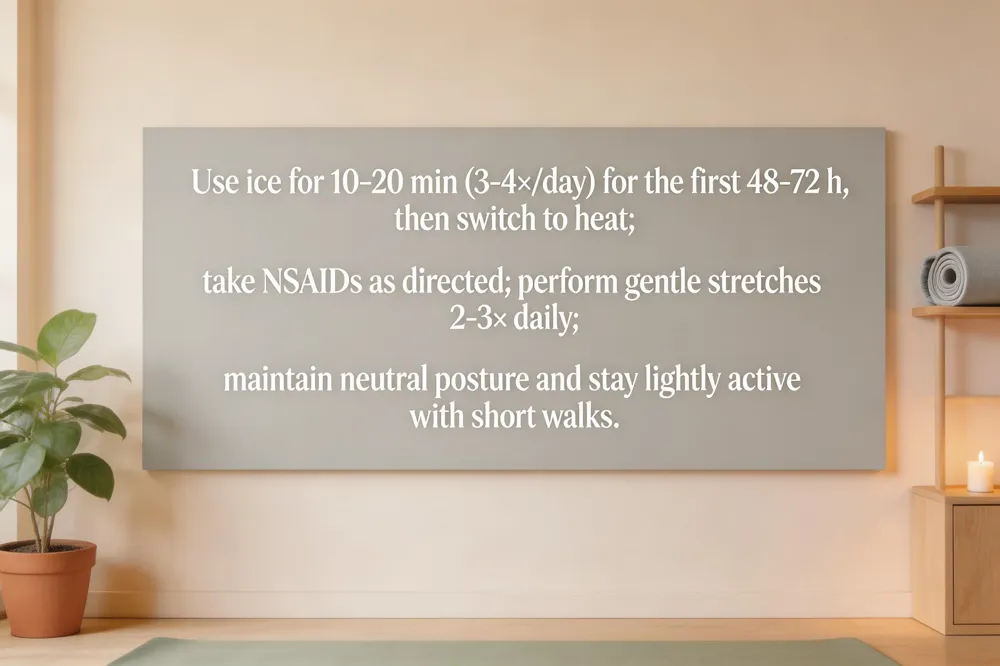 Most back pain can be eased at home with a few simple steps.
Ice and heat therapy – Apply a cold pack wrapped in a thin towel to the painful area for 10‑20 minutes, 3‑4 times a day during the first 48‑72 hours to reduce inflammation. After the initial period, switch to a heating pad or warm compress for 15‑20 minutes to relax tight muscles and improve blood flow.
Over‑the‑counter NSAIDs – Ibuprofen or naproxen (taken as directed and without contraindications) helps control pain and swelling.
Gentle stretches – Perform knee‑to‑chest, lower‑back rotational, cat‑cow, and bridge exercises 2‑3 times daily, increasing repetitions slowly as tolerated.
Posture tips – Keep the spine neutral while sitting and standing, engage the core, and use a rolled‑towel under the pelvis for lumbar support.
Activity modification – Avoid heavy lifting, prolonged sitting, and sudden movements; instead, take short walks or light activity every hour to keep blood circulating.
Q: How to relieve back pain fast at home? Apply ice for the first 48‑72 hours, then heat; take an NSAID; do gentle stretches 2‑3 times daily; maintain good posture and stay lightly active.
Q: How to get rid of back pain instantly? Use a cold pack followed by a warm compress, take a short‑acting NSAID, perform a few gentle stretches, and practice deep‑breathing or brief mindfulness to calm the nervous system. For persistent symptoms, schedule an evaluation with Dr. David S. Raskas at the Orthopedic Spine Institute of St. Louis.
Conservative Management of Spinal Stenosis
 Physical therapy is the cornerstone of conservative care for lumbar spinal stenosis. Structured programs begin with core‑stabilization and lumbar flexion‑based stretches that open the foraminal space and reduce pressure on nerves. Nerve‑gliding (neural mobilization) drills promote mobility of the sciatic and femoral nerves, while manual therapy—joint mobilizations and soft‑tissue work—restores segmental motion and eases muscle tension. Low‑impact aerobic conditioning such as walking or stationary cycling improves endurance and supports weight management, further decreasing spinal load. Education on posture, body mechanics, and a personalized home‑exercise plan completes the regimen. Evidence shows that these nonsurgical interventions can match surgical outcomes for many patients, making PT the first‑line option. Traction may be tried in select cases but is not a primary therapy. Overall, PT aims to relieve pain, enhance walking tolerance, and delay or avoid surgery, improving quality of life and long‑term health.
Evidence‑Based Medicine & Shared Decision‑Making
 Evidence‑Based Medicine (EBM) is the practice of making clinical‑care decisions for an individual patient by using the most current, high‑quality evidence from the professional literature. It integrates three pillars: the best available research findings, the clinician’s expertise, and the patient’s values and preferences. This systematic approach replaces anecdote with data‑driven choices, aiming for safe, effective care. Informed consent evolved in the 1950s from a paternalistic model to a documented process that respects patient autonomy and requires clear communication of risks, benefits, and alternatives. Modern patient surveys now monitor how well clinicians involve patients in decision‑making, while health‑information technology tools capture symptom data, preferences, and outcomes to share with providers in real time. Together, these elements support shared decision‑making, ensuring that treatment plans—whether conservative or surgical—align with evidence, clinician judgment, and what matters most to the patient.
Comprehensive Conservative Spine Care
 Spinal treatment without surgery – A patient‑first plan starts with a thorough evaluation and a personalized regimen that blends medication (NSAIDs, muscle relaxants, neuropathic agents), targeted injections (epidural steroids, facet or nerve blocks, radiofrequency ablation), and structured physical therapy to core stability, flexibility, and posture. Mind‑body practices—mindfulness, meditation, yoga, tai‑chi—reduce stress‑related pain amplification. Diet and lifestyle changes (anti‑inflammatory foods, weight control, smoking cessation, ergonomic workstations) lower systemic inflammation and mechanical load. Adjunctive modalities such as acupuncture, chiropractic manipulation, therapeutic massage, ultrasound, heat/cold, and TENS further enhance relief.
What is a conservative treatment for the spine? – Non‑surgical care emphasizes active rehabilitation, core‑strengthening exercises, and posture training, supplemented by NSAIDs or muscle relaxants and, when needed, corticosteroid injections. Lifestyle adjustments sustain gains.
Female lower back pain treatment – Tailored PT programs add pelvic‑floor and core work, NSAIDs or topical agents for inflammation, ergonomic counseling, yoga for stress reduction, and selective injections. Hormonal and pregnancy‑related factors guide therapy choices.
How to reduce back pain for female – Daily low‑impact cardio, core‑strengthening (Pilates, yoga), ergonomic sitting, regular movement breaks, supportive sleep positioning, weight management, hydration, and smoking cessation.
Strong painkillers for lower back pain – Short‑term opioids (oxycodone, hydrocodone) are reserved for severe refractory pain, used with strict monitoring and a taper plan; non‑opioid alternatives are preferred when possible.
What causes back pain in females – Hormonal fluctuations, pregnancy‑related ligament laxity, wider pelvis‑ lumbar lordosis, poor posture, high‑heel use, obesity, arthritis, disc pathology, and gynecologic conditions all contribute.
Non‑invasive surgery for spinal stenosis – Minimally invasive options include endoscopic decompression, percutaneous interspinous spacers, and laser‑assisted laminotomy, which relieve nerve compression through tiny incisions and preserve surrounding tissue.
When Surgery Becomes Necessary
 Indications for surgery – Surgery is considered when pain persists despite 6‑12 weeks of evidence‑based Conservative care, when imaging shows structural problems such as severe lumbar stenosis, herniated disc, or instability, or when red‑flag symptoms (progressive weakness, bowel/bladder dysfunction, or loss of ambulation) appear.
Minimally invasive options – Techniques such as endoscopic discectomy, tubular laminectomy, and percutaneous facet or radiofrequency ablation allow surgeons like Dr. David S. Raskas to decompress nerves or stabilize the spine while preserving tissue, reducing blood loss and hospital stay.
Risk assessment – Complication rates for minimally invasive spine surgery are <5 % (infection, nerve injury, DVT). Risks increase with smoking, diabetes, or advanced age, so pre‑op optimization is essential.
Recovery timelines – Most patients resume light activities within 2‑4 weeks, with full functional recovery by 3‑6 months; fusion healing is confirmed at 6‑12 months.
Cost‑effectiveness – Conservative care is less costly and avoids surgery‑related expenses; however, for severe, function‑limiting disease, minimally invasive surgery can be cost‑saving over a 5‑year horizon by restoring work capacity.
FAQs
- Best treatment for severe back pain? Begin with activity, NSAIDs, and targeted PT; add epidural steroids if needed; proceed to minimally invasive surgery when structural issues remain.
- Can spinal stenosis be reversed without surgery? Not fully, but PT, weight control, NSAIDs, and epidural steroids can relieve symptoms in ~70 % of patients.
- Recovery time for thoracic fusion? Light activity by 3‑4 weeks, PT from 6‑8 weeks, return to daily tasks by 10‑12 weeks; full fusion confirmed at 6‑12 months.
- How risky is thoracic spine surgery? Overall serious complications <5 %, higher in smokers/diabetics; minimally invasive approaches lower infection and pain.
- Can you walk up stairs after spinal fusion? Typically allowed after 4‑6 weeks with hand‑rail support; full stair use by 3‑6 months.
- Why is physical therapy better than surgery? PT offers pain relief, shorter recovery, fewer complications, and functional strengthening without the risks of anesthesia or invasive tissue disruption.
Tools, Aids, and Ongoing Support
 Walking aids are a cornerstone of conservative care for lumbar spinal stenosis. A lightweight rollator or four‑wheeled walker with a seat encourages a forward‑leaning posture, decompressing the spinal canal while providing stability and rest opportunities. Physical therapists can tailor the device choice—cane, rollator, or walker—to each patient’s home layout and activity level.Post‑surgery rehabilitation at the Orthopedic Spine Institute of St. Louis follows a patient‑first model. After minimally invasive decompression or fusion, a structured PT program—core strengthening, gait training, and gradual return to activity—helps restore function while minimizing complications. Our team coordinates with surgeons to ensure a seamless transition from surgery to rehab.
Insurance navigation is handled by OSI staff who verify benefits, obtain pre‑authorizations for PT, injections, or surgery, and explain out‑of‑pocket costs. Patients can also use our secure online portal to complete intake forms, schedule appointments, and track treatment progress—all designed to empower patients and keep care on track.
Your Next Steps at the Orthopedic Spine Institute
Take the first step toward relief by scheduling a personalized evaluation with Dr. David S. Raskas and the OSI team. During this visit we will review your history, imaging, and functional goals to design a patient‑first treatment plan that begins with evidence‑based conservative care. Before you come, explore our insurance assistance resources—our staff will verify coverage, explain pre‑authorization requirements, and help you understand any out‑of‑pocket costs. To streamline the process, complete the secure online intake forms on our website; they collect essential health information, medication lists, and prior imaging, allowing your provider to focus on the clinical discussion when you arrive. By committing to a step‑wise, shared‑decision‑making approach, you empower yourself to pursue the most effective, safest therapy—whether that means structured physical therapy, targeted injections, or, when truly needed, minimally invasive surgery. OSI is dedicated to guiding you every step of the way.