Why a Structured Checklist Matters After a Collision
A well‑organized post‑crash checklist starts with immediate safety: call 911, immobilize the spine, and watch for red‑flag symptoms such as loss of bladder control or severe head pain. Within 24–48 hours, seek a medical evaluation and obtain imaging (X‑ray, CT, MRI) to rule out fractures, disc herniations, or cord compression—early detection prevents chronic disability. Bring a complete medication list; pharmacy‑led reconciliation can cut medication discrepancies by up to 68%, and accessing health‑information exchange reduces repeat imaging by up to 5%. Finally, plan long‑term rehabilitation (physical therapy, core strengthening, psychosocial support) while documenting symptoms, costs, and provider notes for insurance and potential legal claims. A structured checklist streamlines care, minimizes errors, and protects both health and financial outcomes.
Recognizing Red‑Flag Symptoms and Immediate Care
 After a motor‑vehicle collision, call 911 immediately. Keep the victim completely still, immobilize the head and neck with rolled towels, a cervical collar, or by gently holding the head, and never move the spine unless required for airway or safety. If the person is not breathing, begin CPR while maintaining spinal precautions.
Five classic signs of spinal injury: (1) extreme back or neck pain, (2) weakness or loss of coordination in the limbs, (3) numbness, tingling, or pins‑and‑needles sensation, (4) loss of bladder or bowel control, and (5) difficulty walking or maintaining balance.
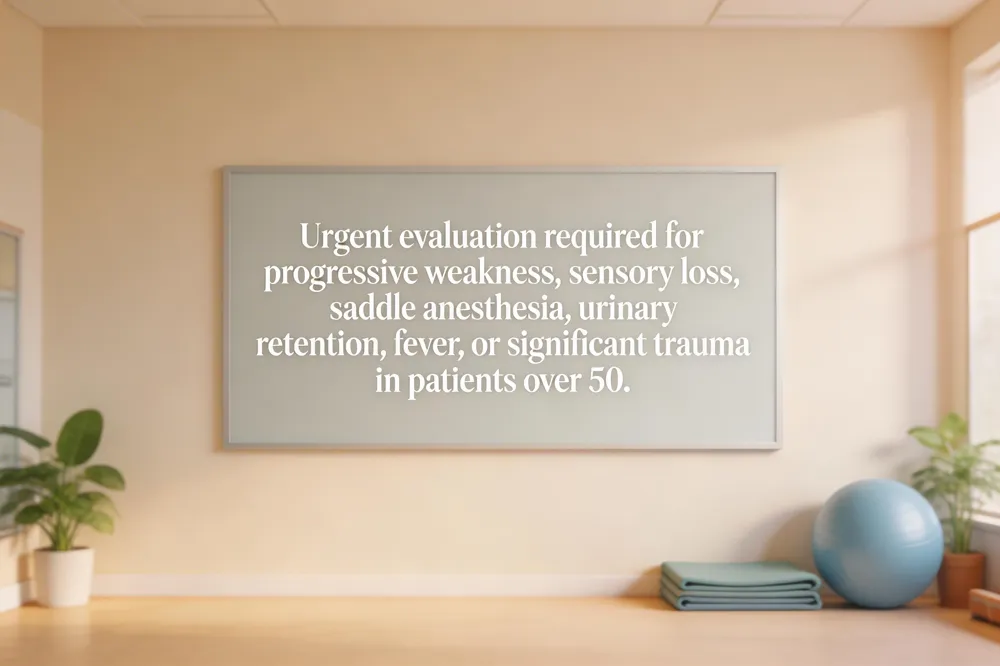
Red‑flag warning signs demanding urgent evaluation include progressive motor weakness, sensory loss, reflex changes, saddle anesthesia, urinary retention, fever, unexplained weight loss, or a history of significant trauma in a patient over 50.
Immediate complications of spinal cord injury can be neurogenic shock, autonomic dysreflexia, respiratory failure, urinary retention, bowel dysmotility, pressure‑ulcer formation, venous thromboembolism, spasticity, severe pain, and temperature‑regulation abnormalities.
The five E’s of accident prevention are Education, Encouragement, Engineering, Enforcement, and Evaluation.
Four things to avoid right after injury: applying heat, consuming alcohol, doing vigorous exercise, and massaging the injured area.
A person with a spinal cord injury is referred to as an individual with SCI; depending on level and completeness they may be described as paraplegic or quadriplegic, using person‑first language whenever possible.
Step‑by‑Step Spine Injury Assessment and Imaging
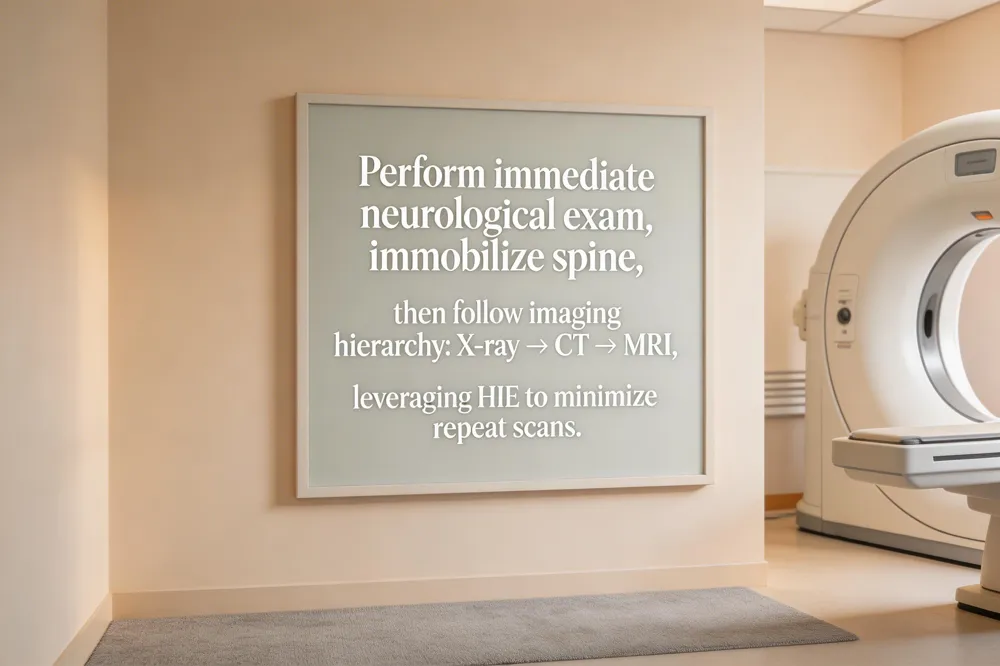 When a patient arrives after a motor‑vehicle crash, the first move is a quick physical and neurological exam. The clinician checks for neck or back pain, weakness, numbness, loss of sensation, and tests reflexes and muscle strength. If any red‑flag signs appear, immobilization is applied immediately—usually a rigid cervical collar and, if needed, a thoracolumbar brace or spine board—to keep the spine neutral while imaging is arranged.
Imaging sequence: 1) X‑ray – screens for obvious fractures or dislocations. 2) CT scan – provides detailed cross‑sectional bone images when X‑ray is inconclusive or the injury is complex. 3) MRI – visualizes the spinal cord, discs, ligaments, and any soft‑tissue compression, essential for surgical planning.
To avoid unnecessary repeat scans, clinicians should access the health information exchange (HIE) and bring prior imaging reports or files; studies show repeat imaging drops from 8 % to 5 % when HIE is used.
A one‑page symptom timeline (date of crash, symptom onset, location, radiation, aggravating factors, functional limits) improves diagnostic accuracy and streamlines treatment decisions.
Question: What are the steps for checking for a spinal injury?
Answer: First, a medical professional conducts an immediate physical and neurological exam, checking for pain, weakness, numbness, loss of movement, and testing sensation and reflexes. Next, the spine is carefully immobilized with a cervical collar or brace to prevent further damage while diagnostic testing is arranged. Then, X‑rays are taken to identify any fractures or misalignments of the vertebrae. If the X‑ray is inconclusive or more detail is needed, a CT scan provides cross‑sectional images of bone and surrounding tissue, and an MRI is used to visualize the spinal cord, discs, ligaments, and any soft‑tissue injuries. Finally, after the initial swelling subsides, a comprehensive neurological reassessment is performed to determine the level and completeness of the injury and guide appropriate treatment, ranging from conservative management to minimally invasive surgery.
Medication Reconciliation and Health Information Exchange
 Medication discrepancies are alarmingly common after a car‑accident hospital stay—up to two‑thirds of patients have at least one unintended error on admission and up to 81 % after discharge.
A pharmacy‑led medication reconciliation program can cut the proportion of patients with discrepancies by 68 % (RR 0.32) and reduce discrepancy events by an impressive 88 % (RR 0.12).
When health information exchange (HIE) is accessed, only 5 % of studies are repeated versus 8 % without it.
Repeat imaging within 30 days at unaffiliated emergency departments ranges from 14.7 % (CT) to 20.7 % (ultrasound).
Bring a current, written medication list (including over‑the‑counter drugs) and any recent radiology reports or CDs/portal links to your first post‑crash visit. This enables the clinician to verify the medication regimen, avoid duplicate scans, and streamline treatment planning, ultimately reducing pain, cost, and unnecessary radiation exposure.
Understanding Specific Spinal Levels: L3‑L5 Injuries
 The lumbar vertebrae L3‑L5 form the lower back’s support pillar and protect the exiting nerve roots of the cauda equina. Damage at these levels typically produces lower‑back pain that radiates to the hips, thighs, calves, and feet—classic sciatica. Patients may notice weakness in hip flexion, knee extension, and ankle dorsiflexion, plus numbness or tingling in the same distribution. Because the spinal cord ends around L1‑L2, injuries here affect the nerve roots rather than the cord itself, but compression of the cauda equina can cause urgent red‑flag signs such as loss of bladder or bowel control. Early evaluation with X‑ray, CT, or MRI guides treatment. Conservative options include NSAIDs, ice/heat therapy, core‑strengthening exercises, and physical therapy; when symptoms persist, minimally invasive procedures—such as micro‑discectomy or percutaneous decompression—offer quicker recovery and lower complication rates.
What happens if you damage your L3, L4, and L5 spine?
Damage to the L3‑L5 vertebrae typically causes pain, numbness, weakness, or tingling that radiates from the hips down the thighs, calves, and feet (sciatica). Because the spinal cord ends around L1‑L2, injury at these levels mainly affects the exiting nerve roots and the cauda equina, which control lower‑body sensation and motor function. Patients may experience reduced strength in hip flexion, knee extension, ankle dorsiflexion, and difficulty walking or standing. In severe cases the cauda equina can be compressed, leading to loss of bladder or bowel control and a medical emergency that often requires urgent surgical decompression. Early evaluation, imaging, and a combination of conservative therapy or minimally invasive surgery can help restore function and prevent long‑term disability.
Common Car‑Crash Spine Injuries and Their Frequency
 Whiplash is the most common spinal injury in a car accident. The rapid forward‑and‑backward motion of the head forces the cervical vertebrae, discs, ligaments, and muscles beyond their normal range, causing pain, stiffness, and reduced motion. Other frequent injuries include disc herniation, facet‑joint sprains, and vertebral fractures; these are less common than whiplash but can produce significant pain and neurological signs when they occur. Delayed symptoms often appear because adrenaline and endorphins mask pain at the scene, and swelling or hematoma can develop over hours to days. Early evaluation within 24–48 hours is critical: it allows clinicians to obtain imaging, perform medication reconciliation, and start anti‑inflammatory therapy before chronic changes set in.
Question: What is the most common spinal injury in a car accident?
Answer: Whiplash is the most common spinal injury sustained in a car accident. It occurs when the sudden forward‑and‑backward movement of the head forces the cervical vertebrae, discs, ligaments, and surrounding muscles beyond their normal range of motion. This rapid motion strains the neck’s soft tissues, leading to pain, stiffness, and a reduced range of motion. While herniated discs, fractured vertebrae, and spinal cord injuries also occur, they are far less frequent than whiplash. Prompt evaluation and conservative treatment are essential to prevent chronic discomfort and restore function.
Financial Impact: Settlements and Insurance Considerations
 Spinal injuries from car accidents often lead to substantial compensation, but the exact amount varies. In California, the overall average settlement for a spinal injury is roughly $100,000, with minor cases $30,000–$100,000, moderate injuries $100,000–$250,000, and severe injuries $250,000–$500,000 or more. The 2025 average for back and neck injuries sits around $263,030, though the median is only $34,065.
Factors influencing compensation include the severity of the injury, medical expenses, lost wages, pain and suffering, long‑term care needs, liability clarity, and policy limits.
Early documentation—a detailed symptom diary, imaging reports, medication lists, and prompt communication with insurers—helps establish the injury’s impact and reduces disputes.
An experienced attorney can audit medical records, negotiate with insurers, and ensure all damages (including future care) are accounted for, maximizing recovery and protecting your financial future.
Post‑Crash Spine Changes, Rehabilitation, and Long‑Term Outlook
 After a car accident the spine endures rapid acceleration‑deceleration forces that can displace vertebrae, strain ligaments, and cause disc herniation or bruising. This biomechanical impact often produces whiplash, facet joint sprains, and muscle spasms, leading to pain, numbness, or weakness that may appear immediately or develop over 24‑48 hours. Keeping a one‑page symptom timeline—date, onset, location, radiation, aggravating factors, and functional limits—helps clinicians track progression and avoid unnecessary repeat imaging. Early mobility, guided by a physical therapist, includes gentle range‑of‑motion, core‑strengthening exercises such as planks and bird‑dogs, and ergonomic supports like lumbar rolls or cervical collars as prescribed. Multidisciplinary care—physiatrists, surgeons, therapists, and pain specialists—coordinates treatment, and when conservative measures fail, minimally invasive surgery can relieve compression. Follow‑up visits at 1‑2 weeks, then monthly, plus annual health‑maintenance checks for SCI patients, monitor recovery, medication complications, and long‑term function and quality of life.
Putting the Checklist Into Action
Schedule a medical evaluation within the first 24‑48 hours after the crash—early assessment catches hidden spinal or neurological injury before swelling worsens. When you go to the office, bring a complete medication list, any prior imaging reports (or the actual CD/portal files), and a concise one‑page symptom timeline that notes crash date, symptom onset, location, radiation, aggravating factors, and functional limits. Follow the step‑by‑step care plan outlined in the checklist: pain control, ice‑then‑heat therapy, gentle range‑of‑motion exercises, and timely imaging if red‑flag signs appear. If conservative care fails, engage the Orthopedic Spine Institute of St. Louis for patient‑first, minimally invasive options such as micro‑discectomy or vertebroplasty. Finally, document every visit, medication change, imaging study, and communication with providers—this detailed record streamlines insurance claims and protects your legal rights.