Why Paying Attention to Back Pain Matters
In the United States, roughly 80‑85 % of adults will experience back pain at some point, making it the nation's leading cause of disability. While 95 % of acute episodes resolve within three months—most improvement occurring in the first 1‑6 weeks—persistent or worsening pain signals a deeper issue that deserves timely evaluation. The Orthopedic Spine Institute of St. Louis embraces a patient‑first philosophy: we begin with evidence‑based conservative care, reserve imaging and minimally invasive surgery for cases that fail to improve, and tailor each plan to the individual’s functional goals. By recognizing red‑flag symptoms early and following a structured, compassionate pathway, patients can avoid unnecessary delays, protect nerve health, and achieve faster, lasting relief.
Red‑Flag Symptoms and When to Seek Immediate Care
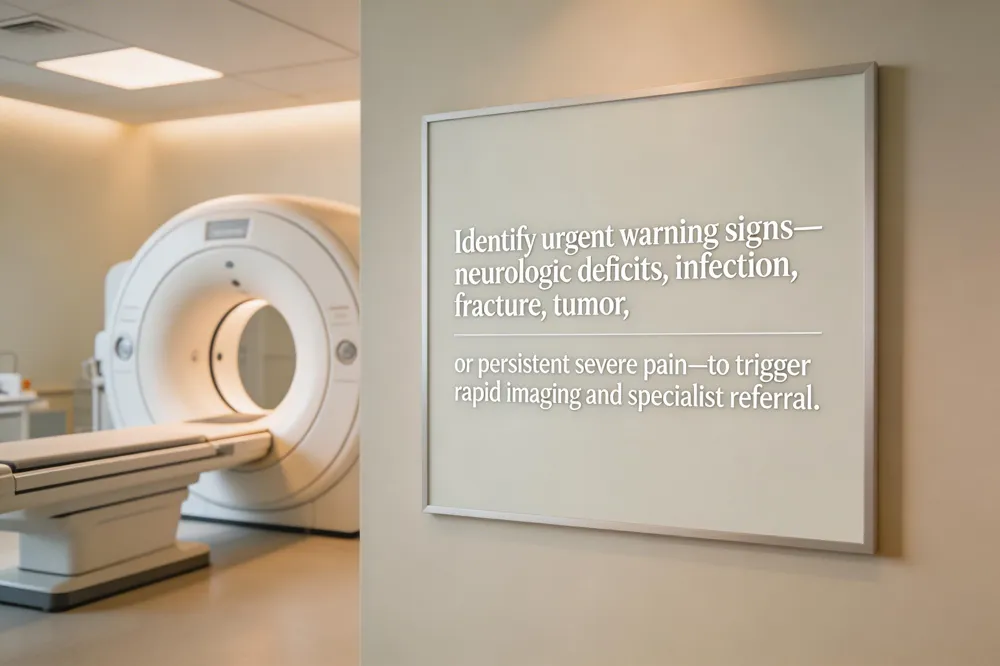 Back pain is common, but certain red‑flag findings signal a serious underlying problem that requires urgent evaluation.
Neurological deficits and cauda equina syndrome – Sudden leg weakness, numbness, tingling, or loss of coordination, especially when accompanied by saddle anesthesia (tingling in the groin, buttocks, inner thighs) or loss of bladder/bowel control, points to nerve root compression or cauda equina syndrome. This is a neurosurgical emergency; immediate imaging and decompression are needed to prevent permanent injury.
Signs of infection, fracture, or tumor – Fever, chills, night sweats, unexplained weight loss or a recent history of cancer raise suspicion for spinal infection (discitis, epidural abscess), metastatic tumor, or vertebral fracture. Long‑term steroid use, osteoporosis, or recent trauma (fall, motor‑vehicle accident) increase fracture risk. Prompt MRI/CT and laboratory work‑up guide treatment, which may include antibiotics, drainage, or surgical stabilization.
Pain patterns that signal serious pathology – Persistent pain >6 weeks that does not improve with rest, NSAIDs, or physical therapy; severe night pain that awakens the patient and and radiating pain that follows a dermatomal pattern and that reaches the knee are red flags. New onset back pain in a patient with known cancer or pain that worsens with lying flat, also suggests structural disease.
Emergency department evaluation – In the ER, clinicians perform a rapid neurological exam, obtain X‑ray, and if indicated, CT or MRI to assess for fracture, infection, or tumor. Blood tests screen for infection or inflammatory markers. IV analgesics and muscle relaxants are given while the spine specialist is consulted.
Answers to common questions
- Five red flags: age < 18 or > 50, pain unrelieved by rest/analgesics, recent trauma or surgery, systemic signs (fever, weight loss, cancer history), neurologic deficits (weakness, numbness, bowel/bladder loss).
- Alarming signs: sudden weakness/numbness, saddle anesthesia, loss of bladder/bowel control, night pain that wakes you, fever/weight loss, rapid post‑operative changes.
- Red flag for spine pain: any of the above clinical features indicating serious disease.
- Upper back pain: seek care if pain persists >1 week, follows trauma, or is accompanied by arm numbness, weakness, saddle anesthesia, or systemic symptoms.
- Lower back pain: see a doctor if pain lasts >1 week, radiates to legs, causes numbness/weakness, bladder/bowel changes, night pain, fever, or weight loss.
- Back pain reddit: evaluate after two weeks of worsening pain, especially if daily activities are limited or red‑flag signs appear.
- ER management: rapid assessment, imaging (X‑ray → CT/MRI), labs, IV pain control, and urgent referral to a spine surgeon if a structural problem is identified.
When Surgery Becomes Necessary and What to Expect
 Back surgery should be avoided whenever possible because most low‑back pain improves on its own within three months and can be managed with non‑invasive treatments. Surgical procedures carry risks—infection, nerve injury, prolonged recovery—and often fail to relieve the original back pain even if leg symptoms improve. Conservative measures such as weight control, aerobic activity, and smoking cessation address the root causes of spinal stress. Only after exhaustive trials of physical therapy, medication, and lifestyle changes should a qualified spine specialist consider surgery, preferably via minimally invasive techniques.
When surgery is finally indicated, success rates for lower‑back procedures like discectomy, laminectomy, or fusion range from 60 % to 80 %, while complication rates vary between 7 % and 20 %. Mortality is very low (≈0.13 %), but serious risks such as nerve injury or infection can occur. Outcomes depend on the specific condition, patient health, age, and adherence to post‑operative rehabilitation.
Key indications for surgery include persistent disabling pain despite conservative care, radiating leg pain or numbness indicating nerve compression, loss of strength or sensation that interferes with daily activities, and imaging that shows severe spinal stenosis, disc degeneration, or instability. For L4‑L5 disc disease, surgery is recommended after 6–12 weeks of non‑operative treatment if symptoms remain severe or progressive.
Post‑operative red‑flag signs to watch for are wound infection (redness, warmth, drainage, fever), worsening pain, new neurologic deficits (weakness, numbness, loss of bladder/bowel control), and signs of blood clots (leg swelling, shortness of breath). Early recognition of these symptoms and prompt evaluation with a spine specialist such as Dr. David S. Raskas can prevent permanent damage and improve long‑term outcomes.
Navigating Cost, Insurance, and Referrals
 When you’re dealing with persistent back or neck pain, understanding the financial and logistical steps can help you focus on healing rather than paperwork.
How much does it cost to see a spine specialist? An initial consultation typically ranges from $150 to $300 out‑of‑pocket. Most U.S. insurers cover the visit once any deductible or copay is met, and the Orthopedic Spine Institute of St. Louis bills insurers directly to minimize personal expense. Patients with high‑deductible plans, no insurance, or limited coverage can often use financing options or payment plans offered by the practice.
Why am I being referred to a spine specialist? Primary‑care doctors refer patients when pain persists despite rest, physical therapy, or over‑the‑counter meds, or when red‑flag symptoms appear—such as unexplained weakness, numbness, tingling, or radiating pain that suggests nerve compression. A specialist can determine whether minimally invasive procedures or surgery are needed.
What will a doctor do for back pain? The first visit includes a detailed medical history, physical exam, and often imaging (X‑ray, MRI, or CT). Based on findings, the doctor may order blood tests, nerve studies, prescribe medication, recommend physical therapy, or perform injections. If conservative care fails, a referral for minimally invasive spine surgery is considered.
What is a spine specialist called? Spine specialists are most commonly referred to as spine surgeons, encompassing orthopedic spine surgeons and neurosurgeons with fellowship training in spine care. In non‑surgical settings they may be called a spine doctor or simply a spine specialist.
Understanding the Roots: Causes by Sex and Region
 Back pain isn’t a one‑size‑fits‑all problem. In women, a wider pelvis, greater lumbar lordosis and hormonal swings that loosen ligaments can make the spine more vulnerable. Osteoarthritis, spondylolisthesis, sacroiliac joint dysfunction and even gynecologic conditions such as endometriosis often refer pain to the lower back. Men, on the other hand, more frequently suffer from disc bulges or herniations, spinal stenosis and spondylolisthesis caused by heavy lifting, awkward twists or chronic poor posture; systemic issues like ankylosing spondylitis, osteoporosis, kidney stones or infections also play a role. Upper‑back pain usually stems from posture‑related muscle strain, thoracic disc degeneration or arthritis, and occasionally from referred cardiac, pulmonary or gastrointestinal disease. Across all groups, four primary pain types emerge: (1) mechanical pain from muscles, ligaments or joints; (2) inflammatory pain linked to arthritis that eases with movement; (3) neuropathic pain—sharp, shooting sensations from nerve compression; and (4) referred pain that originates elsewhere (e.g., kidney or pancreatic disease). Recognizing these patterns helps patients and clinicians decide when conservative care suffices and when a spine specialist’s evaluation—and possibly minimally invasive surgery—becomes essential.
Practical Management, Self‑Help, and Quick Relief
 Back pain is first managed with a conservative hierarchy: activity modification, heat or cold therapy, over‑the‑counter NSAIDs, and a personalized home‑exercise program guided by a physical therapist to improve flexibility, core strength, and posture. If pain persists, physicians may add prescription medications, muscle relaxants, short‑term opioids, or targeted injections such as cortisone or radiofrequency. Mind‑body techniques, ergonomic adjustments, and dietary changes also support recovery. Rapid pain‑relief techniques include a 15‑20‑minute cold pack to reduce inflammation, followed by gentle heat to loosen tight muscles, simple stretches (knee‑to‑chest, lower‑back rotation), and immediate posture correction (sit upright, shoulders back). For core strengthening, the McGill Big 3—bird‑dog, side plank, and modified curl‑up—target deep stabilizers and have been shown to reduce chronic lower‑back pain when performed consistently. A quick self‑assessment “Do I Need Back Surgery?” quiz asks about pain duration, prior therapy, red‑flag symptoms (e.g., loss of bladder/bowel control, numbness, weakness) and trial of minimally invasive options. Positive findings suggest scheduling a specialist consultation with Dr. David S. Raskas at the Orthopedic Spine Institute of St. Louis for a comprehensive evaluation.
Take Action Today – Your Spine Deserves Care
Red‑flag signs such as sudden leg weakness, numbness, loss of bladder or bowel control, unexplained fever, weight loss, or severe pain after trauma demand immediate evaluation. At the Orthopedic Spine Institute of St. Louis we place you first—starting with thorough history, physical exam and imaging, then offering tailored conservative care before any surgery. When non‑operative measures fail or neurologic risk is present, Dr. David S. Raskas discusses minimally invasive options that preserve tissue and speed recovery. To schedule a consultation, call 1‑800‑555‑1234, request an appointment through our online portal, or email appointments@ospistl.org. Your spine’s health starts with a single step.