Why a Patient‑First Lens Matters
Choosing a spine surgeon is about more than a board‑certified badge. While ABOS or ABNS certification confirms rigorous training, patients should also examine a surgeon’s experience with the exact procedure they need—volume of cases, success and complication rates, and a track record of minimally invasive techniques. A patient‑first approach begins with conservative care; surgeons who first explore physical therapy, targeted injections, lifestyle changes, and pain‑management options demonstrate an evidence‑based, low‑risk philosophy and reserve surgery for when it truly adds value.
Multidisciplinary teams and accredited hospitals are another pillar of quality care. Practices such as the Orthopedic Spine Institute of St. Louis coordinate orthopedic surgeons, pain specialists, physical therapists, and anesthesiologists within a Joint Commission‑accredited spine center, ensuring seamless pre‑operative evaluation, intra‑operative navigation, and postoperative rehabilitation.
Patients can feel confident by asking key questions: How many of my specific surgery has the surgeon performed? What non‑surgical options are available? How does the hospital’s accreditation and multidisciplinary team support my recovery? What are the surgeon’s documented outcomes and complication rates? These inquiries illuminate the surgeon’s commitment to transparent, personalized, and patient‑first care.
Understanding the Spine Specialist Landscape
Understanding the Spine Specialist Landscape
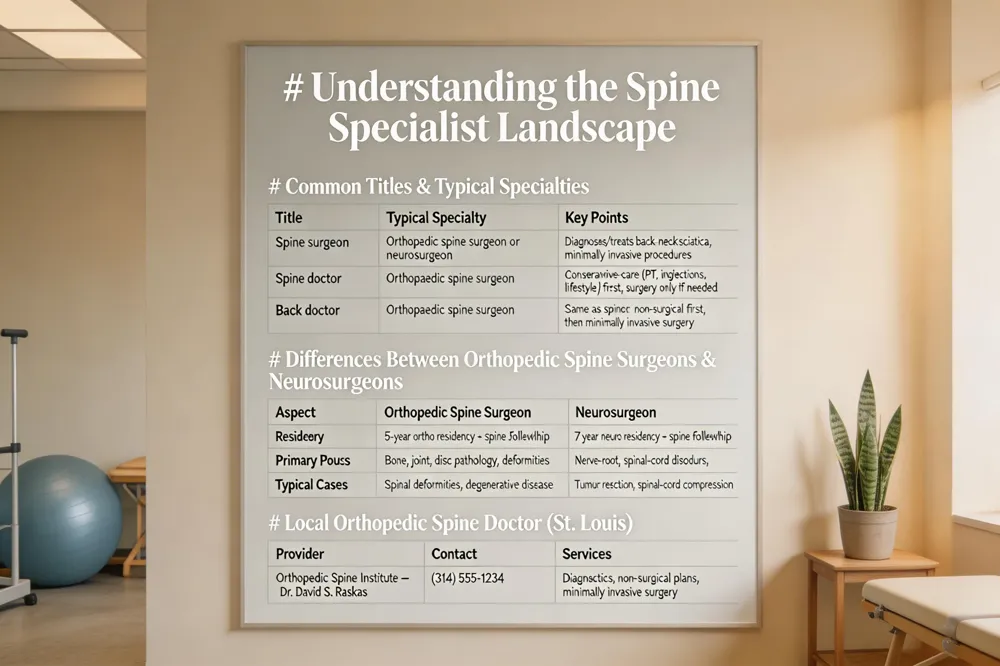
Common Titles & Typical Specialties
| Title | Typical Specialty | Key Points |
|---|---|---|
| Spine surgeon | Orthopedic spine surgeon or neurosurgeon | Diagnoses, treats, and performs minimally invasive procedures for back, neck, and sciatica pain |
| Spine doctor | Orthopaedic spine surgeon | Begins with conservative care (PT, injections, lifestyle counseling) and proceeds to surgery only when necessary |
| Back doctor | Orthopaedic spine surgeon | Same as “spine doctor” – focuses on non‑surgical options first, then minimally invasive surgery |
Differences Between Orthopedic Spine Surgeons & Neurosurgeons
| Aspect | Orthopedic Spine Surgeon | Neurosurgeon |
|---|---|---|
| Residency | 5‑year orthopedic residency + spine fellowship | Neurosurgical residency (often 7‑year) + spine fellowship |
| Primary Focus | Bone, joint, disc pathology; complex deformities | Nerve‑root, spinal‑cord disorders; tumors and cord‑related cases |
| Typical Cases | Joint‑related issues, spinal deformities, degenerative disease | Tumor resection, spinal‑cord compression, complex neurological cases |
Local Orthopedic Spine Doctor (St. Louis)
| Provider | Contact | Services |
|---|---|---|
| Orthopedic Spine Institute – Dr. David S. Raskas | (314) 555‑1234 | Comprehensive diagnostics, personalized non‑surgical plans, minimally invasive surgery |
 Common titles for spine experts
Patients may see "spine surgeon," "spine doctor," or simply "back doctor." The two primary specialties are orthopedic spine surgeons (trained in musculoskeletal surgery) and neurosurgeons (trained in nervous‑system surgery). Both can diagnose, treat, and perform minimally invasive procedures for back, neck, and sciatica pain.
Differences between orthopedic spine surgeons and neurosurgeons
Orthopedic spine surgeons complete a five‑year orthopedic residency plus a spine fellowship, focusing on bone, joint, and disc pathology. Neurosurgeons finish a neurosurgical residency and often a spine fellowship, emphasizing nerve‑root and spinal‑cord disorders. While both are board‑certified, orthopedic surgeons typically handle complex deformities and joint‑related issues, whereas neurosurgeons excel in tumor and cord‑related cases.
What “back doctor” really means in orthopedic practice
A “back doctor” in orthopedics is an orthopaedic spine surgeon. They start with conservative care—physical therapy, injections, lifestyle counseling—and only proceed to surgery when necessary, using minimally invasive techniques that shorten recovery and lower complication risk.
Finding a local orthopedic spine doctor
In St. Louis, the Orthopedic Spine Institute, led by board‑certified Dr. David S. Raskas, offers a patient‑first model: comprehensive diagnostics, personalized non‑surgical plans, and state‑of‑the‑art minimally invasive surgery. Appointments and insurance verification are available online, and the office can be reached at (314) 555‑1234 for a convenient, locally‑based spine specialist.
Credentials, Training and Certifications Explained
Credentials, Training and Certifications Explained
Typical Education Pathway
| Step | Description |
|---|---|
| Undergraduate | 4‑year pre‑medical degree |
| Medical School | 4‑year MD or DO program |
| Residency | 5‑year orthopedic residency (or neurosurgery residency) |
| Fellowship | 1‑year spine‑focused fellowship (e.g., Washington University, Duke) |
| Board Certification | ABOS (Orthopaedic) or ABNS (Neurosurgery) exams; recertify every 8 years |
Certification & Professional Societies
| Credential | Details |
|---|---|
| ABOS / ABNS | American Board of Orthopaedic Surgery or American Board of Neurological Surgery |
| CME & Recertification | Mandatory continuing medical education; renewal every 8 years |
| Society Membership | AAOS, NASS, Scoliosis Research Society (SRS) – signals ongoing education |
| Hospital Accreditation | Joint Commission Advanced Certification in Spine Surgery; participation in American Spine Registry |
Frequently Asked Questions
| Question | Answer |
|---|---|
| How to become an orthopedic physician non‑surgical? | Complete MD/DO, primary‑care or PM&R residency, sports‑medicine or musculoskeletal fellowship, board certification |
| What certifications do orthopedic surgeons need? | Medical license, accredited orthopedic residency, ABOS board certification (recertified every 8 years) |
| How to find the best spine surgeon? | Look for board certification, dedicated spine fellowship, high annual procedure volume, minimally invasive expertise, hospital privileges at an accredited spine center, clear communication |
| Do neurosurgeons do scoliosis surgery? | Yes – neurosurgeons with spine fellowship can perform complex fusions and deformity corrections |
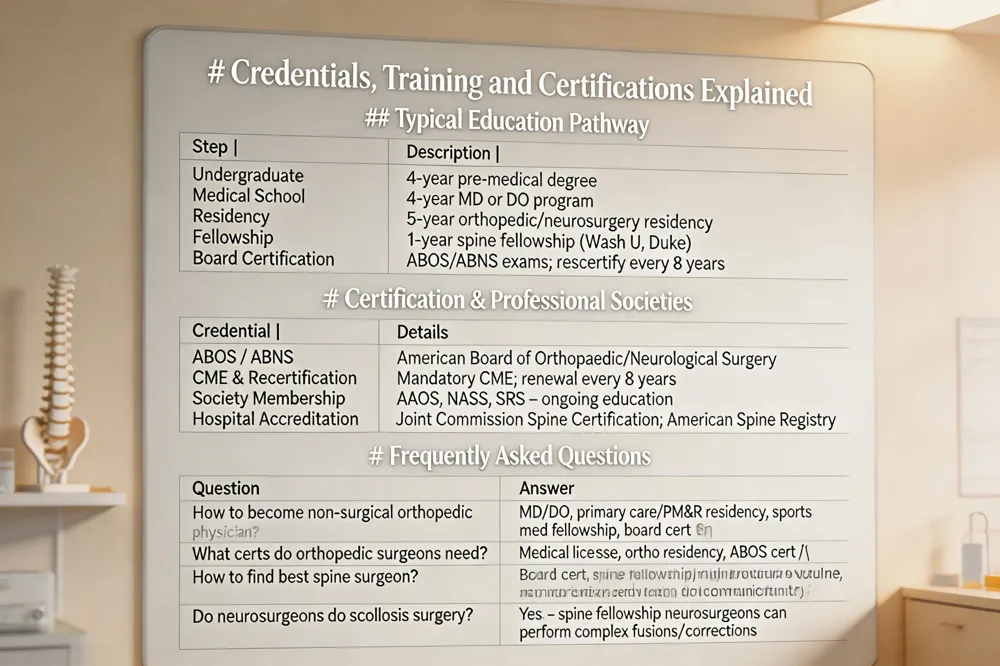 Choosing an orthopedic spine surgeon begins with understanding the education and credentials that guarantee expertise.
Typical education pathway – Surgeons complete a 4‑year undergraduate pre‑medical degree, a 4‑year medical school program, a 5‑year orthopedic residency, and most add a 1‑year spine‑focused fellowship (e.g., at Washington University or Duke). This sequence provides more anatomy knowledge, surgical skill, and exposure to both non‑operative and operative spine care.
Board certification requirements – After residency, surgeons must pass the American Board of Orthopaedic Surgery (ABOS) exams (or the American Board of Neurological Surgery for neurosurgeons). Certification is renewed every eight years through recertification and CME, ensuring current best‑practice knowledge.
Fellowship training impact – Fellowship‑trained spine surgeons have higher case volumes and lower complication rates, especially with minimally invasive techniques such as micro‑discectomy, endoscopic decompression, and robot‑assisted fusion. Studies show that surgeons who perform many of a specific procedure achieve better patient‑reported outcomes.
Professional societies and hospital accreditation – Membership in AAOS, NASS, or Scoliosis Research Society signals ongoing education. Hospitals with Joint Commission Advanced Certification in Spine Surgery, or those participating in the American Spine Registry, meet stringent safety and outcome standards.
Key questions answered
- How to become an orthopedic physician non‑surgical? Complete a medical degree, a primary‑care or PM&R residency, then a sports‑medicine or musculoskeletal fellowship, followed by board certification.
- What certifications do orthopedic surgeons need? A valid medical license, completion of an accredited orthopedic residency, and ABOS board certification (recertified every 8 years).
- How to find the best spine surgeon? Look for board certification, a dedicated spine fellowship, high annual procedure volume, minimally invasive expertise, hospital privileges at an accredited spine center, and clear, compassionate communication.
- Do neurosurgeons do scoliosis surgery? Yes; neurosurgeons trained in spine surgery can perform complex fusions and deformity corrections for severe scoliosis.
By verifying these credentials, patients ensure they receive care from a surgeon who combines rigorous training, evidence‑based practice, and a patient‑first philosophy.
Experience, Volume and Outcomes – The Numbers That Matter
Experience, Volume and Outcomes – The Numbers That Matter
Top 10 Back Surgeons in St. Louis, MO
| Rank | Surgeon |
|---|---|
| 1 | Dr. David S. Raskas |
| 2 | Dr. Benjamin Crane |
| 3 | Dr. Ian G. Dorward |
| 4 | Dr. Lee Thomas |
| 5 | Dr. Brett A. Taylor |
| 6 | Dr. Michael J. Reiter |
| 7 | Dr. Mirkin R. Peter |
| 8 | Dr. Eicholz |
| 9 | Dr. Reeves |
| 10 | Dr. Michael Chabot |
Top 10 Spine Surgeons (America’s Best – 2024)
| Rank | Surgeon |
|---|---|
| 1 | Kingsley O. Abode‑Iyamah, MD |
| 2 | Mark Adams, MD |
| 3 | Bradley D. Ahlgren, MD |
| 4 | Todd Alamin, MD |
| 5 | Kevin N. Ammar, MD |
| 6 | Peter D. Angevine, MD |
| 7 | Roy F. Ashford, MD |
| 8 | Hyun W. Bae, MD |
| 9 | Carlos A. Bagley, MD |
| 10 | Gregory W. Balturshot, MD |
Best Spine Surgeons in Missouri
| Surgeon | Institution |
|---|---|
| Dr. David S. Raskas | Orthopedic Spine Institute, St. Louis |
| Dr. Jacob M. Buchowski, MD, MS | Barnes‑Jewish Hospital |
| Dr. Keith H. Bridwell, MD | Washington University Spine Center |
Safety of L4‑L5 Surgery (Disc Replacement)
| Aspect | Summary |
|---|---|
| Typical Risks | Infection, nerve irritation, implant migration, rare vascular injury |
| Mitigation | Careful patient selection (exclude severe arthritis, multi‑level degeneration, deformity) |
| Outcome Benefits | Motion‑preserving, quicker recovery, lower adjacent‑level stress compared with fusion |
| Overall Safety | Generally low complication rates when performed by high‑volume, fellowship‑trained surgeons |
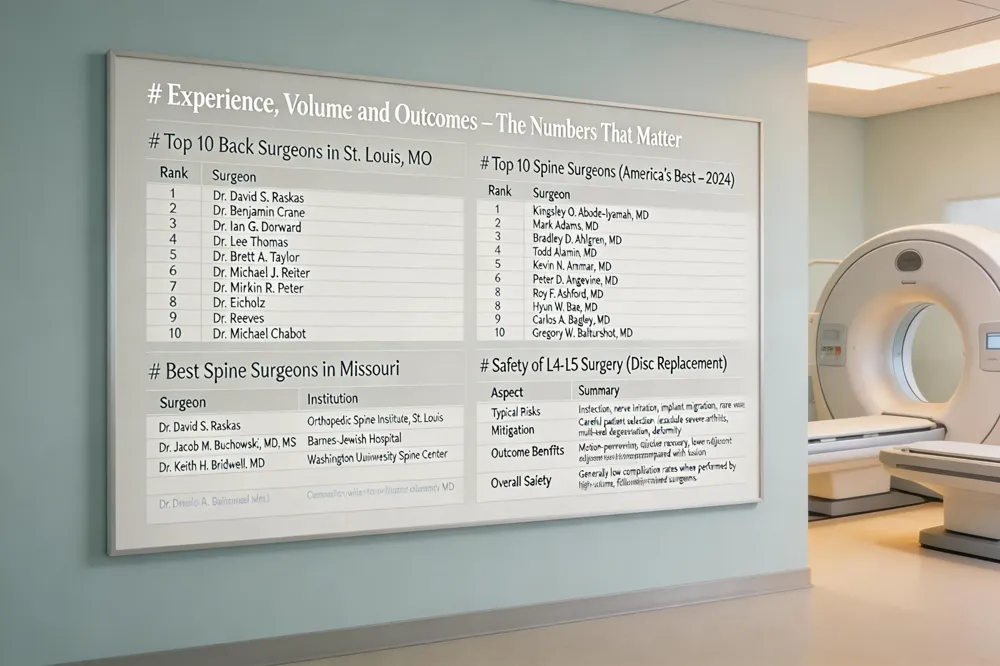 High case volume is a reliable predictor of surgical success because repetitive performance sharpens technical skill, reduces operative time, and lowers complication rates. Studies show that surgeons who perform hundreds of a specific spine procedure each year—such as L4‑L5 disc replacement—achieve better fusion success and fewer infections than low‑volume providers.
The safety profile of L4‑L5 surgery is generally favorable when patients are carefully selected. Typical risks—infection, nerve irritation, implant migration, or rare vascular injury—are mitigated by pre‑operative screening for severe arthritis, multi‑level degeneration, or deformity. The motion‑preserving nature of disc replacement often yields quicker recovery and lower adjacent‑level stress compared with fusion.
National rankings, such as America’s Best Spine Surgeons, and local accolades, like the top ten back surgeons in St. Louis, reflect a blend of board certification, fellowship training, procedural volume, and patient‑reported outcomes. When interpreting complication and success rates, look for transparent reporting of infection, re‑operation, and readmission numbers, as well as validated outcome scores (e.g., Oswestry Disability Index).
Top 10 back surgeons in St Louis, MO – Dr. David S. Raskas, Dr. Benjamin Crane, Dr. Ian G. Dorward, Dr. Lee Thomas, Dr. Brett A. Taylor, Dr. Michael J. Reiter, Dr. Mirkin R. Peter, Dr. Eicholz, Dr. Reeves, and Dr. Michael Chabot lead regional expertise.
Is L4 L5 surgery safe? – Yes; it is generally safe with low complication rates when performed on properly selected candidates, offering significant pain relief and quicker recovery.
Top 10 spine surgeons – The 2024 America’s Best Spine Surgeons list includes Kingsley O. Abode‑Iyamah, MD; Mark Adams, MD; Bradley D. Ahlgren, MD; Todd Alamin, MD; Kevin N. Ammar, MD; Peter D. Angevine, MD; Roy F. Ashford, MD; Hyun W. Bae, MD; Carlos A. Bagley, MD; and Gregory W. Balturshot, MD.
Best spine surgeons in Missouri – Dr. David S. Raskas, Dr. Jacob M. Buchowski, MD, MS, and Dr. Keith H. Bridwell, MD, are board‑certified leaders in conservative and minimally invasive spine care, recognized nationally for research and clinical excellence.
Patient Communication, Decision‑Making and Post‑Op Care
Patient Communication, Decision‑Making and Post‑Op Care
Key Questions to Ask Your Surgeon
| Question | Why It Matters |
|---|---|
| What is your annual volume for this specific procedure? | Higher volume correlates with better outcomes and lower complications |
| What are your success and complication rates for this surgery? | Transparency helps set realistic expectations |
| What non‑surgical options have been tried and why were they insufficient? | Ensures surgery is truly needed |
| What lifestyle changes (e.g., weight loss, smoking cessation) could improve my results? | Optimizes recovery and long‑term outcomes |
| How will you involve me in shared decision‑making? | Demonstrates patient‑first communication |
Typical Post‑Op Recovery Timeline
| Time Frame | Expected Recovery Indicators |
|---|---|
| Day of Surgery | Early ambulation, pain managed with oral meds |
| First Few Days | Mild‑to‑moderate pain, start of physical therapy |
| 2–4 Weeks | Gradual increase in activity, restrictions on lifting >10 lb |
| 6–12 Weeks | Brace (if required) removal, return to most normal activities |
| >12 Weeks | Full return to work/fitness (depending on procedure) |
Red‑Flag Symptoms Requiring Urgent Care
| Symptom | Action |
|---|---|
| Worsening numbness or weakness | Call surgeon immediately |
| Fever >100.4 °F (38 °C) | Seek urgent medical evaluation |
| Severe, unrelenting pain | Contact office or go to ER |
| Drainage or wound infection signs | Notify surgeon promptly |
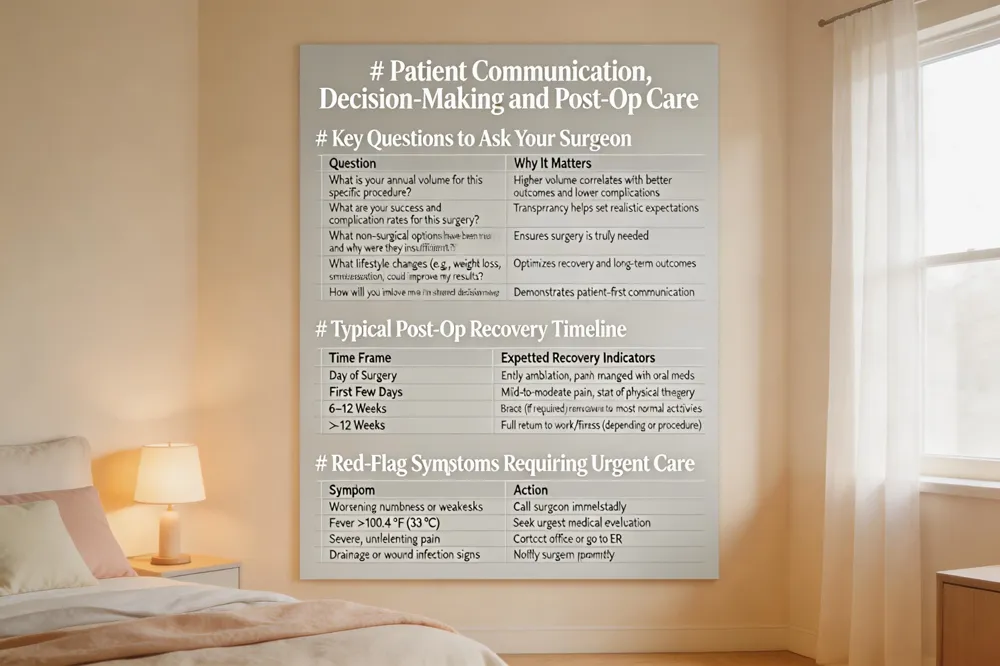 Choosing the right spine surgeon begins with clear, patient‑first communication. Before scheduling an operation, ask the surgeon about the volume of the specific procedure you need (e.g., lumbar discectomy, cervical fusion) and request success and complication rates; high case numbers reliably predict better outcomes. Inquire about non‑surgical alternatives that have been tried, why they were insufficient, and what lifestyle changes (weight loss, smoking cessation) could improve results. A surgeon who explains the diagnosis in lay terms, outlines all treatment options, and involves you in shared decision‑making demonstrates a compassionate, evidence‑based approach.
After surgery, expect mild to moderate pain for the first few weeks, early ambulation on the day of surgery, and restrictions on lifting, bending, or twisting for 6‑12 weeks. Physical therapy usually begins within a few days, and a brace may be required for 6‑12 weeks depending on the procedure. Patients should know signs that require urgent care (e.g., worsening numbness, fever) and have a clear postoperative follow‑up schedule.
Students or those seeking a second opinion should ask about the surgeon’s fellowship training, board certifications, and multidisciplinary team involvement. Request references, ask about the surgeon’s experience with minimally invasive techniques, and verify insurance coverage and cost transparency. This comprehensive dialogue ensures informed consent, realistic expectations, and optimal recovery.
Local Expertise: St. Louis Spine Leaders and Resources
Local Expertise: St. Louis Spine Leaders and Resources
Major Spine Centers & Lead Surgeons
| Center | Lead Surgeons | Services |
|---|---|---|
| Orthopedic Spine Institute | Dr. David S. Raskas | Conservative care, minimally invasive surgery, L4‑L5 disc replacement |
| Washington University Spine Center | Dr. Keith H. Bridwell, Dr. Jacob M. Buchowski, Dr. Matthew L. Goodwin, Dr. John Clayton Clohisy Jr. | Degenerative disease, trauma, tumors, complex deformities |
| Barnes‑Jewish Hospital Spine Center | Dr. Jacob M. Buchowski, Dr. Keith H. Bridwell, Dr. Matthew L. Goodwin, Dr. Brian A. Kelly | Over 3,000 new patients/year; ~1,400 surgeries annually |
| St. Louis Children’s Hospital Spine Program | Pediatric spine specialists (not listed) | Pediatric spinal disorders, scoliosis, congenital anomalies |
Contact Information
| Institution | Phone | Online Portal |
|---|---|---|
| Orthopedic Spine Institute | (314) 555‑1234 | https://ortho.example.com/portal |
| Barnes‑Jewish Hospital Spine Center | 888‑996‑4894 | https://bjjhospital.org/spine |
| Washington University Medical Center | (314) 516‑8000 | https://washington.edu/spine |
Frequently Asked Local Questions
| Question | Answer |
|---|---|
| Who is the best surgeon for scoliosis in St. Louis? | Dr. David S. Raskas – leading scoliosis surgeon with advanced fusion and vertebral‑body tethering techniques |
| Can an orthopedic doctor treat rheumatoid arthritis? | Yes – orthopedic surgeons specialize in joint disease and can manage rheumatoid arthritis surgically and non‑surgically |
| How to schedule a same‑day or next‑day appointment? | Call (314) 514‑3500 or use the secure online portal for the Orthopedic Spine Institute |
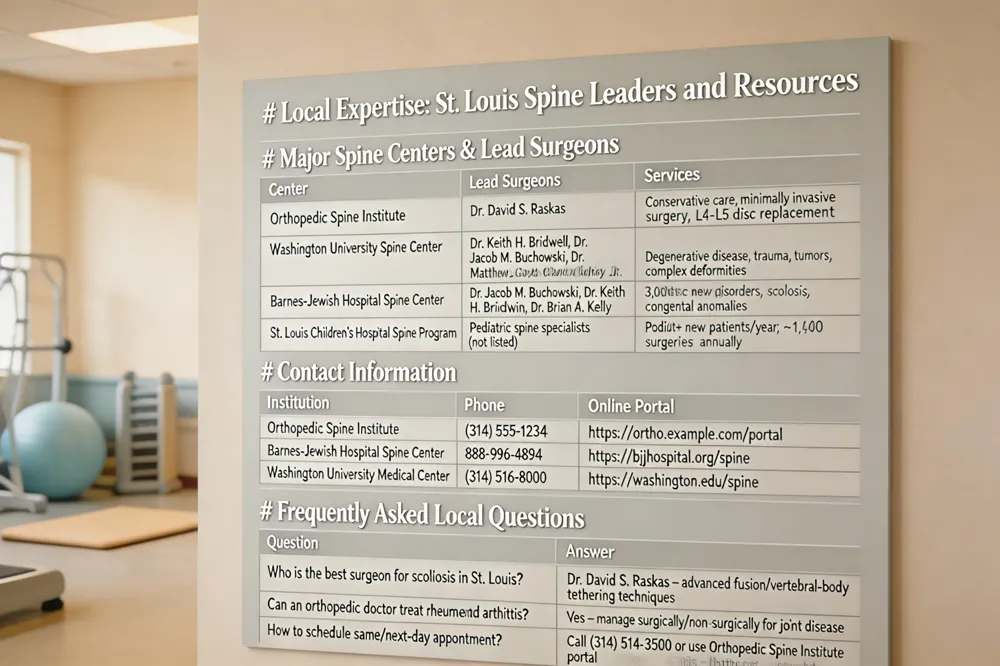 St. Louis offers a concentration of nationally recognized spine specialists who combine board‑certified training, fellowship experience, and a patient‑first philosophy.
Washington University Spine surgeons – The WashU Spine Team includes orthopedic surgeons and neurosurgeons such as Dr. Keith H. Bridwell, Dr. Jacob M. Buchowski, Dr. Matthew L. Goodwin, and Dr. John Clayton Clohisy Jr. Practicing at the Center for Advanced Medicine, Barnes‑Jewish West County Hospital, St. Louis Children’s Hospital and other sites, they treat degenerative disease, trauma, tumors and complex deformities. Their approach begins with conservative care and progresses to minimally invasive surgery when needed.
Who is the best surgeon for scoliosis? – Dr. David S. Raskas, MD, at the Orthopedic Spine Institute of St. Louis, is the leading scoliosis surgeon. He performs advanced fusion, vertebral‑body tethering and growth‑friendly techniques, tailoring each plan to the patient’s anatomy. Dr. Raskas is board‑certified, fellowship‑trained, accepts most insurance plans and is praised for clear communication and high success rates.
Spine surgeon St. Louis – The Orthopedic Spine Institute, led by Dr. Raskas, follows a patient‑first model: thorough physical‑therapy, injections and medication precede any surgery. When surgery is indicated, minimally invasive options such as micro‑decompression and basivertebral nerve ablation are offered, reducing recovery time. Same‑day or next‑day appointments are available via (314) 514‑3500 or the secure online portal.
BJC spine surgeons – Barnes‑Jewish Hospital hosts a multidisciplinary spine center with surgeons like Dr. Jacob M. Buchowski, Dr. Keith H. Bridwell, Dr. Matthew L. Goodwin and Dr. Brian A. Kelly. Their team treats over 3,000 new patients annually, performing ~1,400 surgeries ranging from minimally invasive decompressions to complex reconstructions. For referrals, call 888‑996‑4894.
Who is the best orthopedic surgeon in St. Louis, MO? – Dr. David S. Raskas, MD, is widely regarded as the top orthopedic spine surgeon in the region. His comprehensive, evidence‑based care, board certification and fellowship training ensure optimal outcomes for back, neck and sciatica pain.
Can an orthopedic doctor treat rheumatoid arthritis? – Yes. Orthopedic surgeons specialize in joint disease and can manage rheumatoid arthritis, offering both non‑surgical and surgical options to preserve joint function and limit long‑term damage.
Putting It All Together for a Confident Choice
Choosing an orthopedic spine surgeon is more than checking off a list of credentials. While board certification, fellowship training, and hospital accreditation confirm that a surgeon has met rigorous national standards, the true differentiators are communication, procedural volume, and a patient‑first philosophy. Surgeons who listen, explain the diagnosis in plain language, and outline both non‑surgical and surgical options empower you to make informed decisions and reduce the risk of medical gaslighting. Experience matters: a surgeon who has performed hundreds of the exact procedure you need—whether a minimally invasive lumbar discectomy, a spinal fusion, or a complex deformity correction—demonstrates a lower complication rate and higher success scores. Equally important is the practice’s commitment to coordinated postoperative care, including pain management, physical therapy, and clear follow‑up plans. If you’re ready to move forward, schedule a consultation with Dr. David S. Raskas at the Orthopedic Spine Institute of St. Louis. Dr. Raskas is board‑certified, fellowship‑trained, and works within a multidisciplinary team that prioritizes conservative management before surgery. You can also seek a second opinion from another trusted local specialist to confirm that the treatment plan aligns with your goals and lifestyle.