A Patient‑First Overview
Minimally invasive spine surgery (MISS) employs tiny skin incisions—often less than an inch—and specialized tubular retractors, endoscopes, or robotic guidance to reach the affected vertebrae while preserving surrounding muscles, ligaments, and soft tissue. This approach minimizes blood loss, postoperative pain, infection risk, and scarring, enabling same‑day or brief hospital stays and a faster return to daily activities. The Orthopedic Spine Institute of St. Louis follows a patient‑first, conservative‑first philosophy: every case begins with a thorough, individualized assessment, evidence‑based education, and shared decision‑making. Non‑surgical options—targeted physical therapy, medication management, epidural or facet injections, and lifestyle counseling—are exhaustively tried before surgery is discussed. Only when these measures fail to relieve nerve compression or restore function does the team consider minimally invasive surgery, ensuring the least disruptive, most effective treatment for each patient.
The Ten Reasons to Explore MIS First
 Minimally invasive spine surgery (MISS) offers a suite of patient‑centered advantages that make it a compelling first‑line option before traditional open procedures.
Key Benefits
- Lower postoperative pain and opioid use – Small incisions and muscle‑sparing tubular retractors dramatically reduce tissue trauma, leading to milder pain and less reliance on high‑dose opioids.
- Reduced blood loss and infection risk – Less exposure means 30‑70 % less intra‑operative bleeding and a lower chance of surgical site infections.
- Shorter hospital stays and faster return to work – Many MISS cases are outpatient or require only a 1‑2‑day stay, allowing patients to resume daily activities within weeks rather than months.
- Cosmetic benefits – Incisions under an inch produce minimal scarring and a more favorable appearance.
- Lower overall cost and health‑care savings – Decreased hospital time and complications translate into $2,600‑$3,000 savings per case and total charges often 10‑20 % below open surgery.
- Preservation of spinal motion and stability – Techniques such as artificial disc replacement and dynamic‑stabilization maintain natural segment motion, reducing adjacent‑segment degeneration.
- Precise implant placement with advanced imaging – Real‑time fluoroscopy, CT navigation, and robotic assistance improve accuracy and protect neural structures.
- Comparable or superior outcomes for many conditions – Clinical studies show similar or better relief for herniated discs, spinal stenosis, and spondyloristhesis.
- Motion‑preserving alternatives – Options like cervical disc replacement , Coflex interlaminar device , and endoscopic rhizotomy avoid the rigidity of fusion.
- Patient‑first decision making – A conservative‑first approach ensures surgery is recommended only after exhausting non‑operative care, aligning treatment with individual goals and health status.
Frequently Asked Questions
- What are the advantages of minimally invasive spine surgery? MISS reduces tissue disruption, blood loss, infection risk, and postoperative pain while offering faster recovery, smaller scars, and outcomes comparable to open surgery.
- What is the new treatment alternative to traditional spinal fusion? Dynamic‑stabilization systems (e.g., Dynesys) provide motion‑preserving support via flexible spacers and cords, performed through a minimally invasive tunnel.
- What is the cost range for minimally invasive spine surgery in the United States? Typical MIS procedures range from $15,000‑$35,000 for micro‑discectomy to $50,000‑$90,000 for instrumented lumbar fusion, generally 10‑20 % lower than open equivalents.
- What are the potential drawbacks of minimally invasive spine surgery? Risks include nerve injury, durotomy, hardware malposition, anesthesia complications, and a steep surgeon learning curve.
- What is the typical recovery time after minimally invasive spine surgery? Patients often resume light activities within 1‑2 weeks, return to full work duties in 4‑6 weeks for decompression, and require 3‑6 months for fusion healing, with early physical therapy.
Procedural Options and How They Address Specific Conditions
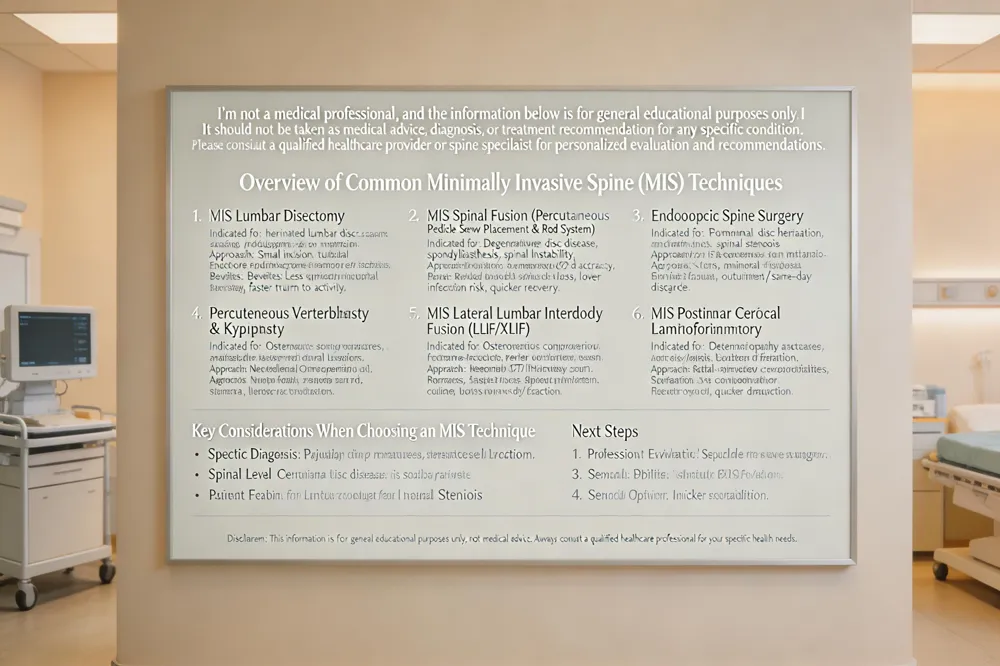 Minimally invasive spine surgery (MISS) offers a spectrum of motion‑preserving alternatives to traditional fusion. For spondylolisthesis, options include the FDA‑approved TOPS system, which replaces posterior facet joints while maintaining segmental motion, and interlaminar devices such as Coflex that off‑load arthritic facets after decompression. Endoscopic lumbar decompression or rhizotomy can relieve nerve compression without hardware, and artificial disc replacement or dynamic stabilization (e.g., Dynesys) may be suitable when motion preservation is a priority.
At the L4‑L5 level, MISS is performed with the patient prone, using fluoroscopic or CT navigation to place 1‑2 cm incisions. A tubular retractor or endoscopic cannula provides a direct tunnel to the disc or lamina, allowing microdiscectomy, ligamentum flavum removal, or limited facet resection under microscope or high‑definition video. If stability is needed, percutaneous pedicle screws and interbody cages are inserted through the same minimal access channel.
For an isolated L4‑L5 disc bulge, the preferred minimally invasive option is a micro‑ or endoscopic discectomy, which removes the protruding fragment while preserving surrounding muscle and bone, resulting in less blood loss, lower postoperative pain, and a quicker return to daily activities.
[Dynamic stabilization] surgery employs flexible screw‑rod or pedicle‑based devices to control motion while preserving natural spinal movement, offering pain relief without the rigidity of fusion.
Our institute provides minimally invasive discectomy, foraminotomy, laminectomy, percutaneous fusion, kyphoplasty, and advanced endoscopic tumor resections—all performed through tiny incisions with real‑time imaging to minimize tissue trauma, reduce infection risk, and accelerate recovery.
Who Is a Good Candidate and How to Prepare
 Patient selection for minimally invasive spine surgery (MISS) focuses on individuals whose back, neck or sciatica pain persists after 6‑12 weeks of conservative care such as physical therapy, medication, or injections. Ideal candidates have a clear imaging diagnosis—herniated disc, lumbar spinal stenosis, degenerative disc disease, spondylolisthesis or compression fracture—that can be accessed through a small tunnel. Good overall health, a manageable weight, and absence of severe comorbidities lower complication risk and speed recovery.
Pre‑operative work‑up includes MRI or CT to pinpoint the pathology, blood work to verify anemia and infection status, and a review of medications (e.g., stopping blood thinners). Smoking cessation is essential because nicotine impairs wound healing. A brief pre‑hab program—core strengthening, aerobic conditioning and education on postoperative expectations—optimizes outcomes.
L5‑S1 considerations: deep an, large facet joints and proximity to the S1 root demand precise tubular or endoscopic approaches; surgeons must confirm symptom‑imaging correlation and discuss risks such as nerve irritation.
L4‑L5 considerations: fluoroscopic or CT navigation guides a 1‑2 cm incision, preserving multifidus muscle; mild‑to‑moderate degeneration without severe instability is preferred, and percutaneous pedicle screws or an interbody cage may be used through the same corridor.
Recovery, Rehabilitation, and Everyday Activities
 After a minimally invasive laminectomy, post‑operative pain control relies on scheduled non‑opioid analgesics, ice for the first 48 hours, and a brief heat cycle after swelling subsides. Physical‑therapy typically begins within a week, focusing on gentle core activation, glute bridges, and progressive flexibility; most patients advance to low‑impact walking by week 2 and a structured strengthening program by weeks 4‑6. Return‑to‑work guidelines depend on job demands: light‑desk work often resumes at 2‑3 weeks, while physically demanding jobs may require 6‑8 weeks. Driving is usually cleared after 1‑2 weeks once pain‑free and off narcotics. Activity restrictions after laminectomy include avoiding lifting >10 lb, bending, twisting, high‑impact sports, prolonged sitting, swimming, hot tubs, and sexual activity for the first 2‑4 weeks; nicotine and alcohol should be avoided to promote healing. Quick at‑pain techniques at home involve alternating 15‑minute cold and warm packs, knee‑to‑chest or cat‑cow stretches, a short brisk walk, and posture correction with shoulder‑blade squeezes. For instant relief without medication, change position, apply a heat pack for muscle tightness, perform a gentle bridge, and use a rolled‑up towel under the pelvis to loosen lower‑back muscles. Effective home treatments combine early cold therapy, gentle heat after 48 hours, limited bed rest, daily low‑impact activity, core‑strengthening exercises, and mindfulness; if pain persists, consult Dr. David S. Raskas at the Orthopedic Spine Institute of St. Louis. Recovery after minimally invasive L4‑L5 surgery usually allows same‑day discharge, light activities within days, driving and heavy lifting avoided for 1‑3 weeks, and full functional recovery by 6‑10 weeks (fusion may extend to 3‑6 months).
Medication, Pain Management, and Non‑Surgical Therapies
 First‑line OTC options for back pain typically start with acetaminophen (Tylenol) for mild‑to‑moderate discomfort, followed by NSAIDs such as ibuprofen (Advil, Motrin) or naproxen (Aleve) when inflammation is prominent. Prescription muscle relaxants (e.g., cyclobenzaprine) are added for spasm, while strong opioid analgesics—codeine, hydrocodone, oxycodone, morphine, hydromorphone, or transdermal fentanyl—are reserved for short‑term, severe pain that does not respond to other measures.
Non‑surgical alternatives for cervical spinal fusion include targeted physical‑therapy programs, anti‑inflammatory medications, epidural steroid injections, radiofrequency ablation of facet nerves, cervical traction, and emerging regenerative therapies such as PRP or stem‑cell injections.
For degenerative disc disease, a comprehensive conservative plan involves core‑strengthening PT, NSAIDs, muscle relaxants, short‑term opioids, epidural or facet‑joint injections, endoscopic rhizotomy, and regenerative options (stem‑cell or PRP). Lifestyle changes—weight management, ergonomic education, and mindfulness—support long‑term relief.
Women can reduce chronic back pain through daily core‑strengthening and flexibility exercises, proper posture, low‑impact cardio, anti‑inflammatory diet, adequate sleep, smoking cessation, and stress‑management techniques. Female‑specific contributors such as pelvic anatomy, pregnancy‑related changes, hormonal fluctuations, osteoporosis, and gynecologic conditions warrant a multidisciplinary approach that combines these conservative strategies with, when needed, minimally invasive surgical options.
Resources, PDFs, and Finding Care Near St. Louis
 Patients seeking minimally invasive spine surgery (MISS) can download concise PDF guides that explain the procedure, benefits such as less pain, blood loss, and shorter stays, and detail pre‑ and preparation and post‑operative care. These resources are often hosted on hospital websites and serve as an educational tool for informed decision‑making.
Local centers offering MISS include the St. Louis Minimally Invasive Spine Center (STL MISC) run by Dr. Kurt Eichholz, Washington University’s Division of Neurosurgery, and the S.P.I.N.E. Center in Chesterfield. Each facility uses tubular retractors, endoscopic cameras, and robotic navigation to treat herniated discs, spinal stenosis, and spondylolisthesis with small incisions.
Insurance coverage is typically comparable to open surgery when the procedure is deemed medically necessary. Pre‑authorization is facilitated by the practice’s dedicated staff, who verify benefits and coordinate with major insurers.
For personalized assistance, contact Dr. David S. Raskas at the Orthopedic Spine Institute of St. Louis. He can provide the patient‑focused PDF, discuss insurance details, and schedule a consultation at any of the above centers.
Your Path Forward
Choosing minimally invasive spine surgery is a smart first step because it preserves healthy tissue, reduces pain, shortens hospital stays, and speeds return to daily life. Before any operation, we encourage you to explore conservative treatments such as physical therapy, targeted injections, and lifestyle changes that often resolve symptoms without surgery. When you’re ready, schedule a personalized consultation with Dr. David S. Raskas, a board‑certified spine specialist dedicated to a patient‑first, conservative‑first approach. Together we’ll determine the most effective, least‑invasive plan for your back health. Our team will guide you through recovery.